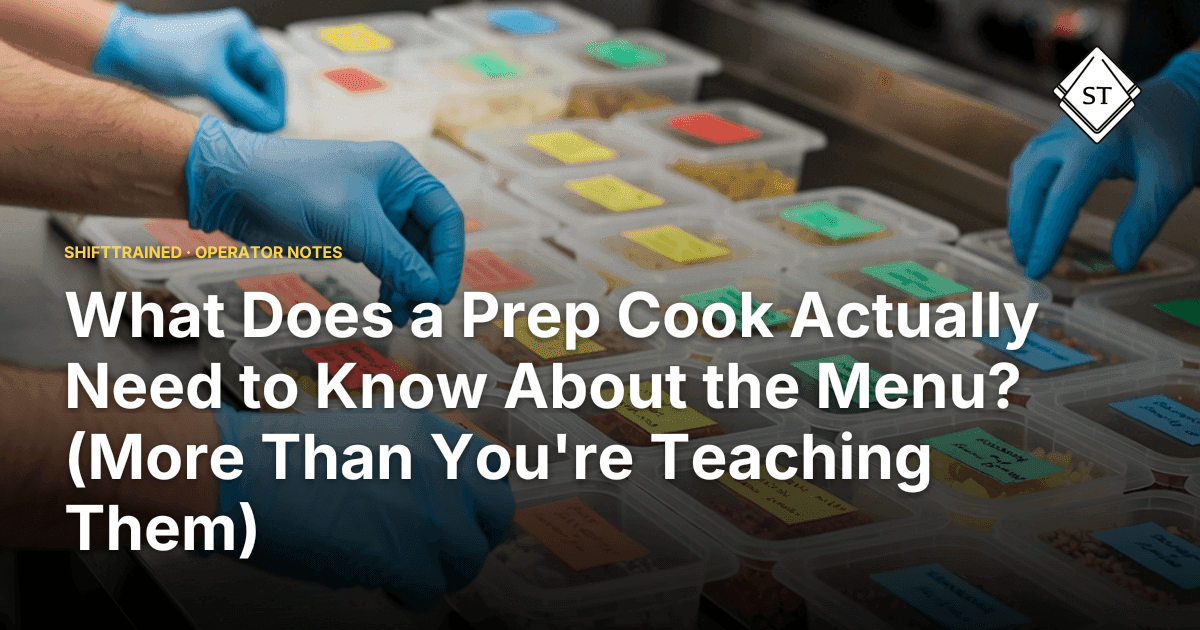
What Does a Prep Cook Actually Need to Know About the Menu? (More Than You're Teaching Them)

Hey Team!
Saturday lunch at a busy wings spot. Table of five, one guest with a severe tree nut allergy. The server marked it on the ticket. The food comes out, guest takes two bites, and fifteen minutes later you're calling an ambulance. Nobody in that kitchen knew the house ranch had cashew oil in it. The prep cook who made that batch two days earlier? She'd never been told. She portioned it correctly, labeled it correctly, stored it correctly. She just didn't know what was in it.
That's not a prep cook failure. That's a training failure. And it's happening in kitchens everywhere.
Here's what most operators actually teach prep cooks: the recipe, the portion, the storage temp, and who to ask when something looks off. That's it. We hand them a spec sheet, walk them through it once, and send them to the cutting board. And for a lot of tasks, that's fine. But fine doesn't cover the moments when the spec sheet is the last line of defense between a guest and a serious incident.
Prep cooks are the first people who touch the food. Think about that. Before a line cook fires it, before a server carries it, before a manager expedites it, the prep cook has already made the decisions that determine whether that dish is safe, consistent, and right. They're not support staff. They're QC. Most of them just don't know that's their job.
The part operators miss is the *why* behind the spec. A prep cook who knows only the portion weight will give you the right number. A prep cook who understands why the portion weight matters, food cost, consistency, the fact that a half-ounce over on the cheese dip across 200 covers a week is real money, that person makes better decisions without being watched. Same goes for garnishes. I've seen prep cooks skip a garnish because it looked like decoration. They didn't know it was part of the dish ID system the line uses to tell a BBQ burger from a bacon burger during a Saturday dinner rush. Small thing. Not so small when four tickets back up and two of them go to the wrong table.
Allergens are where this gets serious. The FDA lists nine major allergens, and a mid-size casual restaurant can easily have exposure points in places nobody thinks to flag during training: a shared fryer, a marinade, a compound butter, a sauce that gets used in three different dishes. Prep cooks cross all of those exposure points. They're making the sauces, marinating the proteins, prepping the garnishes. If they don't know where the allergens live in the production process, nobody does.
Here's what actually works. Five quiz questions a week on dish specs and allergen points. That's the whole program. Not a binder. Not a two-hour food safety class once a year. Five questions, on their phone, before or after their shift.
Ask them where the gluten shows up in the house chili. Ask them what the correct portion weight is for the breakfast burrito filling and what happens to food cost if it drifts by two ounces per order. Ask them which sauces share a container on the prep line and what cross-contact risk that creates. Ask them what the allergen flag means on a build sheet and what they're supposed to do when they see one. These aren't trick questions. They're the actual job.
What you get back is worth more than any audit. You find out fast which crew members actually know the menu and which ones have been winging it. You find the gaps before service, not during. And when something does go wrong, you have a record that training happened, which matters more than most operators realize when there's a liability question.
The consistency side of this is underappreciated too. I've watched operators spend real money on new dishware, updated plating presentations, marketing photos, all of it, and then the dish comes out looking different every third day because whoever prepped the components that morning didn't know the spec had changed. A quick quiz question at the start of the week when a recipe changes costs you nothing. Re-shooting your menu photos and resetting guest expectations costs you a lot.
We built the quiz function at ShiftTrained specifically because the manual version of this, index cards, printed spec sheets, verbal walkthroughs, doesn't stick. People forget. Shifts are loud. Paper gets lost. When questions live on a phone and cycle through on a schedule, the information actually gets reviewed. At Fat Tommy's, prep staff started retaking quizzes voluntarily. Not because anyone told them to. Because they wanted to know if they got it right.
Five questions a week isn't a training burden. It's less time than a pre-shift smoke break. But over twelve weeks it builds something you can't fake: a prep cook who actually knows what they're making, why it matters, and where the danger points are. That's cheaper than one allergen incident, one failed health inspection, one refired ticket on a busy Friday when your line is already in the weeds.
The cheapest QC system in your kitchen isn't another manager on the floor. It's a prep cook who actually understands the menu. You just have to teach them.
Have a great day! — Terry Psaltakis
Your AI Restaurant Guy
For more on putting this into practice, see how ShiftTrained approaches server training.