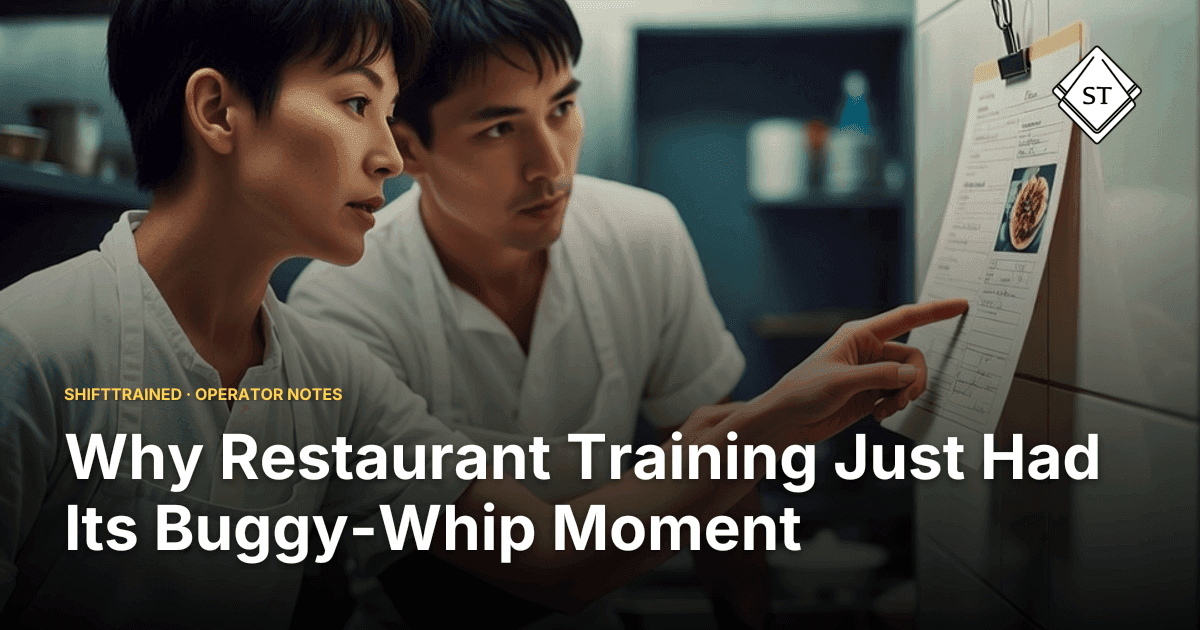
Why Restaurant Training Just Had Its Buggy-Whip Moment

Hey Team!
Theodore Levitt wrote something in 1960 that should have kept a lot of executives up at night. He called it Marketing Myopia. The core idea was simple: buggy-whip makers failed not because demand disappeared, but because they thought they were in the buggy-whip business. They weren't. They were in the transportation acceleration business. The second cars showed up, they were dead and didn't even know it.
I've been in restaurants for thirty years. I've opened over twenty concepts, worked every role from dishwasher to owner, and I spent most of that time doing training the same way everybody else did. Binders. Shadowing. Pre-shift quizzes scribbled on paper, passed around a table before service while half the staff looked at their phones anyway. It worked, sort of, the same way a buggy-whip worked. It got you somewhere. It just wasn't the thing that was going to take you anywhere fast.
Here's what I've watched the training industry do for the last decade. They took the binder and put it on a screen. They took the flashcard and made it digital. They took the 90s-era LMS and gave it a mobile skin. Nicer whip. Faster horse. Still a horse.
The real question, the one Levitt was actually asking, is: what business are you in? Restaurant training tools aren't in the flashcard business. They're not in the quiz business. They're not even in the "onboarding new hires" business. They're in the performance business. They exist to make your staff faster, more confident, more accurate, and more likely to still be working for you in six months. If the tool you're using can't tell you how well your staff actually know the walnut cream sauce you added to the menu last Tuesday, it's a buggy-whip.
Let me tell you what prompted this for me. At Black Barrel Tavern, we rotated a cocktail list. Not a massive change, five or six new drinks. Under the old system, that meant printing new training materials, running a pre-shift, hoping the staff retained it, and then finding out on a Friday night that two servers couldn't describe the garnish on the new old fashioned. The gap between "we told them" and "they know it" was invisible until it showed up in front of a guest.
That gap is what I built ShiftTrained to close. Not because I wanted to start a tech company, but because I was sick of living in that gap. Upload the menu PDF, AI generates the questions, staff takes the quiz on their phones. Twelve minutes from upload to quiz-ready. That's not a feature. That's the moment the car showed up.
The training tools that aren't doing this aren't bad companies. They're doing exactly what they've always done, and most of them are doing it pretty well. But they're making better buggy-whips. The assembly line is already being built.
Now let me be honest about what this shift actually requires, because it's not just a software swap. The real change is in how operators think about training. Most of us treat it as an event. You hire someone, you train them, you're done. Maybe you run a pre-shift before a big weekend. But training-as-event is itself a buggy-whip mindset. The operators winning right now treat training as a continuous signal. Not a one-time upload but a live read on what their staff knows, what they don't, and where the menu knowledge is breaking down before it breaks down in front of a customer.
At Fat Tommy's, we have staff who voluntarily retake quizzes on their own phones. Not because I told them to. Because it became a thing they do. Part of that is gamification, part of it is that the content is actually relevant to their specific menu, not some generic hospitality module about customer service theory. When the training is about your food, your drinks, your allergens, your specials, people engage with it differently. It becomes useful instead of obligatory.
The Cornell study on turnover costs puts replacement at around $5,864 per employee. The National Restaurant Association has reported annual turnover in the 75-80% range for years. Those two numbers together should terrify every operator reading this. Most of the industry has just accepted that math as a cost of doing business. But a chunk of that turnover is training failure. Staff who never got confident. Staff who got embarrassed in front of a table because they didn't know the menu well enough. Staff who decided this job wasn't worth the anxiety. Better training doesn't fix all of that, but it fixes more of it than most operators realize.
Levitt's point wasn't that buggy-whip makers were stupid. They were often the best in the world at what they did. His point was that defining your business too narrowly, around the tool instead of the outcome, is the thing that kills you. The outcome restaurant training has always been chasing is a confident, knowledgeable employee who sticks around and takes care of your guests. The tool was never the point.
The tool just changed.
Have a great day! — Terry Psaltakis
Your AI Restaurant Guy