Training Breakfast and Diner Staff When the Rush Starts at 7am

Hey Team!
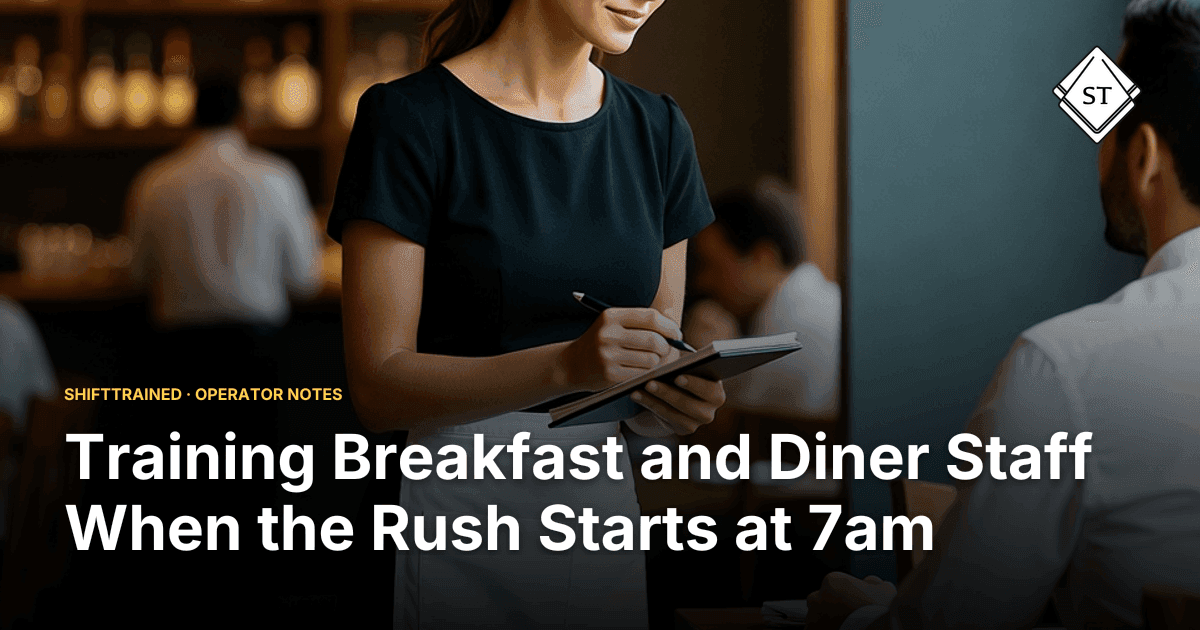
If you've never worked a breakfast rush at a real diner, I want you to picture it for a second. It's 6:55am. The first table sat themselves while your server was still counting tip-out from the night before. The cook is already calling plates. The coffee is ready but the decaf isn't. A four-top just walked in, one of them wants to know if the combo comes with toast or an English muffin, and your newest hire is standing there with a ticket book and absolutely no idea.
That's the job. And here's what's different about breakfast: there's no middle act. In a dinner service, a server can fire an appetizer, disappear for eight minutes, and recover. At a diner on a Tuesday morning, you have roughly forty-five seconds at the table before someone is flagging you down for a refill. The pace doesn't allow for uncertainty. The server who hesitates on whether the veggie skillet comes with home fries or fruit is the server who loses that table's trust before the eggs even hit the window.
I've opened a lot of breakfast concepts over the years, and the training problem is always the same. Operators hand the new hire a laminated menu, maybe walk them through the POS once, and call it good. Then they wonder why ticket times blow up and guests are asking the cook questions through the pass-through window. The binder nobody reads at 6:45am isn't failing because people are lazy. It's failing because nobody can absorb a 40-page training manual when they're tying an apron and trying to remember where the extra syrup pitchers are.
What actually works is short, specific, and testable. Not general. Not "know the menu." Specific. What are the four proteins on the combo plate? What does a guest get if they ask for a substitution on the standard two-egg breakfast? Can someone swap the pancakes for waffles or is that an upcharge? Is coffee self-serve after the first pour or does the server own every refill? These aren't trick questions. But I promise you, at 8am on a Saturday when the counter is full and the wait is out the door, a server who doesn't know the answer to any one of those will make a decision on their own, and it won't always be the right one.
The substitution piece is where breakfast training usually breaks down hardest. Dinner menus have natural structure: appetizer, entree, side, dessert. Guests mostly order within the lanes. Breakfast guests customize everything. Scrambled instead of over easy. No home fries, extra fruit. Can I get sourdough instead of white? Wheat toast but no butter. Two of those questions the server can handle without touching the kitchen. Two of them might change the ticket. If your staff can't sort those instantly, they're either walking back to ask the cook on every order or they're guessing. Neither one is good.
The other thing that bites breakfast operators is allergen exposure, and it's worse at a diner than people think because of cross-contact on a shared flat-top. Eggs, dairy, gluten. Most of your tables have somebody watching one of those three. Your server doesn't need a culinary degree to handle it right. They need to know what's actually on that flat-top, what gets cooked together, and exactly what to say: "I want to make sure I get this right, let me check with the kitchen." That sentence keeps a guest safe and it keeps the server confident. But they have to know to say it, which means it has to be part of training.
Here's what I'd tell any breakfast operator: stop training for the menu and start training for the questions. Write out the fifteen things your servers get asked before 9am. What comes with the combo. How the kids' menu works. Whether you do substitutions on eggs benedict. How the coffee refill policy works. If there's a gluten-free toast option. Whether you'll split a plate. Those are the questions. Train to those. Test on those. Not on a written paragraph, just direct questions with direct answers, the kind someone can actually retain at six in the morning.
The reason I built ShiftTrained was because I watched this exact failure happen in my own places for years. Staff couldn't open a binder between the prep rush and the open. They couldn't retain a two-hour verbal walkthrough from the day before. But give someone fifteen focused questions on their phone before a shift, and they go to the floor with actual confidence. The knowledge has to be portable and it has to be quick, because the gap between when they clock in and when the first table sits is not training time. It's prep time.
Retention without repetition is just luck. And a diner at 7am runs on muscle memory, not luck. Your servers need to know your menu the way they know their own phone number. That only happens if they've answered questions about it enough times that it sticks.
If you run a breakfast spot, write down the twenty things a server gets asked in the first two hours of any shift. Not everything on the menu. Just those twenty things. Make those into questions. Make staff answer them before the rush. That's the training. It doesn't have to be complicated. It just has to happen before the first ticket prints.
Have a great day! — Terry Psaltakis
Your AI Restaurant Guy
For more on putting this into practice, see how ShiftTrained approaches restaurant server training.