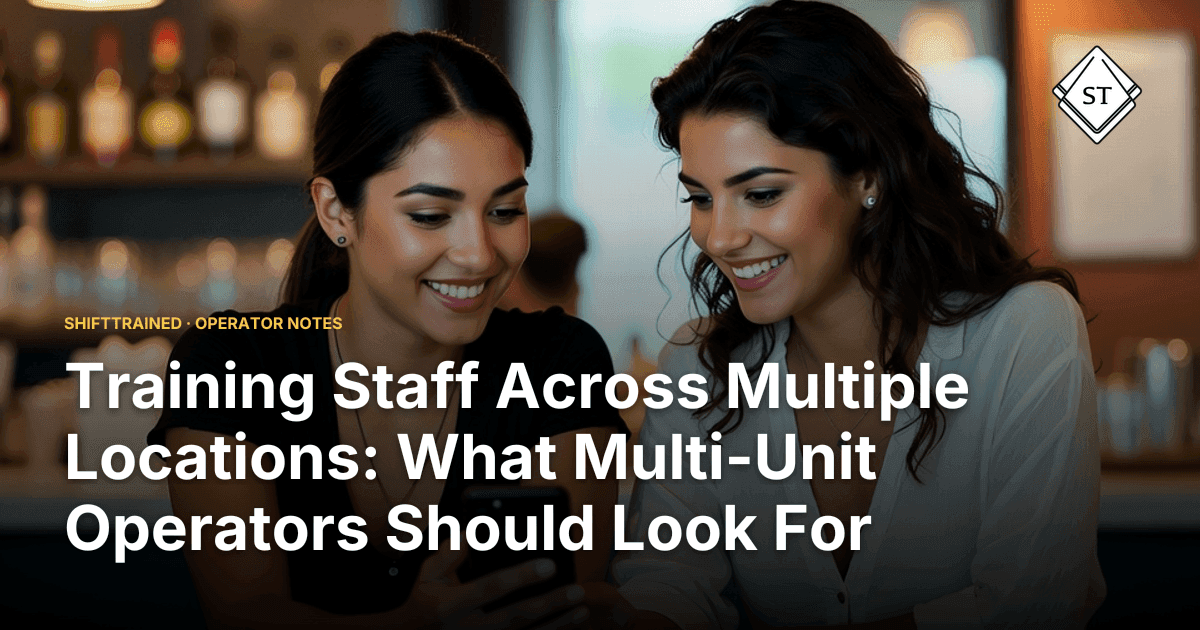
Training Staff Across Multiple Locations: What Multi-Unit Operators Should Look For

Hey Team!
If you're running more than one location, the single biggest training problem you have is inconsistency, not laziness, not bad staff, just the fact that every GM fills in the blanks their own way. Here's what to look for in a training setup that actually holds across locations: one source of menu truth that pushes to every location automatically, scores by location so you can see where the gaps are, a shared pass mark so nobody's inventing their own standard, and a clean way to handle specials that are local without blowing up the master menu.
Let me explain why each of those things matters, because they're not obvious until you've felt the pain.
The GM at your third location is a good operator. Probably great. But if your training content lives in a Google Doc that someone emailed two years ago, and that GM has been updating their own version ever since, you now have three locations running three different menus. Slightly different. Enough to matter. A server at location one knows the burger comes with house-made aioli. The server at location three thinks it's mayo because that's what the laminated sheet behind the host stand says. The guest who's been to both locations notices. You might not, until a review shows up.
The fix isn't yelling at GMs. It's building a system where the menu lives in one place and training flows from that one place. When you update the menu, training updates everywhere. When you add a new item, every location's staff gets quizzed on it. Nobody has to remember to send the email.
If your restaurants are on a modern POS like Toast or Square, there's an opportunity here that most operators don't use. Your menu data is already structured in your POS. The items, the descriptions, the modifiers, the allergens. When your training tool connects to that data, or at minimum draws from the same source document you submitted to the POS, you're not maintaining two separate systems. That's the goal. One update, and both your menu pricing and your staff training reflect the change. The fewer moving parts the better, especially when you're stretched thin managing multiple units.
Now, scores by location. This is the one that changes how you operate once you see it. When every location is running the same quiz and you can pull results by location, you stop guessing where the problem is. A score drop at location two right after a new menu launch tells you something specific. Maybe the training didn't land. Maybe that location had high turnover that week. Maybe the GM needs a conversation. But you know, and you can act. Without location-level data, you're flying blind and making decisions based on whatever the loudest complaint is.
Same pass mark everywhere. This sounds obvious and it almost never gets done correctly. I've walked into multi-unit groups where location one requires a 70% to serve and location three is letting people go at 50% because "it's hard to get staff right now." I get it. Hiring is brutal. But the moment you compromise the pass mark, you've decided that the guest at location three gets a lesser experience. That's a brand decision, and it's usually not a conscious one. It just happens because no one is watching it centrally.
Set the standard once. Enforce it the same way everywhere. If the standard is too high and you're losing people over it, that's a real problem worth solving. But the answer isn't different standards at different locations. The answer is better training so more people can hit the bar.
The one wrinkle with multi-unit training is local specials. Every group has them. Location one is next to a ballpark so you run a draft special on game days. Location three is in a suburb and does a Tuesday family meal deal that the other locations don't carry. You need a system that handles this without forcing you to maintain completely separate training tracks. What works: a shared core menu that trains everywhere, plus a simple way to add location-specific content on top. Staff at location one learn the core menu plus the draft program. Staff at location three learn the core menu plus the family deal. The platform manages the split, not the GM.
At ShiftTrained, this is actually how we built the multi-location side of things, because I lived this problem at my own places. Fat Tommy's and Black Barrel Tavern are different concepts with different menus, different specials, different regulars. But the training logic is the same: one master source, location-level visibility, same grading rules. The GM at each spot isn't inventing training. They're running the program that already exists and adding the local layer on top.
One more thing nobody talks about enough: the ownership gap. In a single-location restaurant, the owner or head GM usually knows exactly how training is going because they're in the building. At three, four, five locations, you lose that visibility fast. If your training tool can't show you a dashboard view of where every location stands, you will find out about training failures from guests before you find out from your managers. That's a terrible way to learn things.
What you want is a simple answer to "did location four train the new spring menu yet?" You want that answer on your phone on a Tuesday morning, without having to text anybody. That's not complicated to build. It just requires that the system tracks it.
If your current setup can't give you that, it's worth asking whether it was designed for multi-unit operators at all, or whether it was designed for a single restaurant and you've been patching it ever since.
Have a great day! — Terry Psaltakis
Your AI Restaurant Guy
For more on putting this into practice, see how ShiftTrained approaches a menu training app.