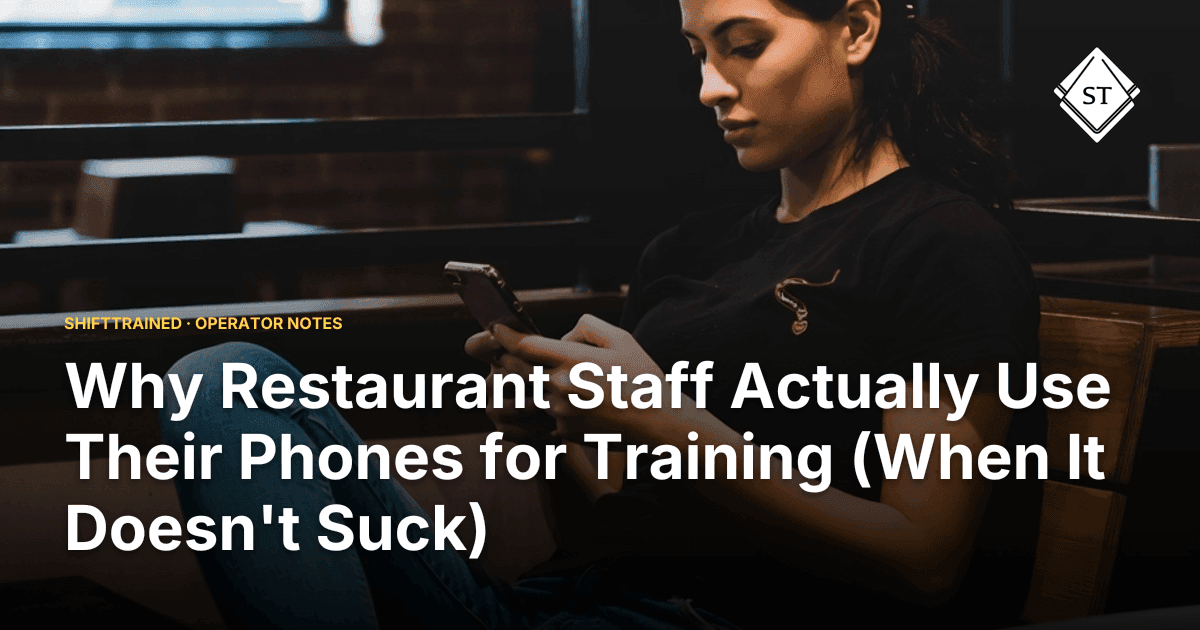
Why Restaurant Staff Actually Use Their Phones for Training (When It Doesn't Suck)

Hey Team!
Saturday night. Ten minutes before we open. Your server is standing at the host stand, phone in hand, and you want them to spend sixty seconds reviewing the new walnut sauce we added to the ribeye at Black Barrel. One question: are they going to do it?
The honest answer is probably not. And the reason isn't laziness. It's friction.
We've built restaurants around the idea that staff won't do something unless you make them. But I've watched our team voluntarily pull up quizzes on their own phones before a shift, and it changed how I think about this. They're not doing it because I asked. They're doing it because it takes two minutes, it loads instantly, and nobody made them download anything.
App fatigue is real. The average person has somewhere between 40 and 80 apps on their phone, and they actively use maybe a dozen of them. When you tell a new hire to "download the training app" you've already lost a chunk of them. Some won't do it on principle. Some have old phones with no storage. Some will download it, use it once, and then it'll sit there taking up space until they delete it the night before a big shift. That's not a training problem. That's a product problem. And it's one operators have been ignoring for years.
Here's the thing nobody in the training space wants to admit. The apps that actually get used on mobile share a very short list of traits. They load in three seconds or less. They don't require a password the person has to dig through their email to find. They don't ask for a profile photo or a date of birth. They work on a four-year-old Android. And they get out of the way fast.
The native app model fights all of that. Downloads, updates, permissions, storage. Every one of those steps is a place where a tired server after a double shift just says forget it. You're not competing against bad training tools. You're competing against Instagram, TikTok, and the fact that your staff already know how to open a browser.
That's the insight that pushed me toward the mobile-web pattern when I was building ShiftTrained. No install. Opens in any browser. Works on any phone. Your staff gets a link, they tap it, they're in. That's it. When we ran it at Fat Tommy's the first time, I was honestly expecting pushback. What I got instead was a server texting a coworker the link because she thought the ribeye quiz was kind of fun. That doesn't happen with a clunky native app that took three minutes to load.
The two-minute threshold matters more than people realize. There's a window before a shift where staff are mentally available. They're waiting for the kitchen to fire up, they're rolling silverware, they've got sixty to ninety seconds of dead time. If your training fits in that window, it gets done. If it doesn't, it waits until the manager asks about it, at which point your server nods and says they'll get to it tonight, and they won't.
Short-form mobile training is also just how people process information now. I'm not saying that's good or bad. I'm saying it's true, and operators who fight it are going to lose. A two-minute phone quiz that covers the three proteins on special tonight is more valuable than a forty-five minute onboarding video that nobody watches past minute eight.
Now let me tell you what actually changes behavior. It's not the format, or not only the format. It's the feeling that it's worth their thirty seconds. When a quiz question is about something real, something they're going to get asked at table four tonight, people pay attention. When it's generic food safety boilerplate that hasn't changed since 2014, they check the boxes and forget it by the time they're tying their apron.
That's why I believe the AI piece matters so much for this. Generating quiz questions off your actual menu, your actual specials, your actual allergen flags, means the training is relevant tonight, not last quarter. Relevance drives engagement in a way that platform design alone can't.
There's also something worth saying about the password problem specifically, because it kills more training sessions than anything else. A staff member who can't remember their login will not reset it before a shift. They'll tell you they did it and then come back to you a week later having learned nothing. Frictionless access, whether that's a link-based login or a simple four-digit code, is not a nice-to-have. It's table stakes.
The operators who get the most traction with mobile training are the ones who stopped thinking about it as a compliance exercise and started thinking about it as a communication tool. The phone is already in their hand. You just need to make it worth opening something other than Snapchat for ninety seconds.
I've been in this business thirty years. I've done pre-shift meetings with a whiteboard and a prayer. I've printed menus and watched them disappear into apron pockets, never to be seen again. The phone-in-pocket problem everybody used to complain about is the same phone that, if you treat it right, becomes the best training tool you've ever had.
You just can't make them hate it first.
Have a great day! — Terry Psaltakis
Your AI Restaurant Guy