Should Restaurants Use AI for Staff Training? (Honest Take)

Hey Team!
Somebody asked me last week whether restaurants should actually be using AI for staff training, or whether it's just hype. Honest answer? Yes. But with a caveat so important that if you ignore it, you'd be better off doing nothing at all.
Here's the caveat: the AI has to generate training content tied to *your* menu. Your items. Your ingredients. Your allergens. Your 86'd items on a Thursday night. If it's spitting out generic content about hospitality and food safety best practices, you haven't solved anything. You've just moved the boredom from a paper packet to a screen.
Let me back up for a second. I've been in this industry for thirty years. Opened over twenty concepts. Done the training every way you can imagine. Printed binders. Tag-alongs. Pre-shift quizzes scribbled on printer paper. The "here, shadow Marcus for a week" method. I've watched every generation of training tools come through this industry promising to fix the problem, and most of them made it slightly more organized but fundamentally the same. A flashcard about what a Caesar salad is doesn't tell a new server that your Caesar has anchovies in the dressing and the guest with the shellfish allergy at table 12 needs to know that before they order it.
That's the thing nobody in the training software world wanted to say out loud. Generic is useless. It doesn't matter how slick the interface is. If the content isn't built from your actual menu, your actual concept, your actual kitchen, it's just a more expensive version of the same textbook that's been gathering grease stains in the back office since 2011.
Now, here's where AI changes the equation, but only when it's actually doing the right job. The right job isn't writing generic food safety trivia. The right job is reading your menu PDF and building quiz questions directly from what's on it. Which dishes have tree nuts. What the preparation method is for your signature item. What "gluten-friendly" actually means at your restaurant versus what it means at the place down the street. Those aren't questions a generic training tool can answer, because it doesn't know your restaurant. Only you know your restaurant.
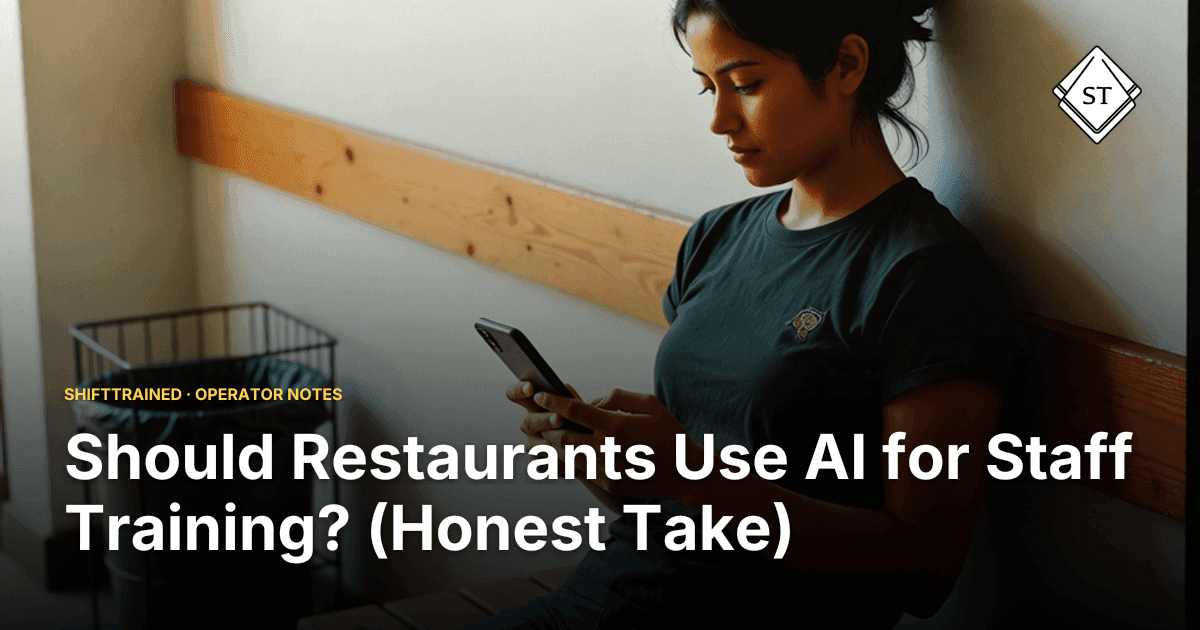
At Fat Tommy's and Black Barrel Tavern, we run the platform I built, ShiftTrained, on exactly this model. Upload the menu, AI generates the questions, staff takes them on their phones. The questions aren't about restaurants in the abstract. They're about the walnut sauce on a specific pasta dish, and whether it needs to be flagged for nut allergies. They're about the ABV on the craft beer we added last quarter. They're about the two items that changed when we updated the fall menu. When one of our servers gets a quiz question wrong about an allergen on a dish, that's a genuine safety catch. That's the system working.
And here's something I didn't expect when we started doing it this way. Staff started retaking the quizzes voluntarily. On their own phones. Not because we made them. Because it actually felt relevant to the job they were doing that night. Generic training is something you sit through. Specific training is something you use.
Now let me talk about the broader framing here, because I think a lot of operators are evaluating the wrong question. They're asking "is AI training better than our current training tool?" when they should be asking "are we still making better buggy-whips?" Theodore Levitt wrote about this in 1960, in a paper called Marketing Myopia. The railroad companies thought they were in the railroad business. They weren't. They were in the transportation business. When trucking and airlines showed up, they were left behind because they optimized the wrong thing.
Most restaurant training tools are optimizing the wrong thing. They're making it slightly easier to deliver content that was always going to be too generic to matter. Better interface, cleaner dashboard, same fundamental problem underneath. That's not a criticism I make lightly, because some of those tools did move the needle on organization and compliance tracking. But the core product, the actual training content, stayed generic. And generic training does not make your staff better at your restaurant.
AI changes this specifically because the hard part of menu-specific training was always the content creation. Writing 200 quiz questions about your menu by hand takes time most operators don't have. So we defaulted to generic because generic was available and affordable and "better than nothing." AI makes specific creation fast enough that there's no longer a good excuse to default to generic. That's the shift. That's the actual opportunity.
So should you use AI for staff training? Yes. But go in with clear eyes about what you're buying. If someone is selling you AI-powered training that doesn't start with your actual menu, your actual concept, your actual items, ask what the AI is actually doing. Because generating generic questions faster than a human could isn't a breakthrough. It's just a faster printer.
The operators I respect most are the ones who ask hard questions about whether a tool actually solves the problem or just moves the problem around. This is one of those cases where the right question cuts straight through the hype. Does it know my menu? If yes, it's worth your time. If no, it doesn't matter what else it does.
Thirty years in this industry taught me that the difference between a mediocre training program and a great one was almost never effort. It was specificity. Operators who trained their staff on their food, their process, their standards, produced better staff. The tool just needs to make that specificity achievable without requiring you to hand-write a test every time the menu changes.
Now we have that. Use it right.
Have a great day! — Terry Psaltakis
Your AI Restaurant Guy