How to Prepare Your Staff for a Health Inspection (Without Panic)

Hey Team!
Picture this. A health inspector walks in on a Tuesday afternoon. No warning, no appointment. Just someone with a clipboard, right in the middle of lunch prep. The first person they find is your newest food runner, three weeks on the job. And the first thing they ask is where you keep your allergen documentation.
Does your runner shrug? Or walk the inspector straight to it?
That answer doesn't happen by accident.
Here's what most operators get wrong about health inspections. They treat it like a cleaning problem. Scrub the walk-in, squeegee the floor mats, label the containers. All of that matters. But the score you walk away with depends just as much on what comes out of your staff's mouths as it does on what's on your shelves. Inspectors are trained to interview employees. They do it on purpose, and they do it specifically because they know nervous line cooks and new servers will tell them things owners would never volunteer.
So let's talk about the eight questions your inspector is very likely to ask, and how you actually prepare your people for them.
First question: where is your allergen information? The inspector wants to know if your staff can locate it, not just whether it exists. Binder on the host stand, document in the POS, laminated sheet at expo, doesn't matter where, as long as every person on your floor knows without hesitating.
Second: what are the major allergens? The FDA recognizes nine. Milk, eggs, fish, shellfish, tree nuts, peanuts, wheat, soybeans, and sesame. Your staff should be able to list them, not just nod when an inspector says them. There's a difference.
Third: what's the temperature for cooking chicken? 165°F internal. Every person who touches food should know this number cold. Inspectors love asking it to line cooks and prep staff because it's basic food safety and it's often where untrained staff fall apart.
Fourth: how do you handle a cross-contamination situation? Let's say raw chicken drips onto a produce shelf. What do you do? Who do you tell? What gets thrown out? Your staff needs a real answer, not a blank stare.
Fifth: how do you calibrate a thermometer? Ice bath method. Boiling water method. Your kitchen staff should know at least one. This question comes up more than people think.
Sixth: when did you last complete your food handler certification? Don't laugh. Inspectors ask employees directly when their certification expires. If your person says "I don't know" or "I think it's current," that's a note on the clipboard.
Seventh: what do you do if you think you're sick? Your sick policy has to be something employees actually know, not just something that lives in the employee handbook nobody read. Vomiting, diarrhea, jaundice, sore throat with fever, these are the reportable symptoms under most state codes. Your people need to know what to do and feel safe enough to actually do it.
Eighth: what is this item on the menu made with? The inspector picks a dish, sometimes at random, sometimes because a modifier was flagged. Your server needs to know what's in it. Not just "it's the salmon," but what the salmon is dressed with, what the sauce contains, whether the glaze has soy.
Now here's the part nobody talks about: knowing the answers and being able to produce them under pressure are completely different skills. An inspector walking up to your 19-year-old food runner during a Tuesday lunch rush is pressure. Telling someone the answers during a pre-shift meeting once does almost nothing. The information doesn't stick. It doesn't show up under stress.
What actually works is repetition that feels low-stakes until the stakes are high. Quiz your people on this stuff regularly. Not the night before a rumored inspection. Not once during orientation. Regularly. Make it part of how you run your operation. When staff have answered "what temperature does chicken cook to" forty times on their phone while waiting for the bus, they answer it without flinching when a stranger in a polo asks them face-to-face.
The restaurants that handle this well drill inspection questions the same way they drill the menu. Short, repeated, mobile-friendly. The platform I built, ShiftTrained, was designed for exactly this, upload your menu and food safety info, and your staff gets tested on it in minutes, on their own phones. But the format matters less than the habit. Whatever tool you use, the goal is the same: your people should be bored by these questions before the inspector ever asks them. Bored means fluent. Fluent means confident. Confident means you walk out of that inspection with your score intact.
One more thing. Your front-of-house staff is just as important here as your kitchen team. Inspectors know that servers interact with guests around allergens every single shift. They will ask your server about cross-contact. They will ask about your gluten-free protocol. Train your whole team, not just the people behind the line.
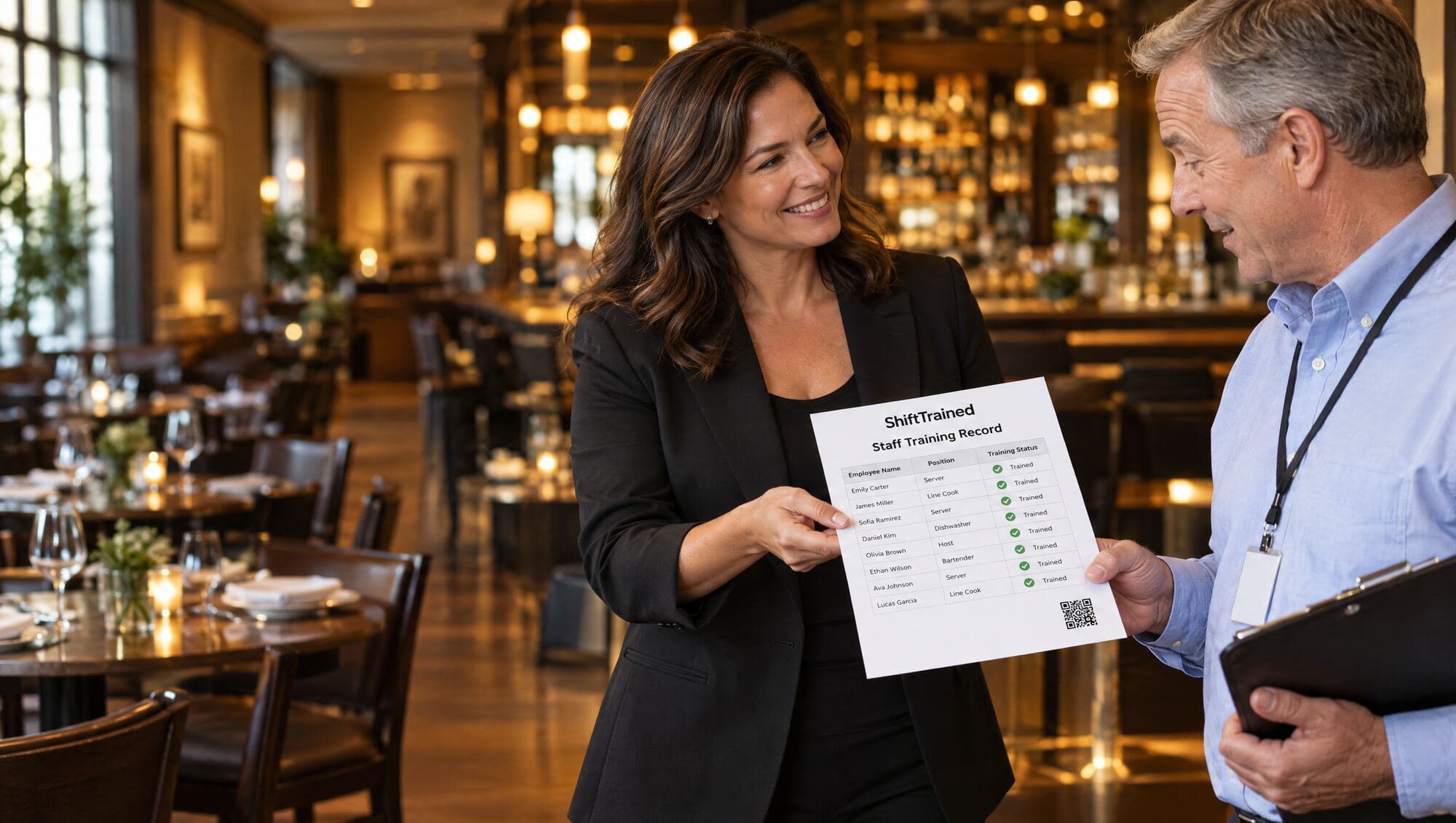
And when the inspector asks you to prove your staff was trained, have the proof ready. ShiftTrained now gives every paid account an inspector report: one page with everyone who passed, the date, their score and their allergen results, ready to show on your phone, print or email. Here is what to hand the inspector, plus guides for US health inspections, Australia's Standard 3.2.2A and UK EHO inspections.
Picture that inspector again. Your three-week food runner walks them straight to the allergen documentation without blinking. That's not luck. That's training.
Have a great day! — Terry Psaltakis
Your AI Restaurant Guy