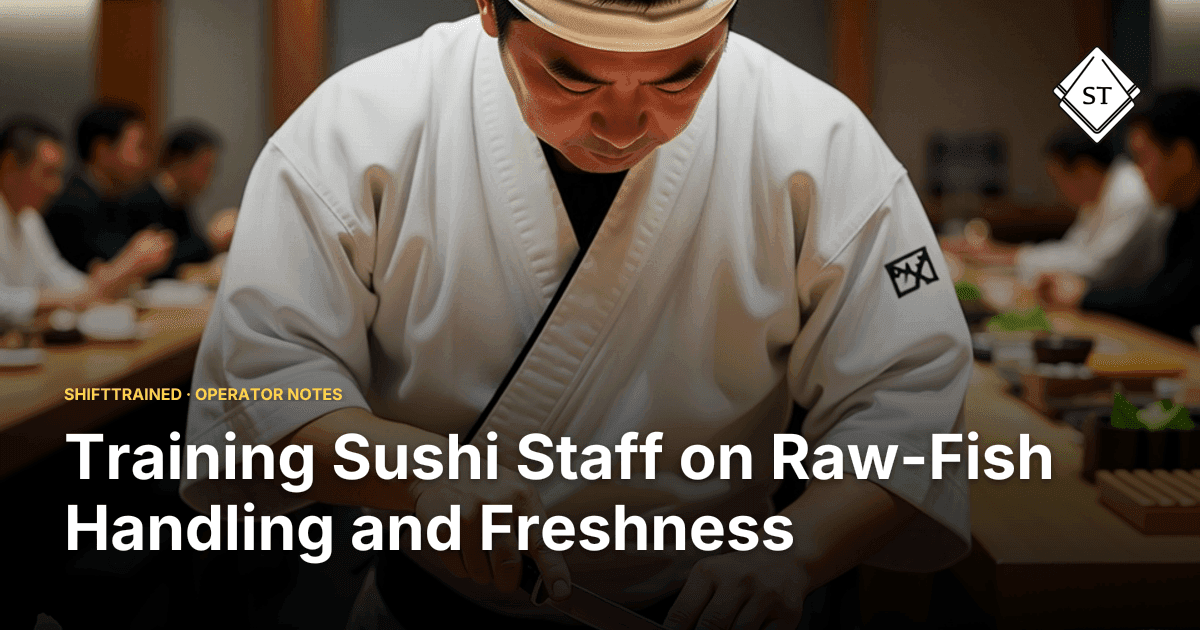
Training Sushi Staff on Raw-Fish Handling and Freshness

Hey Team!
Sushi service is the one place in your building where a knowledge gap can put someone in the hospital. I've run plenty of concepts over the years, and nothing focuses the mind like staring at a sheet tray of bluefin at six in the morning and knowing your staff is about to tell fifty guests tonight whether or not it's good. That conversation at the table, "is this fresh?", sounds like small talk. It isn't. Your server or sushi chef either knows the answer or they're guessing. And guessing with raw fish is a different kind of problem than guessing about a wine pairing.
So let's talk about what your sushi staff actually needs to know cold, before they touch a knife or face a guest.
The temperature window is where most operations quietly fail. Sashimi-grade fish needs to stay at or below 38°F from delivery to the moment it breaks down on the cutting board. That's not a suggestion from a food safety manual nobody reads. That's the line between a fish that's safe and one that's growing bacteria fast enough to matter. Your staff should know that number without thinking. They should also know that once fish comes out of refrigeration for prep, the clock starts. You don't leave nigiri rice half-prepped on a warm counter and walk away for twenty minutes. Temperature isn't a back-of-house concern. It's a guest-safety concern that starts at receiving.
Receiving is the skill most operators underinvest in. When the delivery comes in, someone on your team needs to actually inspect it. That means eyes, nose, and hands. The flesh on a fresh piece of salmon should be firm and spring back when you press it. The color should be vivid, not dull or browning at the edges. The smell should be clean, like cold ocean water. If it smells like fish, that's already a problem. Any serious sushi operation has a reject-and-call protocol, and every person who might touch a receiving delivery should know what that protocol is and be willing to use it. The mistake I see is that operators train their lead sushi chef on receiving standards and nobody else. Then the chef has a day off, a junior cook signs for the delivery, and something marginal gets accepted because he didn't want to make the phone call.
Your staff also needs to understand the difference between what's federally required and what's actually fresh. The FDA requires that fish served raw be frozen to specific temperatures first to kill parasites. Most reputable suppliers handle this before it reaches you. Your team should know that distinction because guests ask about it. "Is this fresh or was it frozen?" is a question with a real answer, and the real answer is almost always "it was frozen to FDA spec, which is actually how we know it's safe to eat." That's not a dodge. That's a fact. Staff who can say that with confidence instead of panicking and fumbling the answer are doing something valuable. They're being honest with a guest and building trust at the same time.
Freshness windows are tighter than most staff realize. Whole fish properly stored has more runway than broken-down portions. Once you've cut tuna into blocks, you've exposed more surface area to oxidation and bacteria. That's why how you label and rotate your prep matters as much as anything else in that kitchen. Every portion should be dated. Every station should know what the pull timeline is for each species. Yellowtail and salmon don't have the same window. Uni is different again. These aren't details your staff should look up. They should know them.
Now here's the part that takes a minute to teach but pays off every service. When a guest asks "is this fresh?" your staff should be able to answer with actual specifics, not just "yes, absolutely." Something like: "We received the salmon this morning, it came in whole and was broken down about two hours ago." That answer is twenty times more reassuring than a reflexive yes, and it's only possible if your team knows the journey of every protein from delivery to plate. That knowledge doesn't come from hanging a poster in the break room. It comes from training that makes staff walk through the supply chain, ask questions about it, and get tested on it until the answers are automatic.
The allergen layer on top of all of this is serious. Shellfish, finfish, and sesame are all common in a sushi build. Cross-contact between a shrimp-based dish and a finfish dish is a real risk when your prep station is small and turnover is fast. Staff need to know which items contain which allergens and what cross-contact looks like in their actual station, not in the abstract. "Our tempura shrimp and the yellowtail rolls are prepped on adjacent boards" is the kind of specific your team needs to have memorized.
At ShiftTrained, this is exactly the kind of training that the platform was built for. You upload your menu and your protocols, and the AI generates the quiz questions your staff actually needs to know, on their phones, in minutes. For a sushi operation specifically, that means temperature thresholds, species-specific freshness windows, receiving inspection criteria, and allergen flags all become testable knowledge before someone's first service.
But regardless of what tool you use, the standard is the same. Raw fish is unforgiving. Your staff either knows it or they don't. There's no middle ground that protects your guests or your reputation.
Have a great day! — Terry Psaltakis
Your AI Restaurant Guy
For more on putting this into practice, see how ShiftTrained approaches a menu training app.