How to Train Staff on Portion Sizes and Plate Specs

Hey Team!
Saturday night, full rail, and a table in section three just sent back a plate. Not because the food was bad. Because the guy who ordered the same dish last week got a noticeably bigger portion, and he remembered. That's a real conversation I had to have with a cook at Black Barrel Tavern. Good cook, bad night, slightly heavy hand on the protein. Cost me a table's trust and a few points of food cost I didn't budget for.
That's the thing about portion inconsistency. Operators want to make it a personality problem. "Danny just doesn't care" or "she rushes when it's busy." But most of the time it's a training problem. You never actually drilled the spec. You showed someone once, maybe twice, and assumed it landed. It didn't.
The spec is the standard. Everything else is noise.
Before you can train anyone on portions, you have to have the spec written down in a way a 19-year-old on their third shift can read and execute. Not "a generous scoop" or "fill the bowl." Six ounces of pulled pork, weighed. Two ounces of sauce, ladled. Fourteen fries in a basket, no I'm kidding, but you get what I mean. The number has to exist. If it doesn't exist on paper, it doesn't exist in the kitchen.
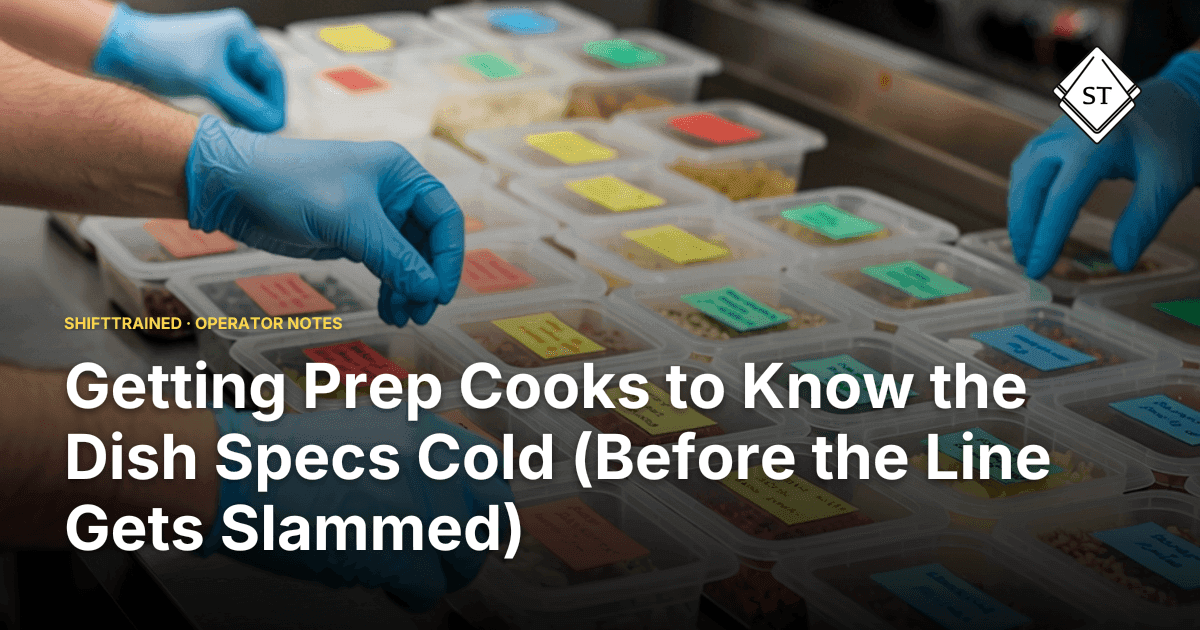
At Fat Tommy's we photo-spec every plate. A printed card with the finished dish, the weight of each protein, the count on the sides, the placement. It lives in a laminated binder on the line. When we added a walnut cream sauce to the pork chop last fall, we didn't just tell the team about it. We weighed the pour, photographed the plate at that pour, and updated the card that week. The spec card is a living document, not a thing you make once when you open and never touch again.
Now here's what most operators skip. Showing someone a spec card is not training. It's orientation. Training is repetition with feedback.
The cook needs to plate the dish. Then you weigh the protein in front of them. Then they do it again. You're not trying to embarrass anyone. You're building muscle memory. Scales on the line aren't an insult to experienced cooks. They're a tool, same as a thermometer. Any cook worth their salt in a professional kitchen should want to know they're hitting the number.
The feedback loop is everything. If a cook plates sixty dishes in a shift and nobody checks a single one until a manager notices something's off, you've lost your chance to correct in real time. The habit gets set wrong. It calculates into your food cost in a way that's slow, quiet, and brutal to reverse.
I'd argue that pre-shift is where portion training should live on a regular basis. Not every night, but often enough that it stays fresh. Bring out a protein. Have two cooks plate it independently without watching each other. Weigh both portions. Talk about what happened. That's a five-minute exercise that does more than any training manual. It makes the number real and it makes it a team standard, not an arbitrary rule someone wrote down.
For front-of-house, portion training looks different but it matters just as much. If a server describes the ribeye as "huge" to one guest and says nothing about size to another, you've got a mismatch in expectation before the plate even hits the table. Your FOH team needs to know the specs well enough to set honest expectations. "It's a ten-ounce cut, it comes sliced, the portion's designed to be a full meal." That's what good service sounds like. Your servers knowing the plate specs cold is a quality control step, not just a sales skill.
The place this breaks down hardest is turnover. Restaurant industry turnover is 75 to 80 percent annually according to the National Restaurant Association. That's a real problem for portion consistency because your institutional knowledge walks out the door constantly. Every new hire is a reset. If your training process is "watch someone else do it for a week and pick it up," your eighth hire is getting a faint photocopy of what your first hire learned. The spec drifts.
The platform I built, ShiftTrained, generates quiz questions directly from your menu and spec documents. One of the things we built it for was exactly this kind of operational knowledge. "What is the portion size of the pulled pork?" has to have a right answer, and your staff has to be tested on it. Not lectured on it once. Tested, repeatedly, until it sticks. Our staff at both Fat Tommy's and Black Barrel Tavern retakes those quizzes on their own phones. That's not because we forced them. It's because the quiz is fast, it's on their phone, and people actually want to know they've got the right answer.
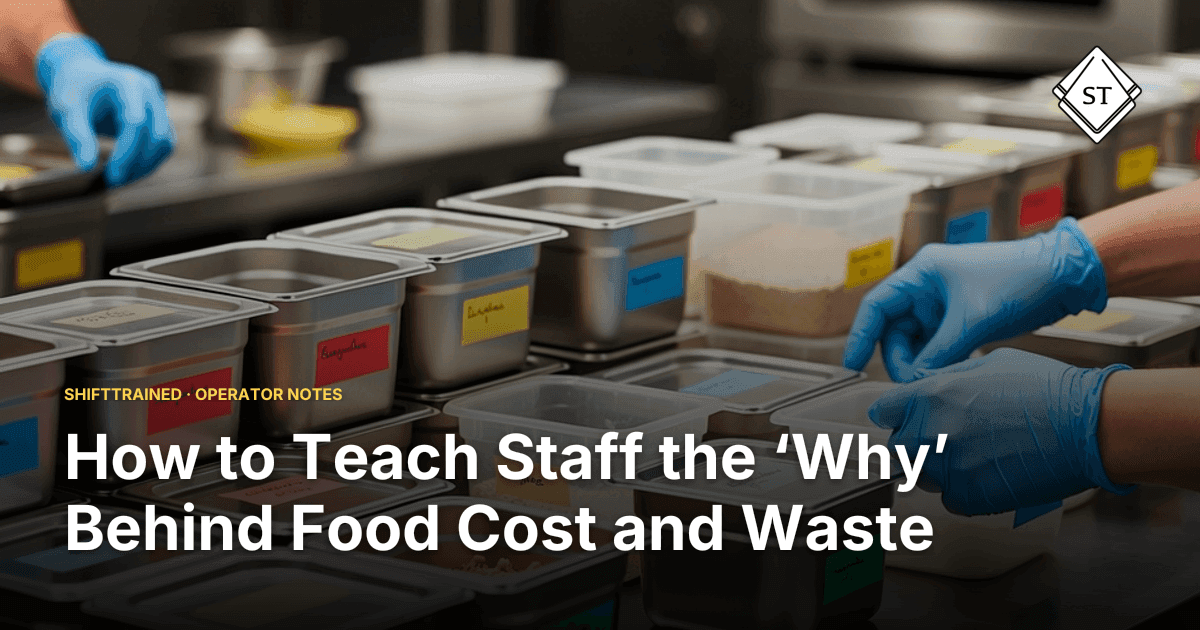
The practical side of all this is food cost. You can't manage food cost if your portions aren't consistent. A half-ounce of protein over spec on a high-volume item across a hundred covers a night is real money. I've seen kitchens running two to three points over food cost target with no obvious explanation in purchasing or waste, and when we walked through and weighed portions, there it was. Nobody was stealing. Nobody was careless. They just never had a hard number they believed in and practiced to.
So write the spec. Photograph the plate. Put the scale on the line and use it without apology. Build repetition into your pre-shift, even if it's just five minutes twice a week. And train your FOH on the specs the same way you train the kitchen, because they're the last layer of quality control before the plate reaches the guest.
The eighth plate should look like the first. That's not a high bar. It's the whole job.
Have a great day! — Terry Psaltakis
Your AI Restaurant Guy