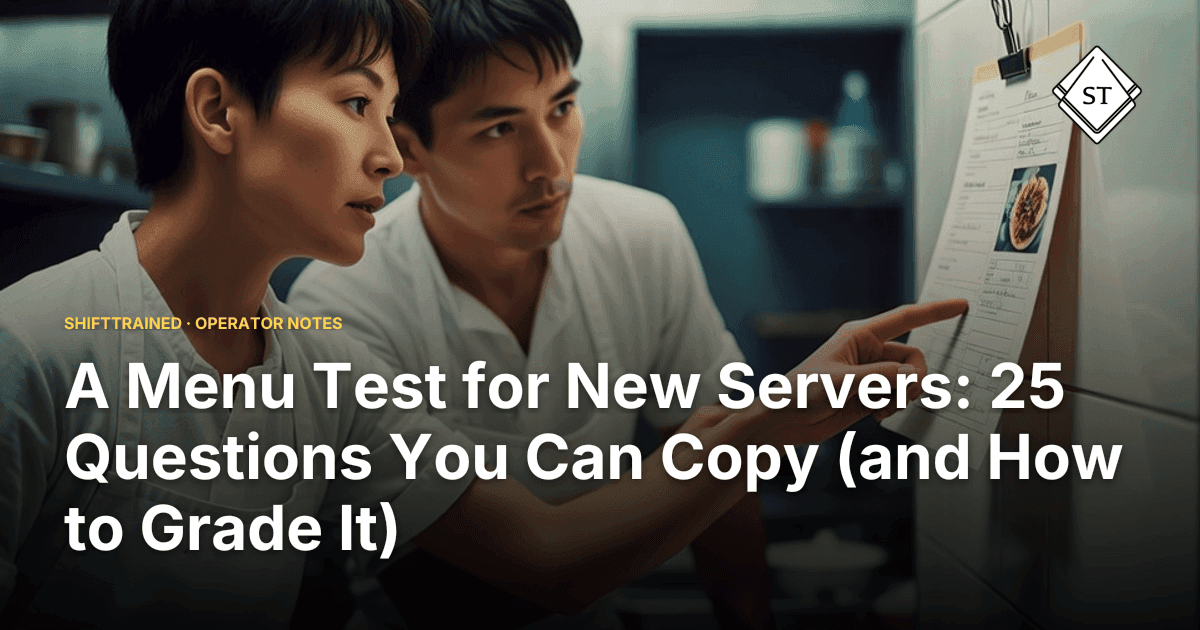
A Menu Test for New Servers: 25 Questions You Can Copy (and How to Grade It)

Hey Team!
Here are 25 question types you can copy right now to build a server menu test, and here's how to grade it: pass is 80 percent, anything missed gets reviewed face-to-face, then you retest on just those questions a week later.
That's the whole system. Now let me show you what the test actually looks like.
A server menu test isn't about making your staff nervous. It's about giving you a clear picture of who's ready to take tables and who needs another day. The difference between a server who knows the menu cold and one who's guessing costs you in comped dishes, in guest complaints, in tables that don't come back. Twenty-five questions sounds like a lot. It's really about 15 minutes of reading time, then 20 minutes on the test.
Here's the structure I'd use. Take this, fill in your actual dishes, and you've got a working test by end of day.
The first five questions should cover what comes with every entree. "What sides does the burger come with? Can the guest swap the fries?" Basic stuff. Guests ask it on every table and servers shouldn't have to walk back to find out.
Questions 6 through 10 should cover sauces and dressings. Which dressings come on the side automatically? What's the house sauce on the chicken sandwich? Is the aioli dairy-based? If your kitchen makes anything from scratch, those questions belong here too, because guests ask where things come from all the time now.
Questions 11 through 15 are about how dishes are cooked. Burgers: what temperature do you cook to by default, and what do you say when someone orders well-done? Salmon: is it pan-seared or grilled? Wings: fried or baked? Your servers don't need to know the whole recipe. They need the ten-second answer that sounds confident at the table.
Questions 16 through 18 are about add-ons and their prices. Extra protein, extra cheese, gluten-free bun, side upgrade. Guests ask. Servers either know it or they say "let me check," and that's a dead spot in service where the table starts looking at their phones.
Questions 19 through 21 are allergen questions. Not "what are our allergens" as a category but specific: "Does the ranch contain dairy?" "Is the bun on the chicken sandwich gluten-free?" "What does the Caesar dressing have in it?" Your menu probably prints some of this. Your servers need to know it cold, not squint at the menu to find it. An allergen answer delivered with hesitation is nearly as bad as a wrong one.
Questions 22 and 23 are drink pairings. Two questions is enough. Pick the two most popular entrees and ask what beer or wine you'd suggest with each, and why. You don't need a sommelier speech. You need a server who can say "I'd go with the lager, it cuts through the heat pretty well" without blanking. One confident suggestion sells.
Questions 24 and 25 are about current specials. What's on tonight? What's it made with? What's in the cocktail special? Specials are where you make margin and where guests try something they didn't plan to. If your server can't describe it, it doesn't sell.
Now for grading.
Eighty percent is the pass mark. That's 20 out of 25. I'm not asking for perfect. I'm asking for solid. A server who scores 82 is ready. A server who scores 64 needs another day before they're on the floor, and that's not a punishment, that's just honest.
When someone misses questions, don't just hand the paper back. Sit down for five minutes and go through the missed ones together. Was it a knowledge gap or a reading mistake? Most of the time it's one specific area: they blanked on allergens, or they hadn't read the specials board yet. You can usually find it fast.
Then retest on the missed questions a week later. Just those questions, not the whole 25. You're checking retention, not punishing them with a full exam. If they nail the missed ones at the retest, they're good. If they blank again, something deeper is going on, maybe they're not studying, maybe the written format isn't how they absorb information, and that's worth a real conversation.
One thing I'd add: keep a log. Even just a spreadsheet. Date, staff name, score, which questions they missed. After a few months you'll see patterns. If question 19 (the allergen one) has the worst score across your whole staff, that's not a staff problem. That's a training problem. Fix the training.
The manual version of this test, building it yourself, keeping it updated every time the menu changes, reprinting it, collecting paper, logging scores, is tedious enough that most operators do it once and then let it slide. I built ShiftTrained because I watched myself do exactly that for years. The platform generates the quiz straight from a menu PDF, allergen questions and all, so the test is always current and staff takes it on their phones. But even if you do it by hand using the structure above, you'll be ahead of 80 percent of operators who are still running servers with a 20-minute tag-along and a prayer.
Know the menu. Know it well enough to sell it. That's all this test is for. Build it, use it, update it when the menu changes, and your floor will feel the difference inside a week.
Have a great day! — Terry Psaltakis
Your AI Restaurant Guy
For more on putting this into practice, see how ShiftTrained approaches restaurant staff training.