The Forgetting Curve and Why Restaurants Keep Retraining the Same Staff

Hey Team!
There's a German psychologist named Hermann Ebbinghaus who figured something out in 1885 that the restaurant industry has ignored for 140 years. He sat alone in a room and memorized lists of nonsense syllables, then tested himself at intervals to see how much he retained. What he found is brutal in its simplicity. Within 24 hours of learning something new, people forget roughly half of it. Within a week, they've lost about 75% of it. Without reinforcement, knowledge just drains away. He called it the forgetting curve, and it's as true in your dining room today as it was in his German laboratory in 1885.
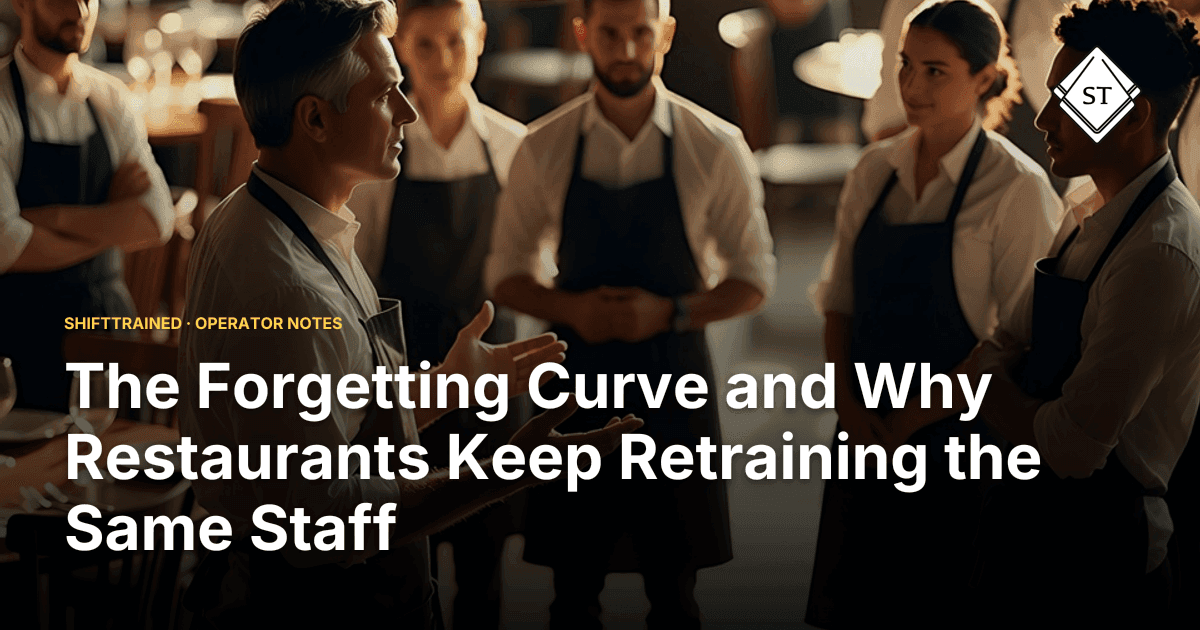
Now think about how most restaurants train. New server comes in. You do a few days of tag-alongs, maybe a printed menu to take home, a pre-shift rundown from a manager who's got 40 other things on their mind. Then you put them on the floor. Two weeks later they're misidentifying the fish or they forgot that the romesco has almonds in it. So you retrain them. Then 90 days later, same thing. You're stuck in a loop and it feels like a staff quality problem. It's not a staff quality problem. It's a memory problem, and it's completely predictable.
Here's what Ebbinghaus also discovered, the part people forget to mention. The forgetting curve is not a fixed wall. It flattens out with repetition. Every time you successfully retrieve a piece of information and test yourself on it, the decay slows down. The curve gets shallower. Psychologists call this spaced repetition. You don't need to relearn everything from scratch, you just need strategically timed reminders before the information is fully gone. That's the whole game.
The problem is that restaurant training was designed before anyone built a practical system around this. You had paper flashcards, manager-led pre-shifts, maybe a binder that lived under the host stand. None of those are spaced. None of them track what a specific person knows versus what they've forgotten. You end up training the whole team on the same stuff at the same time regardless of who actually needs reinforcement. That's not just inefficient, it means your best servers are bored and your weakest servers still aren't retaining what they need.
I see this constantly. A friend of mine added a walnut-based sauce to a sandwich about two years ago. The kind of allergen detail that absolutely cannot slip. We did a pre-shift on it. Managers mentioned it. We put it on the line. Three weeks later he tested the floor staff casually during a slow Tuesday and about half of them couldn't name the nut. Not because they're bad employees. Because three weeks had gone by and nobody had touched that information since the night we introduced it.
That's the forgetting curve doing exactly what Ebbinghaus said it would do.
Spaced repetition fixes this, but it requires a system that actually delivers the right question to the right person at the right time. Not a quiz-the-whole-room approach. Personalized. If someone just learned the new seasonal item yesterday, they should see a question on it tomorrow, then in three days, then in a week. If they're getting it right, the interval stretches. If they're missing it, the interval shortens and you know who needs attention. This is not a new idea in education. It's been the backbone of serious language-learning platforms for decades. Restaurants just haven't had a tool built around their actual content until recently.
The other thing operators miss is the difference between recognition and retrieval. If you hand someone a menu and ask them to read it, they recognize everything. That feels like training. But recognition and retrieval are completely different cognitive functions. Retrieval is what happens on a Saturday at 8pm when a table asks your server what's in the sauce and there's no menu in their hand. You need retrieval practice, not recognition practice. That means questions. It means being forced to pull the answer from memory without a cheat sheet. That's what actually builds the neural pathways that stick.
And here's the part that surprised me when we started building real quiz infrastructure into ShiftTrained. Staff actually like it. I expected pushback. I expected "I'm not doing homework for a restaurant job." What I got instead was people pulling out their phones during a lull and running through questions on their own. Gamification plays a part in that, but I think the deeper thing is that people like knowing they know something. Competence feels good. A server who can answer any question about the menu with confidence has a better shift than one who's guessing. That's real.
The Cornell hospitality research on employee turnover puts replacement costs at around $5,864 per person. The National Restaurant Association reports turnover running 75 to 80 percent annually in the industry. So you've got a workforce that walks out the door at a staggering rate, and a training system that doesn't account for the basic science of how human memory works. Those two facts together explain a lot of the pain operators feel every single quarter.
The forgetting curve isn't a theory. It's a law of human cognition that's been documented for a century and a half. Training a new hire once and hoping for the best isn't a training program. It's a wish. The fix isn't complicated, it's just consistent, spaced, retrieval-based reinforcement. Build that into your system, whatever system you use, and you stop retraining the same things over and over again. The loop breaks.
Have a great day! — Terry Psaltakis
Your AI Restaurant Guy