Training Back-of-House Staff When You Don't Have Time

Hey Team!
Training back-of-house is just harder. Full stop. Anyone who tells you otherwise hasn't spent real time in a kitchen.
Think about what you're actually asking someone to do when you try to train a line cook. You want them to stop, pay attention, and learn something new. But they're standing next to a fryer at 350 degrees, tickets are coming in, the guy across the line is calling for pickup, and the prep list isn't done yet. "Hey, let me walk you through the new sauce component" lands somewhere between ignored and resented. That's not a people problem. That's a physics problem.
I've opened over twenty concepts and I've tried every version of BOH training you can imagine. New hire shadowing, printed recipe binders, laminated cards taped to the reach-in, the five-minute pre-shift rundown before service. They all have the same flaw: they ask the kitchen to slow down so training can happen. And the kitchen doesn't slow down. Ever.
The binder thing especially. Every kitchen I've ever walked into has a binder somewhere. It's usually on top of the office refrigerator, covered in something unidentifiable, and nobody has opened it since 2019. That's not the team failing at training. That's training failing the team.
Here's the thing most operators don't realize: the knowledge gap in your kitchen costs you way more than you think. It costs you in inconsistency. A guest gets your short rib on Tuesday and it's perfect. They bring their client on Thursday and a different cook is on, the braise time was a little short, the plating was off. That guest doesn't come back. You never find out why. The Cornell Center for Hospitality Research has clocked replacement costs for a single restaurant employee at over $5,800. Turnover is running 75 to 80 percent industry-wide according to the National Restaurant Association. When you lose a trained cook, you're not just losing a body. You're losing everything they learned, and you're paying to rebuild it from scratch with whoever comes next.
So what actually works in the back of house?
The answer I keep coming back to is this: training has to fit *around* the kitchen's rhythm, not ask the kitchen to bend to training's rhythm. That means short. That means mobile. That means it happens during the one window every cook actually has, which is prep.
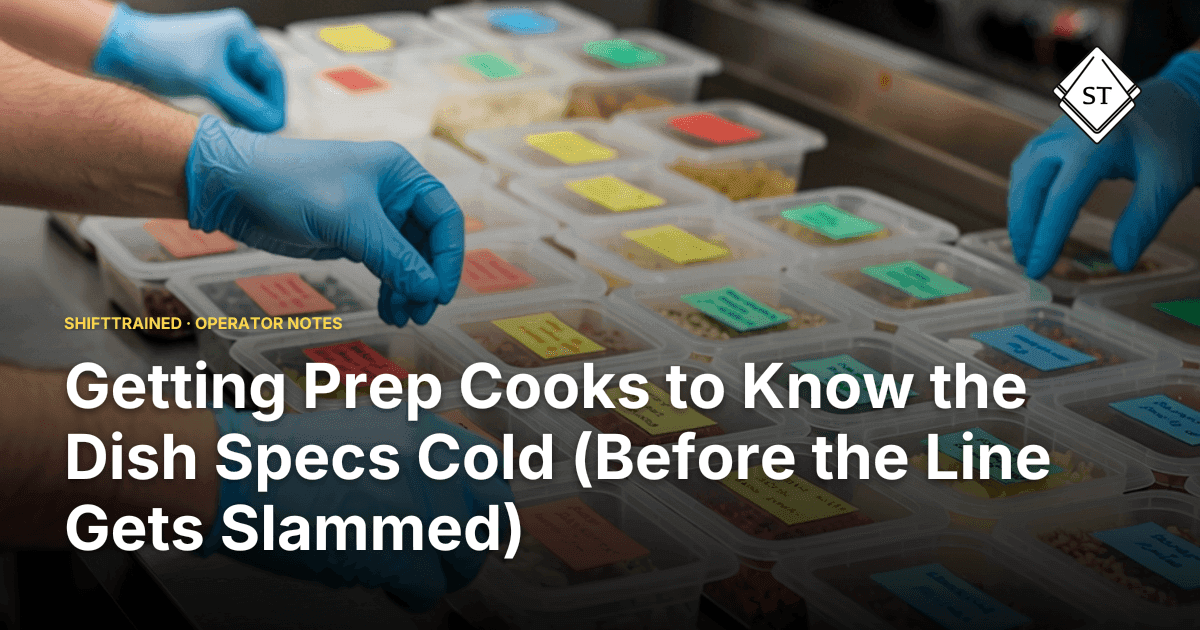
Prep time is genuinely underused for learning. Not mid-service, not post-close when everyone wants to get out. Prep. A cook has their hands busy but their brain has some capacity. They're not being yelled at. They're not racing. That 45-minute window where they're breaking down proteins or setting up mise en place is when you can actually reach them.
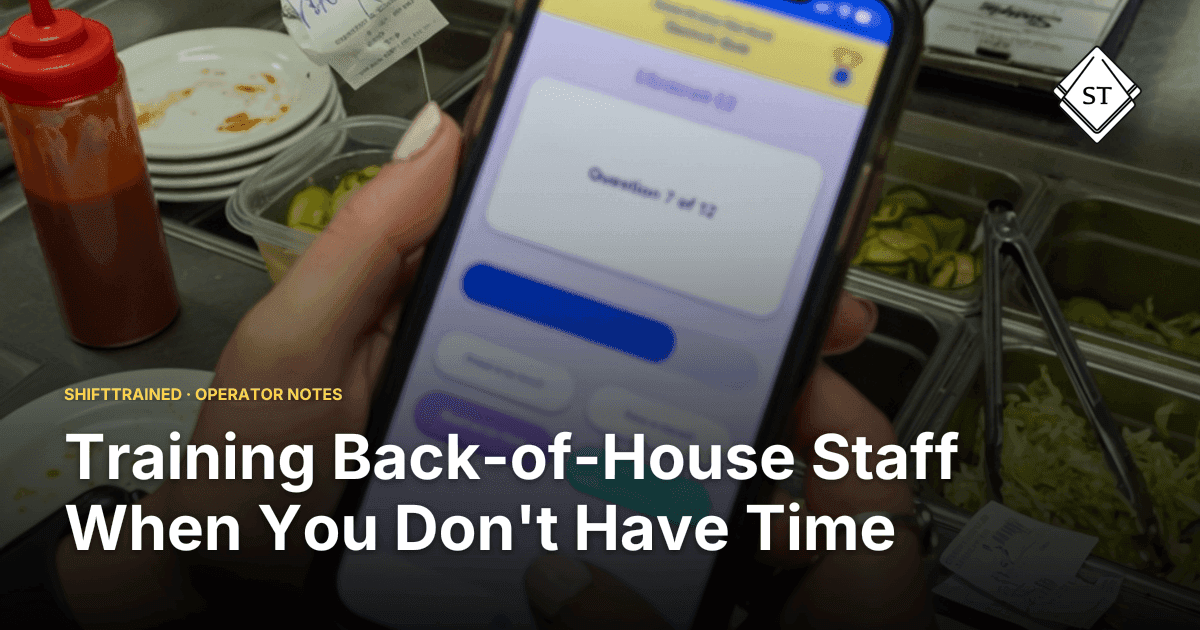
At Fat Tommy's, we started pulling recipe cards and turning them into short quizzes that cooks could run through on their phones during prep. Not a lecture. Not a video they have to sit still for. Ten questions, five minutes, done. What's the internal temp on the brisket? What's in the dry rub? What does the plate look like on the chopped sandwich? Stuff they should know cold, tested in a way that doesn't require a manager to stand there and administer anything.
What happened was interesting. Cooks started competing with each other. Not in a forced gamification way where you're bribing them with gift cards. Just naturally. Someone gets a 90, someone else wants to beat it. That's real engagement, and it came from making the format fit the environment instead of forcing the environment to fit the format.
The other thing that changed was consistency. When you can verify that every cook on the line has been tested on a recipe, not just told about it once during a chaotic onboarding week, your product gets tighter. Guests notice. Your ticket times don't necessarily change, but your refire rate does.
Now here's the part I'll be honest about: FOH training on a phone is a mostly solved problem. Menu knowledge, allergen awareness, table steps, suggestive selling. That stuff translates directly to a quiz format and the staff takes it on their own time. BOH is trickier. Recipe training has more variables. Technique, timing, temperature, plating standards. The quiz has to be smarter about what it's testing. It also has to pull from recipe cards, which aren't always clean documents.
At ShiftTrained, the BOH training module is something we're deep in right now. The goal is to take a recipe card, the same one your kitchen already uses, and turn it into a functional training quiz automatically. Allergens, temps, prep steps, plating, the works. No manual entry. No manager sitting down and building questions by hand. You upload the card; the training exists.
We're not there publicly yet. But it's coming, and the operators I've talked to who've seen early versions are the ones who've been doing the phone-and-prep approach manually and are exhausted by the maintenance. Because that's the other side of this. Even when you build the right habit, keeping the content current every time you 86 something or add a seasonal special is a real labor cost. Automation fixes that.
Until then, if you're doing BOH training right now, my honest advice is simple. Find the prep window. Build ten questions off your recipe card, even in a Google Form if that's what you have. Get your cooks testing themselves on their phones before service instead of hoping the binder does the work. It won't change your whole kitchen overnight but it'll change the conversation you're having about consistency. And that conversation is worth having.
Have a great day! — Terry Psaltakis
Your AI Restaurant Guy