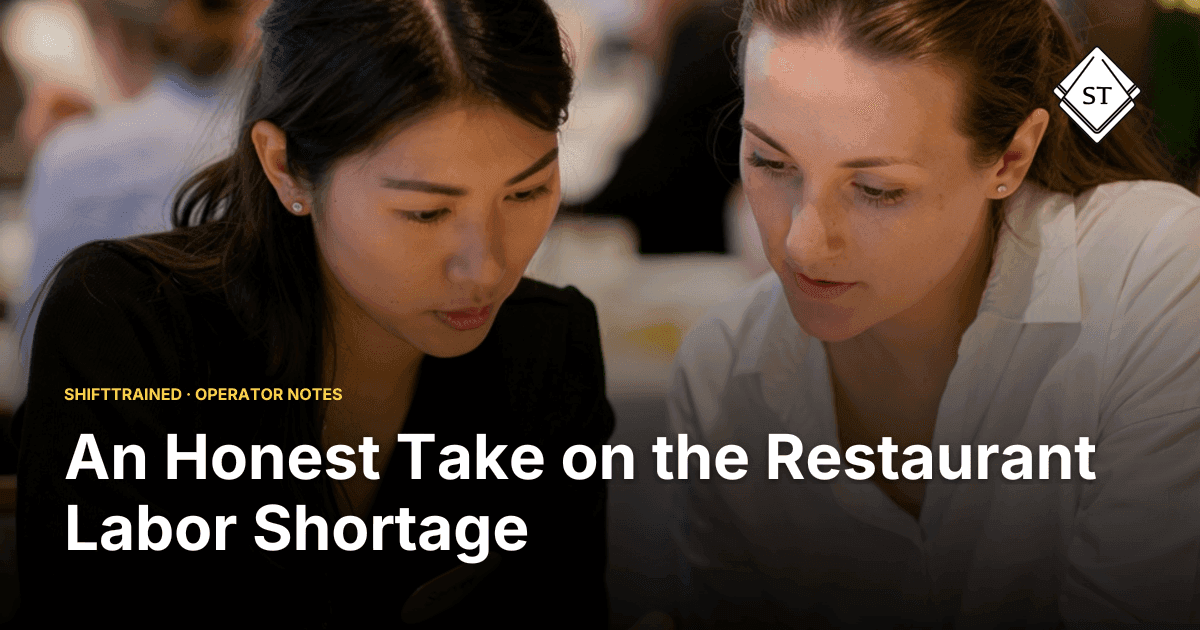
An Honest Take on the Restaurant Labor Shortage

Hey Team!
I keep seeing the same headline cycle through every trade publication. "Labor shortage." "Staffing crisis." "Nobody wants to work in restaurants anymore." And every time I read it, I think, that's not quite right.
Here's what I actually see in the industry after thirty years. It's not that workers are gone. It's that they leave. Fast, and often.
The National Restaurant Association puts annual turnover somewhere between 75 and 80 percent. That number gets thrown around so much it's almost lost its power to shock people. But think about what it means in practice. Walk into most restaurants right now and a significant chunk of the floor staff hasn't been there six months. Some haven't been there six weeks. The people who do want this job, who are good at this job, are leaving before they ever really get started.
So when owners tell me they can't find people, I push back gently. Are you sure you can't find them? Or are you just losing them before anyone notices?
That reframe matters because it points to a completely different solution. If the problem is hiring, you fix it with recruiting. Better ads, more job boards, sign-on bonuses. If the problem is retention, you fix it with the experience of working there. And the experience of working somewhere, especially in the first 60 days, is almost entirely shaped by training.
Cornell's School of Hotel Administration has studied this. Tracy and Hinkin put the cost of replacing a single hourly restaurant employee at around $5,864 when you factor in separation, recruitment, selection, and onboarding. That number is from a real study, not a back-of-napkin guess. Multiply it by even a few preventable departures a quarter and you're looking at serious money walking out the door.
I've lived this. At Fat Tommy's, years before I built the platform I run now, we'd hire someone, spend two shifts doing the traditional tag-along, hand them a laminated menu, and send them out on the floor. And they'd drown. Not because they weren't capable. Because we hadn't actually prepared them. We'd just hoped the job would teach itself.
What happens when a server drowns? They get flustered. They don't know the ingredients in the Italian beef. They can't confidently answer when a guest asks if something has nuts in it. They guess, or they go check, or they avoid the question altogether. And flustered servers don't perform well. They don't upsell. They don't build rapport. And because they don't do those things, their tips reflect it.
This is the piece nobody talks about. Tips are feedback. In real time, every shift. A server who walks out with $180 on a Friday night versus $80 isn't just making more money. They're getting a signal that they're good at this, that they belong here, that the job is worth doing. The server pocketing $80 because they couldn't describe the menu, couldn't explain the modifiers, couldn't answer a question about allergens, that person goes home discouraged. Maybe they pick up a shift at the place down the street. Maybe they don't come back.
Confidence is the thing training either builds or fails to build. And confidence on the floor is almost entirely about product knowledge. Can you describe this dish without reading off the menu? Do you know which sauces have dairy? Do you know what makes the cocktail program different from every other bar in the neighborhood? When you know the answers, you stand differently. You make eye contact. You make a recommendation instead of reciting a list. Guests feel that, and they tip accordingly.
At Black Barrel Tavern, we added a walnut sauce to one of the small plates a while back. Simple change on paper. But we've got guests with tree nut allergies in there regularly. The old way of handling that update was a quick mention at pre-shift and a hope that everyone caught it. The new way is that the update hits the training tool that day and staff actually gets quizzed on it before they're back on the floor. The difference isn't just about preventing an allergy incident, as critical as that is. It's that staff walks in knowing the answer already. They're confident. That confidence carries through the whole shift.
Now let me say something that's uncomfortable to admit. A lot of operators know training is broken. They know the tag-along method is hit or miss. They know the laminated menu doesn't cut it. But they stick with it because creating something better looks like a massive project. Building a training program used to mean someone sitting down for weeks writing questions, formatting documents, fighting with a learning management system that was designed for a corporate HR department, not a 40-cover bistro.
That's the real bottleneck. Not the desire to train better. The friction of doing it.
There's a reason I built ShiftTrained the way I did. I wanted to eliminate that friction completely. But that's a conversation for another day.
The point I want to leave you with is this. The labor market isn't a force of nature you have to accept. Turnover is driven by experience. Experience is driven by how prepared people feel on their first ten shifts. And how prepared they feel is almost entirely on us, the people who run these restaurants. We can blame the applicant pool, or we can look at what happens after someone says yes. One of those things we can control.
Start there.
Have a great day! — Terry Psaltakis
Your AI Restaurant Guy