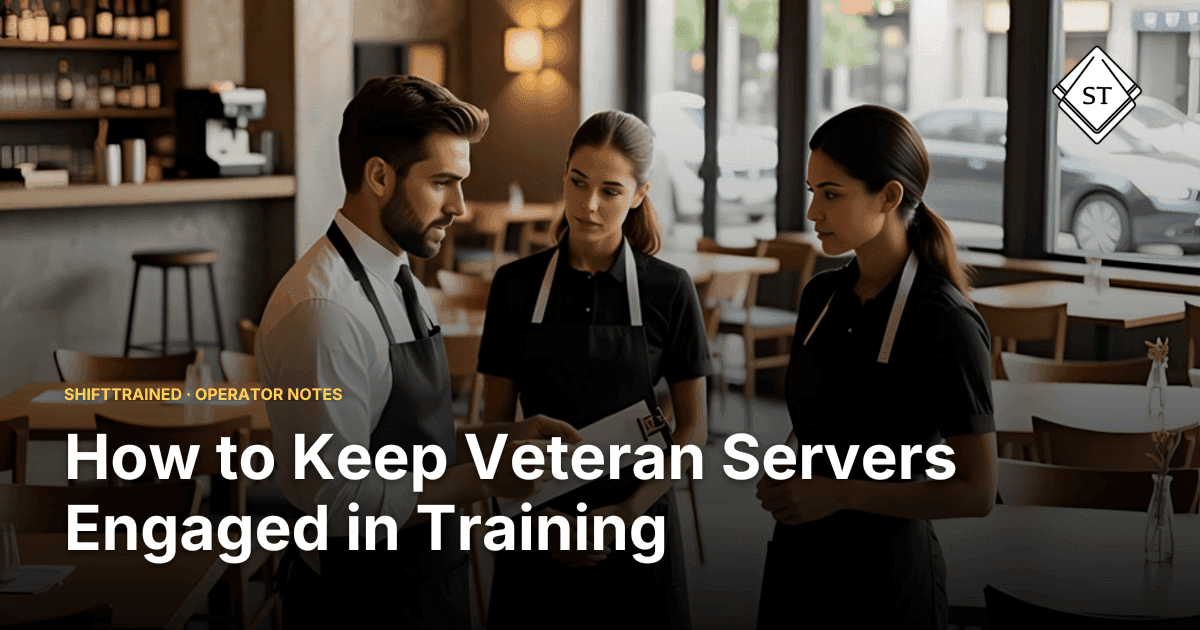
How to Keep Veteran Servers Engaged in Training

Hey Team!
Your best server has been running tables since before some of your line cooks got their driver's licenses. She knows the menu. She knows the regulars. She knows exactly when to drop the check without being asked. She's also, nine times out of ten, the person in your pre-shift who's mentally somewhere else the moment you say the word "training."
I get it. I was that employee once. And then I became the manager watching that employee, and then the owner who had to figure out what to do about that employee. After thirty years and twenty-plus concepts, here's what I know: your veteran isn't disengaged because she doesn't care. She's disengaged because you keep asking her to sit through something she already passed, five years ago, in a different building.
That's not an engagement problem. That's a design problem.
The gut instinct most operators have is to excuse veterans from training altogether. "She knows the menu. Let her do sidework while the new people run through it." I understand the logic, and it's wrong. Not because she doesn't know the menu. She probably does. But habits calcify. A server who's been running your caesar salad for four years has also been telling guests it contains anchovies in whatever shorthand she landed on in year one. Maybe that shorthand is accurate. Maybe it drifted. Maybe your supplier changed and now there's a new allergen consideration that nobody caught because she was skipping the refresher.
The other thing that happens with veterans who opt out: they become the shadow trainers. New hires don't learn from you. They learn from the person who's been there longest. If that person has a workaround, a shortcut, or a misconception that never got corrected, it spreads to every new hire they shadow. That's the real cost of letting the ten-year server coast through training. It's not her knowledge you're worried about. It's what she's passing down.
So the solution isn't more training. It's better-designed training that respects what she already knows while still holding her to the same standard as everyone else.
Here's where the leaderboard changes everything.
When training is a score, it stops being a lecture and becomes a competition. And veterans are, almost universally, competitive. They've built their identity around being good at this job. The moment there's a ranked score posted, the calculus shifts. Now it's not "I have to sit through this again." It's "I'm not letting the new guy beat me."
I watched this play out at Black Barrel Tavern. We pushed out a quiz refresh after we updated the craft beer list. New proteins, new descriptions, two new taps, updated pairings. The servers who'd been there four or five years were the first ones on the leaderboard. Not because we told them to care. Because there was a number next to their name and they weren't about to let it be lower than someone who'd been working tables for eight months.
The trick is that the leaderboard has to be visible to the whole team. Not just managers. When a veteran can see that a newer hire is sitting at 94% and she's at 88%, she retakes it. On her own. On her phone. Before her next shift. Nobody asked her to. The score asked her to.
This is also why the quiz content matters as much as the format. A ten-question quiz full of stuff she could answer in her sleep isn't going to reveal anything, and it's not going to create any urgency. You want questions at the edge of what she knows. The things that changed recently. The things that are genuinely tricky. The specific verbiage on a new dish. The updated prep notes on a dietary accommodation. The questions that make even a veteran stop and think, because those are the questions where drift actually happens.
When the content is genuinely sharp, a 90% doesn't feel like a pass. It feels like there's something she missed. And that's exactly the feeling you want.
The other thing I'd push on is frequency. Annual training refreshes are nearly useless for anyone, but they're especially useless for veterans. Monthly micro-quizzes on rotating content keep the competitive habit going, and they prevent the score from ever feeling too comfortable. Five questions, menu-specific, timed. Quick enough that nobody groans about it, substantial enough that it matters.
What I've seen work at a practical level: don't frame it as training, frame it as the standard. "We run scores monthly. Everyone participates." Not "even the veterans." Just everyone. It normalizes participation in a way that singling out new hires never does, and it takes away the implied insult that veteran participation sometimes carries, as though you're telling them they don't know their job. You're not. You're just running the same standard across the board, the way a good kitchen runs every line cook through the same mise en place check regardless of seniority.
The platform I built does a lot of the mechanical lifting here, generating the quizzes, hosting the leaderboard, letting staff take it on their phones between sections. But the underlying idea works whether you're using software or index cards. Compete the veteran. Don't lecture the veteran. Give her something worth defending, and she'll defend it by actually learning.
Your ten-year server is one of the most valuable people in your building. She's also the most likely to have a habit that hardened in 2019 and never got corrected. The leaderboard is how you fix the second thing without losing the first thing. That's the whole play.
Have a great day! — Terry Psaltakis
Your AI Restaurant Guy
For more on putting this into practice, see how ShiftTrained approaches menu training software.