Your Gluten-Free Menu Items Don't Matter If Your Staff Doesn't Understand Cross-Contact in the Kitchen

Hey Team!
A guest sits down at your bar on a Saturday night and asks if you have gluten-free options. Your server nods confidently, points to the little GF symbol on four items, and puts the order in. Back of house is running at full speed. Fryer baskets are rotating between your regular wings and your "gluten-free" naked wings. The pasta water has been boiling all night with flour residue floating on the surface. Someone just dusted the prep table with flour an hour ago and wiped it down, not scrubbed it.
That guest with celiac disease is about to have a very bad night.
And your restaurant is going to own that.
Here's what I've watched happen in this industry for thirty years. Operators add GF labels to their menus, print new menus, train the front of house to point at the symbols, and call it done. They genuinely believe they've done the right thing. Their intentions are good. But a label is not a system. A label is a promise. And if your kitchen can't keep that promise, the label is actually worse than nothing, because now you've built false confidence in a guest who really can't afford it.
The actual danger isn't the dish itself. Most celiac-unsafe situations in a restaurant kitchen have nothing to do with the recipe. They come from shared equipment. A fryer that cooks breaded items and naked items in the same oil is contaminated. Full stop. The oil carries gluten protein. A dedicated fryer, kept separate, managed separately, is what "gluten-free fried item" actually requires. Not a different recipe. A different piece of equipment with a different protocol.
Same goes for shared pasta water. I've been in dozens of kitchens where the cook drops gluten-free pasta into the same pot they just pulled wheat pasta out of. The water is murky with starch. The cook doesn't think twice because the pasta itself is rice-based. But celiac disease doesn't work on logic about ingredients. It works on exposure, and that water is loaded.
Flour is the sneaky one. In any kitchen doing baking, breading, or dredging, flour becomes airborne. It settles on surfaces, on prep containers, on the edges of sheet pans stacked nearby. A "clean" surface that got wiped but not sanitized after flour contact is still a contamination surface. Your staff needs to know this, not as a general concept, but as a specific practice with specific steps.
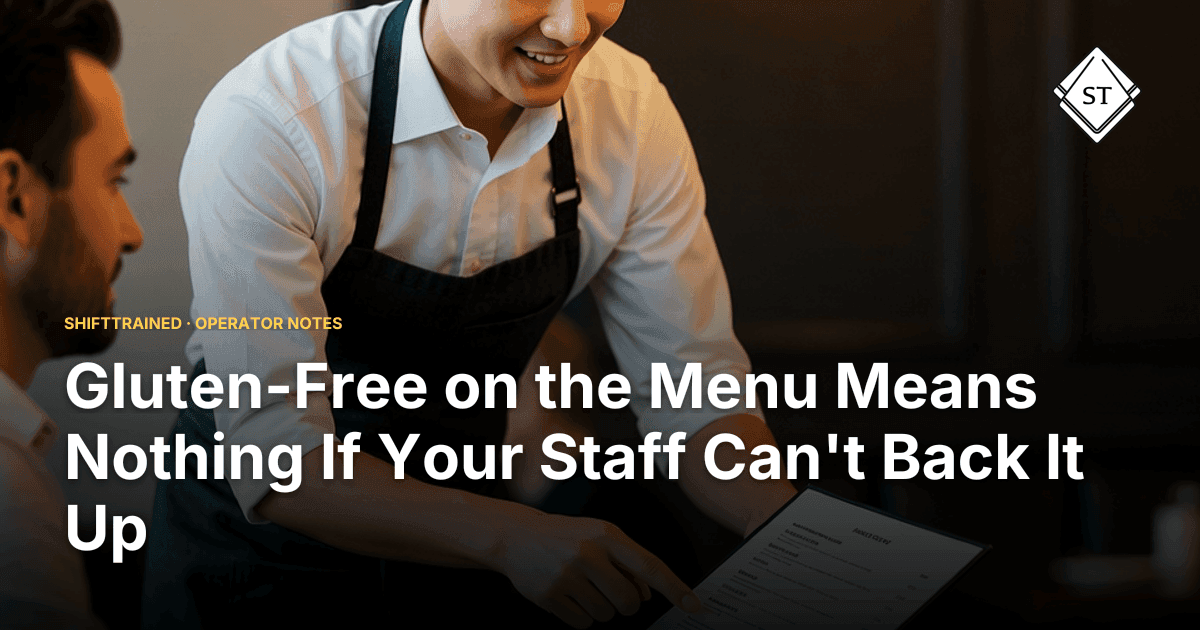
Now here's the part that actually matters for training. Most operators try to solve this problem by teaching servers to memorize the GF menu items. That's the wrong target. What you actually need is for your front of house to understand kitchen limitations well enough to have an honest conversation with a guest.
That conversation sounds like this: "We do have items labeled gluten-free, but I want to be upfront with you. Our kitchen shares fryer oil between gluten items and non-gluten items, so if you have celiac, I can't guarantee those are safe. We can do a few things, but I want to make sure I'm getting you accurate information before we order."
That server just protected a guest from getting sick. That server also protected your restaurant. More than that, they built real trust. A guest with celiac disease who gets that honest answer will come back. They will tell their friends. They know most restaurants don't bother to understand what they actually need, so when one does, it lands hard.
The guest who gets the confident nod, eats the contaminated food, and spends the next three days sick? They don't come back. They leave a review. And they should.
Training your staff to communicate kitchen limitations honestly is a harder ask than training them to point at a symbol. It requires that they actually understand what cross-contact is, what shared equipment means, and what questions to ask the kitchen before they make promises. It requires a culture where a server can say "I need to check on this" without feeling like they're slowing down the table.
At Fat Tommy's, we go through this in training specifically because we run a high-volume kitchen with shared equipment and we have to be honest about what that means. The standard isn't "here are our GF items." The standard is "here's what our kitchen can and can't guarantee, and here's how you tell a guest that clearly." Staff who can't explain cross-contact aren't ready to answer allergen questions. That's the bar.
If you want to actually serve celiac guests safely, you need dedicated equipment, written protocols for cross-contact prevention, and line staff who follow them every single service. If you don't have that yet, the right move is to train your front of house to say so. Not to keep pointing at the label and hoping.
The GF symbol on your menu is a promise your kitchen has to be able to keep. If it can't keep it, your staff needs to know that and say that. Honest communication beats a wrong answer every time, especially when the stakes are someone's health.
Know your kitchen. Train your staff to know it too.
Have a great day! — Terry Psaltakis
Your AI Restaurant Guy
For more on putting this into practice, see how ShiftTrained approaches the best menu training programs.