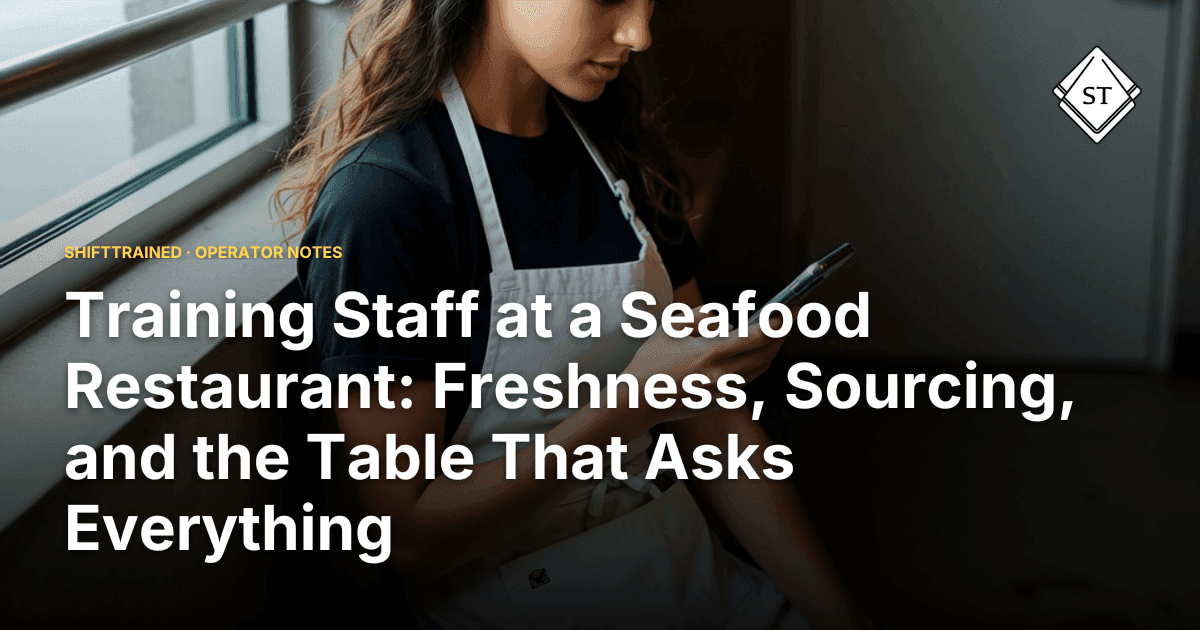
Training Staff at a Seafood Restaurant: Freshness, Sourcing, and the Table That Asks Everything

Hey Team!
You know that table. You've had that table. They sat down five minutes ago and before the server even sets down the bread, someone opens with "is the halibut fresh?" And that's just the warmup. By the time the server gets to the second chair, it's "where is it from?" Then chair three: "Is it wild or farmed?" Then the husband, almost apologetic: "My wife has a shellfish allergy, so we just want to make sure." And the wife, not apologetic at all: "Does the salmon have a strong fishy taste or is it mild?"
That server just got hit with five questions that require five completely different kinds of knowledge. In sixty seconds. On a Friday night with four other tables in their section.
If they're not ready, the whole table feels it. Not just the answer they stumble on. All of it. Confidence is a package deal. You hesitate on one and they start second-guessing everything.
Seafood restaurants are knowledge-intensive in a way that a burger joint or a pizza place just isn't. And I don't mean that as a knock on those concepts. I mean it as a real, structural fact about what you're asking your staff to carry. A server at a seafood restaurant needs to know freshness windows, sourcing origins, flavor profiles from mild to briny to rich, and the difference between a crustacean and a mollusk, all at the same time, all under pressure. That's a lot to hold.
The shellfish allergy piece alone should keep every seafood operator up at night. And here's the part most operators don't think about carefully enough: shellfish is not one thing. Crustaceans (shrimp, crab, lobster, crayfish) and mollusks (clams, oysters, scallops, mussels, squid) are classified separately by the FDA. Someone with a shellfish allergy may react to one and not the other, or they may react to both. But your server who learned "no shellfish" as a single rule is going to handle that table wrong. They'll either over-restrict and kill the experience, or under-restrict and put someone at risk. Neither is acceptable.
The sourcing story problem is different but just as real. Guests at a seafood restaurant are paying more. They know they're paying more. They want to feel like it's worth it. When a guest asks "where is this from?" and your server says "um, I think the Pacific?" that's not just a missed opportunity. It's a credibility hit that doesn't come back. But when your server says "this is Pacific halibut from Alaska, it comes in Tuesday and Thursday, we're mid-week so it came in yesterday", that's a guest who orders it confidently and tells their friends about the experience.
At Black Barrel Tavern, when we ran a rotating fish special, I watched the servers who actually knew the sourcing story outsell the ones who didn't by a margin that wasn't even close. Not because they were better salespeople. Because knowledge reads as confidence, and confidence is what sells a $42 piece of fish.
Flavor profiling is the third layer. "Is it fishy?" is the question guests are usually too embarrassed to ask, so they ask it sideways: "Is it mild?" "What does it taste like?" If your server's answer is "it's really good" or "it's one of our most popular items," you've just lost the sale for the guest who was actually worried about a strong flavor. But if your server can say "halibut is very mild, almost buttery, it's one of the least 'fishy' fish we have", that guest orders it and loves it.
The problem in most kitchens isn't that the knowledge doesn't exist. It does. The chef knows exactly where every fish came from and why. The issue is the transfer. How do you get what lives in the chef's head into the server's head before Saturday service?
The old answer was pre-shift line-ups and printed spec sheets. And look, I've done both for thirty years. They're not worthless. But a five-minute pre-shift doesn't make information stick. A spec sheet that lives in the office gets forgotten after day two. What you actually need is repetition, retrieval practice specifically, the kind where the server has to pull the answer from their own memory rather than just reading it again.
That's the whole idea behind what I built with ShiftTrained. Upload the menu, the platform generates quiz questions in minutes, staff takes them on their phones between sections or before they clock in. But the deeper point isn't about the tool. It's about the methodology. Testing is learning. Every food science researcher who has looked at this says the same thing. Reading something once doesn't make it retrievable under pressure. Being asked to recall it does. That's what a server needs at 7pm on a Saturday: not that they read the spec sheet, but that they can retrieve the answer fast and say it with confidence.
For seafood specifically, this means drilling on crustacean vs. mollusk distinctions until they're automatic. It means running sourcing questions by fish name until the server doesn't have to think. It means quizzing flavor profiles so the server can describe the halibut differently than the swordfish differently than the branzino without pausing.
The table that asks everything is a gift if your staff is ready for it. That's the table that becomes a regular. That's the table that spends more, tips better, and tells two friends. The only thing standing between your server and a great outcome with that table is whether you put the knowledge in their head before they walked on the floor.
That part is on us as operators. Not on them.
Have a great day! — Terry Psaltakis
Your AI Restaurant Guy