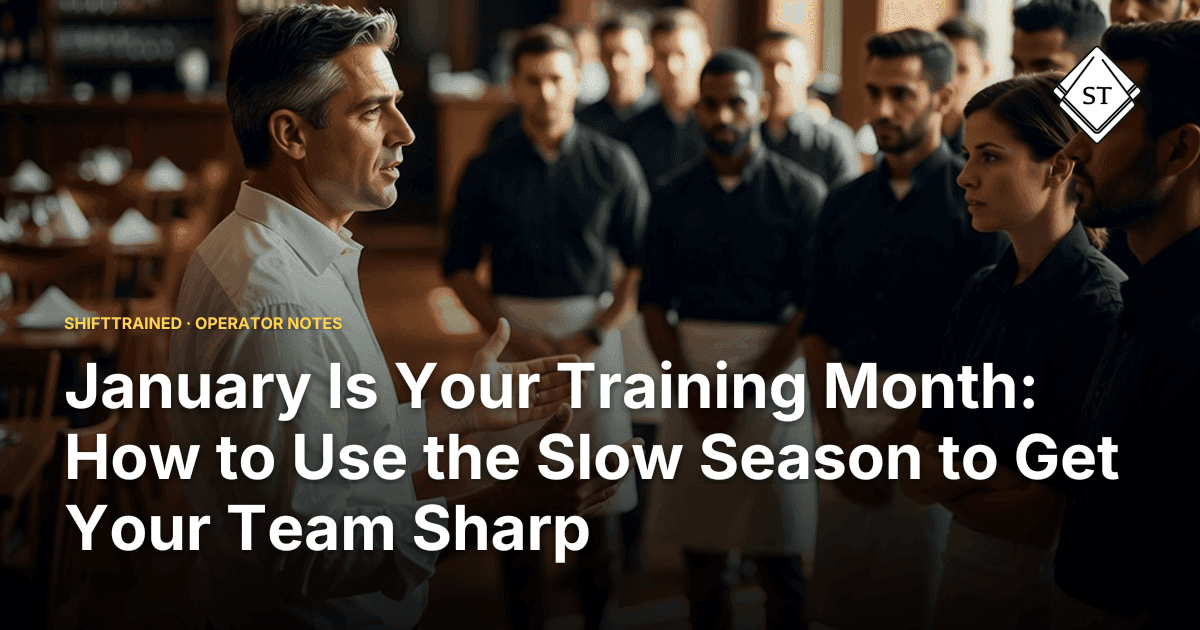
January Is Your Training Month: How to Use the Slow Season to Get Your Team Sharp

Hey Team!
January is your best training month of the year. The covers are down, the pressure is off, and you've got the time to actually fix things instead of just surviving the next rush.
Most operators I know treat January like a holding pattern. They're watching the numbers, cutting hours, waiting for February. I get it. But I wasted too many slow Januaries that way. Thirty years in this business taught me that the operators who come out of winter sharp are the ones who treated the slow season like a gift, not a wound.
Here's how I think about it. Your team just came off the holidays. They're tired, they've been running on adrenaline, and half of them have been guessing on menu questions for two months because nobody had time to retrain during December. January is the first moment you've had since fall to actually sit with your people and get everybody on the same page.
So let me walk you through a four-week approach that I've used, refined, and now built into how we operate.
Week one is a full menu reset. I mean a full one. Don't assume your servers can describe your top ten items with any real accuracy right now. Ask them. You'll be surprised. Pull out your menu and go through every item, allergens and all. Gluten questions, tree nut questions, dairy substitutions. Your staff should be able to answer those in their sleep, and odds are some of them can't. This is the week to fix that. At ShiftTrained, I built the platform specifically so you can upload your menu PDF and have a full quiz set ready in minutes, because I got tired of writing questions by hand on Sunday nights. However you do it, get the questions built and get your team through them before week two starts.
Week two is for your slow scorers. Every training round surfaces somebody who's guessing more than they know. Don't let it slide. This is the week to sit with those staff members individually and figure out what's actually going on. Is it a comprehension issue? A language barrier? Did they just click through without reading? The answer changes your approach. Sometimes it's ten minutes of coaching. Sometimes it's a conversation about whether this role is the right fit. Either way, January is the time to have it, not during a Friday dinner rush in March.
Week three is cross-training. This is the one most operators skip, and I think it's the biggest missed opportunity of the slow season. Take your hosts and put them through busser training. Take your bussers and walk them through a full table-turn alongside a server. Take a server who's expressed interest and let them shadow the bar for a couple of shifts. Cross-training does two things. It gives you flexibility when you're short-staffed (which will happen), and it makes people better at their own jobs because they finally understand what the person next to them is doing all day. A host who's never bussed a table has no instinct for when a section is falling behind. A server who's never stood behind the bar doesn't understand why a drink takes four minutes during a rush. Cross-training fixes that.
Week four is about what's coming next. If you're rolling a spring menu in March or April, your January team meeting is where you start laying groundwork. Share the direction. Let people ask questions. If you've got new proteins, new prep methods, new dietary options coming, your staff needs lead time to internalize them. I've made the mistake of dropping a menu change on a team two days before launch and watching them fumble through it for three weeks. Rollouts land better when staff have had time to sit with the information, even loosely, before they have to sell it.
One more thing I want to name, because I see operators miss this every year. January is also when you find out who your keepers are. The people who show up to optional training on a Tuesday afternoon in January, who retake the quiz because they want a better score, who ask questions during cross-training because they're actually curious. Those are your future shift leads. You're not going to spot them during a Saturday night in November when everyone's just trying to survive. You spot them in January when there's no adrenaline forcing the issue and effort is actually voluntary.
The Cornell research on restaurant turnover puts replacement cost at close to $5,864 per employee. The National Restaurant Association puts industry turnover in the 75 to 80 percent range. Those numbers never surprised me. What surprised me was realizing how much of that turnover is preventable, not by paying more (though that helps), but by making people feel competent and connected to what they're doing. A server who knows your menu cold, who understands the kitchen's flow, who's been trusted with cross-training carries themselves differently. They stay longer. They bring others up with them.
January won't be slow forever. February picks up. March picks up faster. And by the time your spring menu drops, you want a team that's sharp, confident, and already fluent in what they're selling. Four weeks. A menu reset, retesting your weak spots, cross-training across roles, and a head start on spring. That's the whole plan.
Use the slow season like it's the offseason, because it is.
Have a great day! — Terry Psaltakis
Your AI Restaurant Guy
For more on putting this into practice, see how ShiftTrained approaches a menu training app.