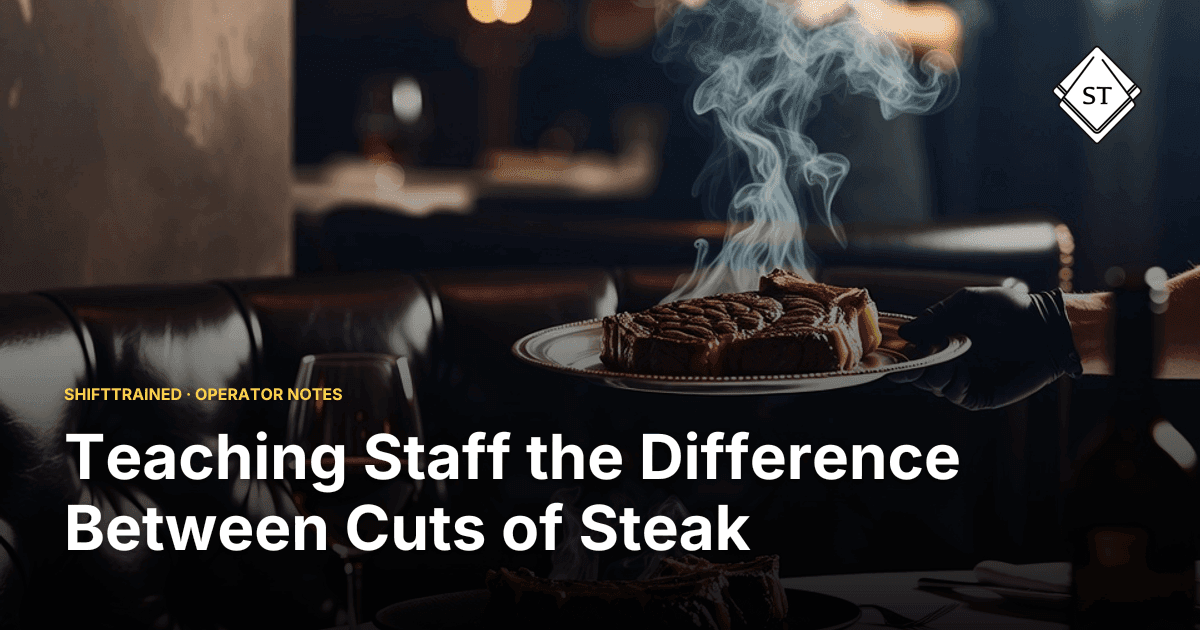
Teaching Staff the Difference Between Cuts of Steak

Hey Team!
A guest sits down at your best table on a Friday night, looks up from the menu, and asks your server: "What's the difference between the ribeye and the filet?" And your server says, "They're both really good.", or worse yet "Ummm, about $4." That answer just cost you the table's trust. Maybe it cost you the upsell. Definitely cost you a shot at a return visit.
Steak knowledge is one of those things operators assume servers will pick up by osmosis. Watch a few steaks go out. Read the menu. Figure it out. And some do. But a lot of servers are quietly guessing for months, hoping the guest doesn't ask a follow-up question.
Here's what I know from running steakhouse and bar concepts for thirty years: if you drill the right five facts per cut, your servers can answer any table question with real confidence. Not a recitation. Confidence. There's a difference.
So let me walk you through the cuts your staff actually needs to own, and the facts that matter per cut.
The ribeye is where you start. It comes from the rib section, which is one of the least-worked muscles on the animal. That's why it has all that intramuscular fat, the marbling you can see running through the meat. Fat carries flavor. A ribeye is going to be rich, beefy, and intense. Your servers need to be able to say that in plain language: "It's the most flavorful cut we carry. The fat content is what makes it taste that way." Perfect temp is medium-rare to medium. Go above that and you render out the fat, and you've wasted what makes the cut special.
The filet mignon is the other end of the spectrum. It's cut from the tenderloin, the psoas muscle, which does almost no work at all. That's why it's so tender. A sharp steak knife feels like overkill. But here's the tradeoff, and your servers need to say this honestly: tenderness and flavor don't always live together. The filet is mild. Buttery texture, but a lighter beef flavor than a ribeye. Guests who order filet are usually choosing texture over intensity. Recommended temp is medium-rare. It's a lean cut, so it dries out fast above medium.
The New York strip is the cut that gets undersold. It comes from the short loin, which is a moderately worked muscle, so you get more structure and chew than a filet but a cleaner finish than a ribeye. There's a fat cap on the outside that bastes the meat as it cooks. The strip is what I'd call the "steak drinker's steak" because it pairs beautifully with a big red wine. Servers should describe it as firm, flavorful, and leaner than a ribeye without going as mild as a filet. Medium-rare is the sweet spot.
The T-bone and porterhouse are the same basic idea. You have a bone down the middle with strip on one side and tenderloin on the other. The difference between the two is just the size of the tenderloin section. A porterhouse has a larger tenderloin and requires a bigger cut of beef to produce, which is why it runs bigger and costs more. For servers, the most useful talking point is this: "You're getting two experiences in one cut." The challenge is cooking them evenly because the strip and the tenderloin hit their ideal temps at slightly different rates. Your servers don't need to explain the physics, but they should know that these cuts are best ordered medium-rare and that the kitchen is paying attention to placement on the grill.
The tomahawk deserves a mention because guests ask about it constantly. It's a ribeye with an extended rib bone left intact, usually 6 to 8 inches of bone. It's a presentation cut as much as anything else. The flavor profile is identical to a ribeye. Your server's job with the tomahawk is mostly about the experience: the size, the tableside moment, the shareable nature. They should know it's not a different animal than the ribeye. Same marbling, same flavor, same recommended temps.
Now let me tell you how to actually drill this stuff into your team.
Reading a description and remembering it in the weeds of a Saturday service are two different things. The way I've seen this stick is through repetition under mild pressure. Flash-card style quizzing on specifics: "Name the muscle the filet comes from." "What temp do you recommend for a ribeye and why?" "Guest says they want the most tender cut on the menu, what do you say?" Questions that require a real answer, not a yes or no. You're training servers to access information quickly because that's the actual job, answering a guest question in real time without looking nervous.
At Fat Tommy's, before we had a system to manage this, I was doing verbal pre-shifts at every table turnover. It worked okay but it was inconsistent. The servers who worked a lot of shifts got more reps. The part-timers fell behind. The platform I built solves exactly that problem by generating quiz questions straight from whatever menu you upload and letting staff run through them on their phones between shifts or before they clock in. But the principle is the same whether you're doing it on a phone or standing at the server station with index cards: repetition, then retrieval. That's how it sticks.
One more thing worth saying. Guests who ask about steak cuts aren't usually trying to quiz your staff. They're trying to decide. A server who can say "If you love big, beefy flavor and you're okay with a richer bite, the ribeye is your cut. If you want something incredibly tender and a little lighter, go filet" has done something useful. They've made the guest feel like they're in good hands. That's the job. Train your people to do that job, and the upsells will follow.
Have a great day! — Terry Psaltakis
Your AI Restaurant Guy
For more on putting this into practice, see how ShiftTrained approaches a menu training app.