Training Staff at a Neighborhood Bar That Serves Food

Hey Team!
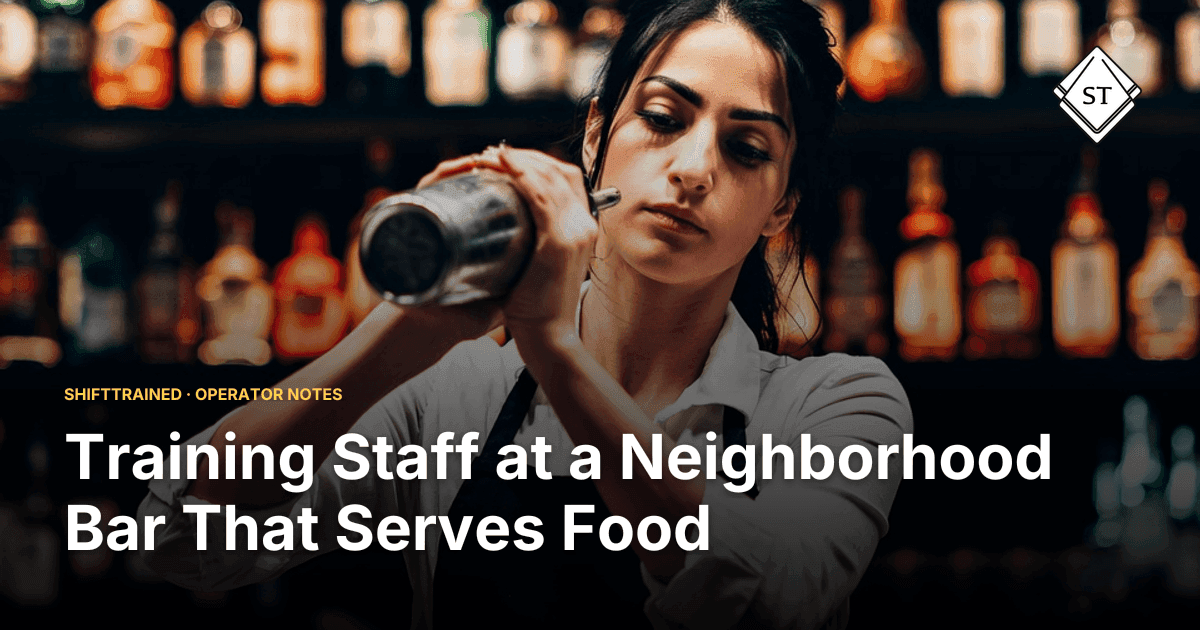
Friday at 9pm, the bar is packed, college football on six screens, and a woman leans over the rail and asks your bartender whether the bar pretzels are cooked in the same fryer as the chicken tenders. Your bartender has been slinging drinks for four years. He's great. He doesn't know. He guesses.
That's the moment I want to talk about.
A lot of neighborhood bars added a kitchen somewhere along the way. Maybe it was a build-out, maybe it was a ghost kitchen setup, maybe it was just a hot plate and a fryer in the back that turned into an actual menu over time. The food side grew organically, and training grew organically too, which usually means it didn't really grow at all. The cooks know the food. The bartenders know the drinks. And nobody thought very hard about what happens when the bartender is the one getting asked.
Most bars I've seen handle this by telling the bartenders to "go ask the kitchen." That's not a bad answer when there's one person at the bar and the kitchen isn't slammed. It falls apart completely on a Friday night when there's a 40-minute ticket time and the kitchen isn't picking up the window radio. The bartender is standing there, the guest is waiting, and the path of least resistance is to say "yeah, I think it's fine." That's how you end up with a liability situation and a very sick guest.
The part that's genuinely fixable here is that bar food menus are short. Most neighborhood bars serve maybe 10 to 15 food items. Wings, pretzels, nachos, a burger, some kind of loaded fries, maybe a flatbread. It's not a 40-course tasting menu. There's no reason a bartender needs more than 20 minutes of focused attention to learn which items share a fryer, which things have gluten, whether the queso has dairy, whether the burger bun is sesame. This isn't culinary school. It's five specific facts per item, and most of those items share answers.
What doesn't work is handing someone a laminated sheet during onboarding and calling it food training. They read it once. They don't retain it. And you have no idea what they actually know. I've watched this play out dozens of times in my own places over the years. You hand someone paper, they nod, and six weeks later they're guessing at allergen questions just like they were before. The information passed through their eyes and didn't stick.
What works is repetition in small doses. Short quizzes. Real questions about real menu items. Not "what are the eight major allergens" in the abstract, but "does the Buffalo dip contain dairy" and "which fryer runs the mozzarella sticks." Contextual, specific, tied to what they're actually going to be asked at 9pm on a Friday. When someone gets a question wrong, they find out immediately and they see the right answer. That's how it gets into memory. Not from reading a sheet, but from being wrong about something and having to correct it.
The resistance I hear from bar operators is usually some version of "my bartenders won't do it." And I get that. Nobody wants to sit through a two-hour food certification class when they showed up to make drinks. But there's a real difference between assigning a 90-minute training module and texting someone a 10-question quiz on their phone between shifts. The second one actually happens. I know this because I've watched it happen at my own bar. People take the quizzes voluntarily. Some of them retake to beat their own score. That's not because training is fun in some abstract sense. It's because it's short, it's on their phone, and it doesn't feel like homework.
The allergen piece is the most urgent reason to close this gap, but it's not the only one. A bartender who knows the food menu sells more food. When someone sitting at the bar asks what's good to eat, a bartender who can say "the loaded fries are ridiculous, they come with smoked brisket on top" is going to ring more tickets than one who says "I don't really know, I just do drinks." That's real money, night after night. And it builds a different kind of experience at the bar. The guest feels like they're talking to someone who actually works there, not just someone standing behind the counter.
There's also staff confidence. Bartenders who don't know the food menu know they don't know it. They feel it when someone asks. It creates this small anxiety that's unnecessary and fixable. When you give them the information in a format that actually sticks, they stop dreading food questions. They answer them. That's a better shift for everyone.
Now I want to be clear about the scope of what I'm talking about. A short food quiz for your bartenders doesn't replace having a proper allergen protocol on the kitchen side, doesn't replace your manager knowing how to handle a serious allergy situation, and doesn't turn your bartenders into food handlers. It closes the gap that exists right now, tonight, where a bartender at a busy neighborhood bar is guessing at a question they shouldn't be guessing at. It's a floor, not a ceiling.
If you run a bar that serves food and your bartenders have never been quizzed on the menu, that's the gap. It's not dramatic to fix. You don't need a training department. You need 15 focused questions, on their phones, before the weekend shift. Do that consistently for a month and see what changes.
Have a great day! — Terry Psaltakis
Your AI Restaurant Guy
For more on putting this into practice, see how ShiftTrained approaches restaurant training software.