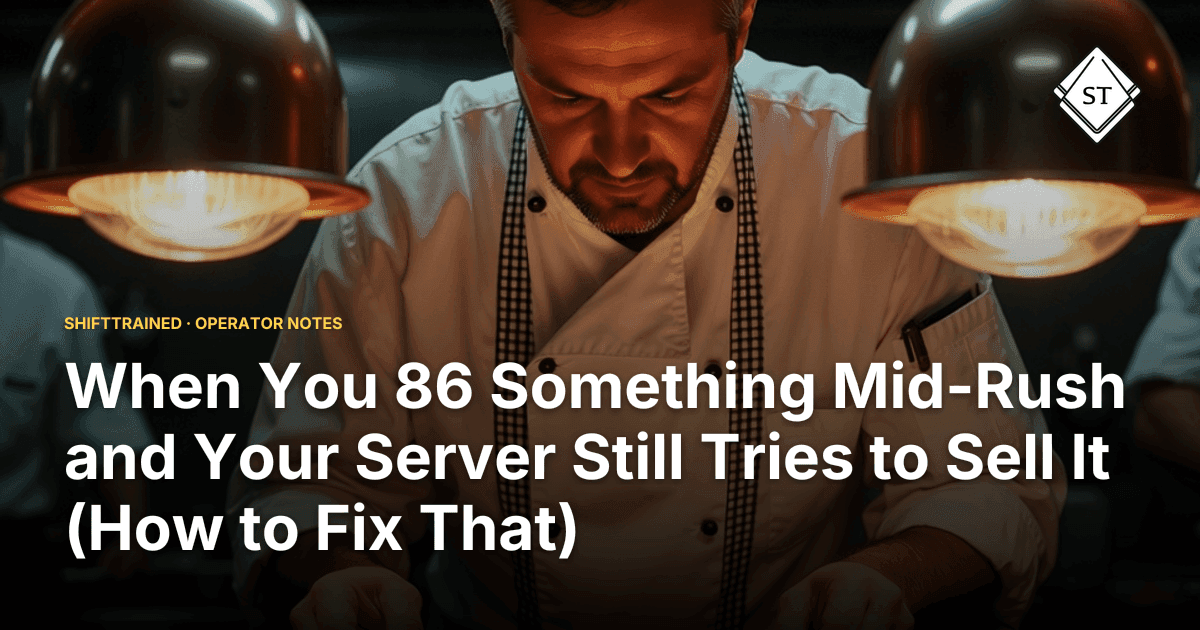
When You 86 Something Mid-Rush and Your Server Still Tries to Sell It (How to Fix That)

Hey Team!
Saturday night at 7:45. You're in the weeds. The kitchen burns through the last of the short rib, the expediter shouts the 86, your POS updates in ten seconds, and you think you're covered. Then table 14 orders the short rib. Then table 22. Then a guy at the bar who "already decided."
Every single one of those servers heard the same POS chime. Not one of them pivoted.
This is the moment that breaks your flow, backs up your kitchen, and sends a guest home mildly annoyed at something they can't quite put their finger on. The server didn't do anything wrong, exactly. They just didn't know what to do next. So they defaulted to the last thing they remembered talking about, which was the dish you just ran out of.
Here's what I've watched operators do wrong for thirty years: they treat an 86 like a communication problem. So they add more communication. A second chime. A manager announcement over the headset. A sticky note on the expo window. And then they're baffled when it happens again next Saturday.
The broadcast isn't the problem. The broadcast is fine. The problem is that your staff has no trained reflex for what comes after the broadcast. They know the item is gone. They just have no idea what to say instead, and they're standing at a table right now.
Think about what that moment actually feels like for a server. They've been selling the short rib all night. The guest is locked in. The server goes back to the table to say it's 86'd, and suddenly they need to redirect a disappointed person toward something equally appealing, on the spot, with four other tables watching their section. That's a hard pivot with zero preparation. Most servers will either stumble through a generic "the kitchen recommends..." filler that sounds hollow, or they'll just apologize and hand the menu back. Neither one sells anything.
What actually fixes this is training the redirect, not just the 86 itself.
That means before service, or better yet in the week before a busy weekend, your staff should already know: if the short rib disappears, here's the play. Not a vague "suggest something similar." A specific sentence. "If you loved the sound of the short rib, the brisket burger runs with the same kind of low-and-slow flavor, and it's what our kitchen is proudest of tonight." That's a pivot a server can actually use. It doesn't sound like damage control. It sounds like knowledge.
This is where I see the training gap most clearly. Pre-shift covers what's on the menu. It almost never covers what to do when something comes off it. Those are two different skills, and only one of them gets practiced.
The fix isn't a longer pre-shift. Your staff is standing in a side station eating family meal and half-listening anyway. The fix is giving them low-stakes repetitions in advance, so the redirect is automatic when the pressure hits. Phone-based micro-drills are exactly right for this. Ten questions on their phone before a Friday shift, one of which says: "The Nashville hot chicken is 86'd at 6pm. A guest already told their friends about it. What's your pivot?" And there's a right answer. They see it, they repeat it, they walk into service having already thought through the scenario.
This is what we built into ShiftTrained. The AI generates those scenario questions directly from your menu, and you can build in that "if this is gone, sell this" logic as part of the quiz bank. Staff run through it on their phones between tasks or on the bus to work. By the time they're on the floor, the 86 redirect isn't a problem they're solving in real time. It's a reflex they already trained.
But even if you're not using any software at all, you can do a version of this right now. Take your five highest-volume items. For each one, write a single sentence pivot. Something specific, something that names the replacement and gives a reason. Print it. Put it in pre-shift. Quiz your staff on it verbally, three nights in a row. The fourth night, watch what happens when you actually 86 one of those items.
I've done this at Black Barrel, and the difference is visible. The server doesn't freeze. They nod, they turn back to the table, and they use the pivot. The guest usually doesn't even register that anything went wrong. That's the goal. Not to hide the 86, but to make the recovery so smooth that the guest experience keeps moving forward.
The operators who get this right treat 86 pivots as a trained skill, not a broadcasting problem. They know that you can ring every bell in the building and a staff member who's never rehearsed the redirect will still stumble. Preparation isn't about more noise. It's about putting the right words in the right mouths before service even starts.
Next time something runs out mid-rush, watch what your servers actually say. If you're hearing a lot of apologies and menu hand-backs, you don't have a communication problem. You have a training gap. And that one's fixable.
Have a great day! — Terry Psaltakis
Your AI Restaurant Guy
For more on putting this into practice, see how ShiftTrained approaches the best menu training programs.