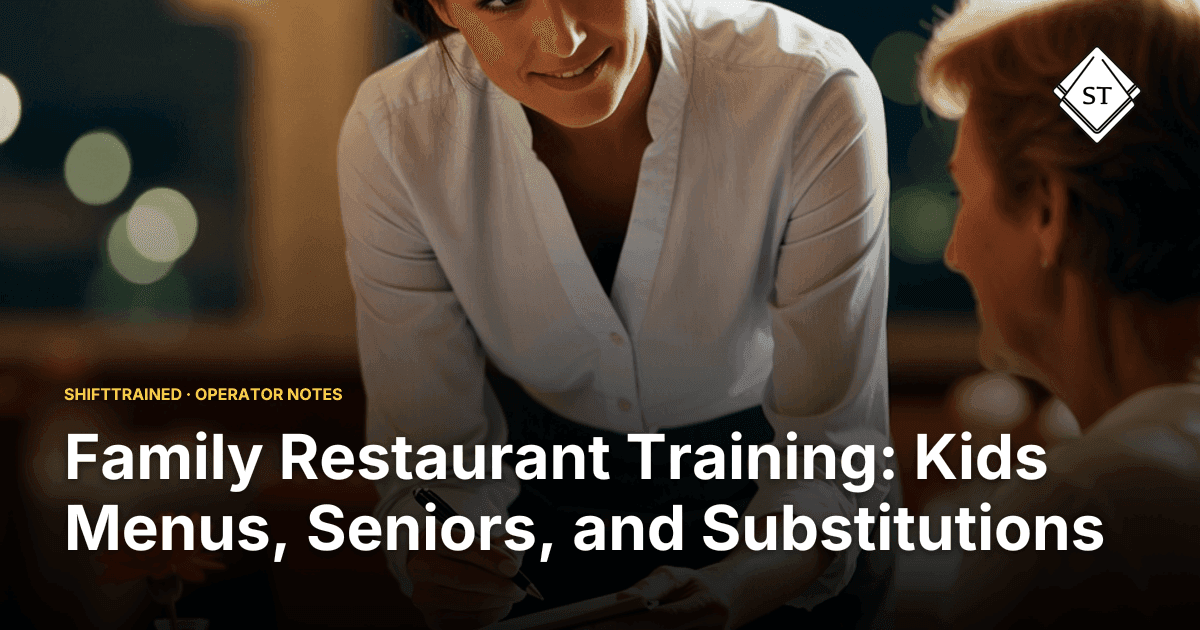
Family Restaurant Training: Kids Menus, Seniors, and Substitutions

Hey Team!
Family restaurants run on the same forty questions every week. You know them before I even say them. "Can you do that without onions?" "Is there dairy in the mac and cheese?" "Do you have a half portion of the pasta for my mom?" "What comes with the kids meal, can we swap the fries for fruit?" Same questions, Sunday after Sunday, table after table. The difference between a great family spot and a frustrating one isn't the food. It's whether your servers can answer those questions without flinching.
I've been in rooms with operators who spend real money on menu design, interior work, kids activity kits, all of it, and then put a 19-year-old server in front of a table of six with a grandmother, two parents, and three kids under eight, and that server has no idea what's actually in the mac. That's where it falls apart. Not on the food. On the moment someone asks a simple question and gets "let me go check."
That pause costs you. Not just the table's patience. It costs you the return visit.
Family restaurants live on regulars. That's not sentiment, that's the math. A family that comes in twice a month is worth more than ten one-time covers. And regulars come back because they feel known. They feel like the staff understands them. That feeling starts with fast, confident answers to the questions they've been asking since the first time they walked in.
So here's what I think about when I look at family restaurant training. It's not sophisticated. It's inventory.
Start by writing down the actual forty questions your guests ask. Not theoretical guest questions. Walk your floor on a busy Saturday lunch, ask your most experienced server to dictate them to you, pull your comment cards. You're going to find the same list every time. What's in the kids mac? Can we do a half order? Does the soup have gluten? Can she get the senior discount on the pasta? What's the smallest portion of the burger? My grandson has a nut allergy, what can he have?
Those are your training targets. Not the whole menu. Those forty questions.
Then you build the answers and you drill them. Every server needs to know, from memory, what dairy is in which kids item. Every server needs to know your substitution policy cold, not just that "we can sometimes do substitutions" but exactly what you'll swap and what you won't. Half portions, senior pricing, split plates, sides that can come out of a meal, items that can be modified for allergies. All of it written down and committed to memory.
The allergen piece matters more than operators sometimes realize. A grandmother's birthday dinner that ends in an allergic reaction isn't just a bad night. It's a lawsuit and it's a family that never comes back and tells everyone they know. Your servers don't need to be dietitians but they absolutely need to know which items contain the top allergens and they need to know to say "let me get you the exact ingredient list" instead of guessing. Guessing is worse than not knowing. Train them on the difference.
Now the seniors piece specifically. A lot of family restaurants have seniors who come in three, four times a week. They're your most loyal guests and they have consistent, predictable needs. Smaller portions. Softer textures sometimes. Sensitivity to sodium and spice. They want their coffee hot and they want it fast. They want to feel respected, not rushed, and not condescended to. Training your team on how to read and serve an older guest is as practical as training them on the POS. It's not soft skills fluff. It's table management for your most loyal demographic.
I watch servers sometimes over-explain to older guests. Or they slow down their speech in a weird way. It comes across as patronizing and the guest feels it immediately. Train your team to just be normal, attentive, and specific. "The portion on that is pretty generous, Mrs. Patterson, would you like me to put in a half portion?" is ten times better than hovering nervously at the table.
The kids menu training runs the other direction. Parents are not embarrassed to ask hard questions about their kids' food. They will ask you exactly what's in something and they want the real answer, not an approximation. Train your servers to own it. If it's box mac with a specific brand of cheese powder, say so. If the chicken tenders are fried in shared oil, say so. Parents appreciate honesty a lot more than vague reassurance.
What actually works for getting all of this into your team's heads is repetition at the right moment. Pre-shift is good. A quick quiz on your three most-asked substitution questions before service starts keeps the information active. The platform I built does this automatically, it pulls from your actual menu and generates the questions, and staff can take them on their phones between tables if they want. But the method matters less than the repetition. Whatever tool you use, the knowledge has to get drilled until the answers come out fast and clean.
Fast and clean is the goal. Not because it impresses guests intellectually, but because confidence is warm. When your server answers "does that have dairy in it?" without a pause, without a trip to the kitchen, without a nervous face, the whole table relaxes. And when the whole table relaxes, they order more, they stay longer, they come back.
That's family restaurant training. Know your forty questions. Know your answers. Drill until it's automatic. Everything else is secondary.
Have a great day! — Terry Psaltakis
Your AI Restaurant Guy
For more on putting this into practice, see how ShiftTrained approaches the best menu training programs.