Guests Are Asking for Pairing Recommendations — Half Your Staff Is Winging It

Hey Team!
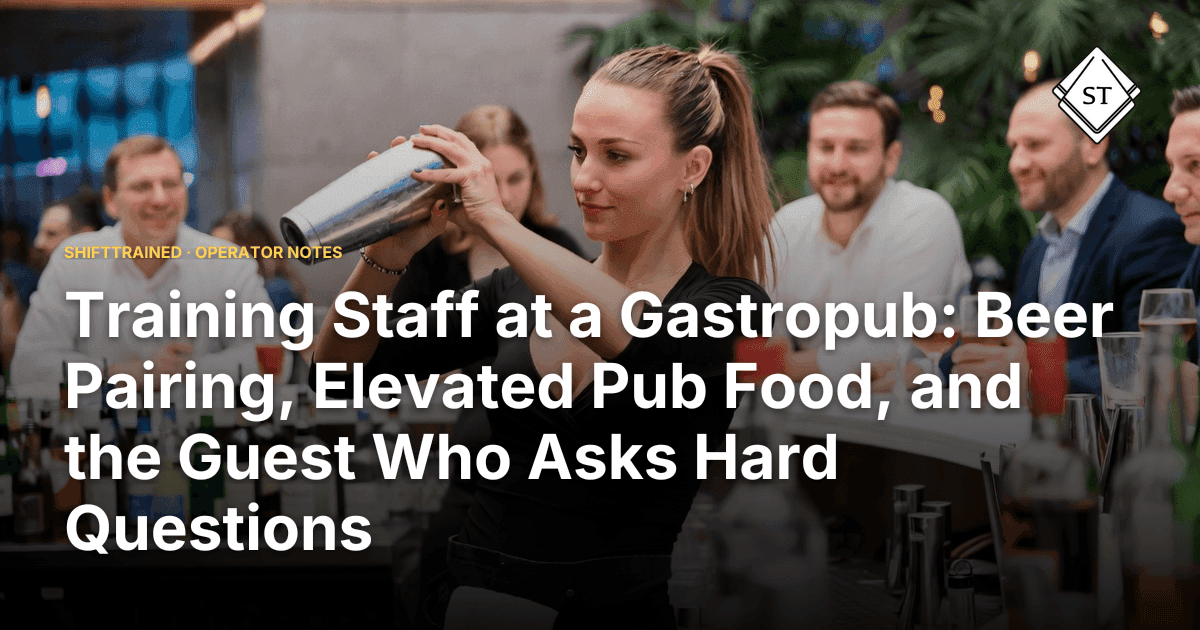
Saturday night, 7pm. Four-top, first time in your place. They're looking at the menu, one of them looks up at the server and says, "What would you pair with the brisket flatbread?" And the server says, "Oh, the Cab is really popular."
That's it. That's the whole answer.
The table nods, orders the Cab, and that moment is over. But here's what actually happened: a guest asked for guidance, the server didn't have any, and a real revenue opportunity just walked out the door. Not because the server is bad at their job. Because nobody ever taught them how to answer that question with any confidence.
Pairing questions are live revenue moments. A guest who asks for a recommendation is already willing to spend more. They're not browsing, they're buying. They want to be pointed somewhere. A server who can say "the smoked porter cuts through that brisket fat really well, you'll get a good contrast there" has just done two things: built trust and moved a higher-margin item. A server who says "the Cab is popular" has done neither.
The fix isn't a laminated chart at the host stand. It's not a PDF they read once during onboarding. It's knowing five pairings cold, the way they know their own name.
Here are the five I'd put in front of any team regardless of your concept. You'll adjust to your menu, but the logic is the same.
Burgers and lagers. This one's almost too easy, but half your staff still defaults to "whatever beer they want." A cold, clean lager cuts the fat in ground beef, resets the palate between bites, and keeps the whole experience lighter. That's a thing they can say. "The lager is going to cut right through that beef, nothing gets in the way of the flavor." That's a recommendation.
Spicy food and something sweet or low-bitterness. Wings with a good IPA is a common recommendation and it's actually pretty rough because the bitterness amplifies heat. A wheat beer, a hard cider, or a light lemonade cocktail is going to cool that down. Teaching your staff this one counterintuitive truth makes them look knowledgeable immediately.
Fried food and sparkling or acidic drinks. French fries, fried chicken tenders, onion rings. The bubbles and acid in sparkling water, a dry cider, or a crisp white wine cut the grease and keep the palate from going flat. "The cider will keep your palate fresh through the whole plate" is a sentence your staff can memorize and use tonight.
Rich, saucy proteins and bold reds. Pulled pork, beef short rib, anything braised heavy. This is where the Cab actually earns its spot. But your server needs to be able to say *why*, even if it's just "something with enough body to stand up to that sauce without getting lost." That's the difference between an order and an experience.
Chocolate or rich dessert and coffee or a dark spirit. An espresso martini with a brownie sundae, a pour of bourbon alongside a slice of chocolate cake. It works because the bitterness in both plays off the sweetness. Your dessert ticket average goes up when someone makes that connection at the table instead of after the check drops.
Five pairings. That's the list. Not twenty-five, not a wall of text. Five things your team knows so well they can say them without thinking.
Now here's the part nobody does. You have to drill these out loud, not on paper. Pairing knowledge that lives in a handout doesn't transfer to a table conversation. It has to live in their mouth.
The format I use is simple. Pre-shift, five minutes, one server per pairing. "You're the guest, I'm the server. Ask me what goes with the BBQ chicken flatbread." They ask. The server answers. You coach the answer in real time. Then you rotate. That's it. You do it every shift for a week and by day four the answers come out clean and natural. By day seven it's automatic.
You don't need every server to know every pairing with equal depth. You need every server to own three pairings confidently. That's a realistic goal. The server who can walk to a table and make three confident, specific recommendations has more earning power than the one who was handed a full pairing chart during orientation and never touched it again.
One more thing. Sometimes the honest answer is "I don't know, but I can find out." That is not a fumble. The fumble is pretending. Train your staff to say "that's a great question, let me check with our bartender and I'll be right back." Then actually come back with a real answer. Guests respect that. What they don't respect is a server who hedges, guesses wrong, and disappears. The quick "let me get you a real answer" move, done fast and followed up, builds more trust than a confident-sounding wrong answer.
The real skill here isn't encyclopedic wine knowledge. It's comfort. A server who's comfortable talking about food and drink pairings, even in simple language, comes across as knowledgeable. A server who freezes or defaults to "it's really popular" comes across as untrained. And guests can feel the difference before they even decide what to order.
Train the five. Drill them out loud. Let three pairings per person be the standard. And when someone doesn't know, teach them to own that cleanly instead of winging it.
That's where the money is.
Have a great day! — Terry Psaltakis
Your AI Restaurant Guy
For more on putting this into practice, see how ShiftTrained approaches a menu training app.