How to Onboard Seasonal and Holiday Staff Without Slowing the Floor

Hey Team!
December at Fat Tommy's is not a training environment. Every table is spoken for, the bar is three deep, and the last thing I can afford is a temp server asking the kitchen what's in the carbonara. But that's exactly the situation you're in when you hire seasonal help. You need bodies. The bodies are green. And the calendar doesn't care.
I've done this wrong more times than I want to admit. Back in the early days I'd hand a new hire a laminated menu and a copy of our standards binder and basically say good luck. Then I'd wonder why table 12 got the wrong allergen answer at 7:30pm on a Friday. The problem wasn't the new hire. The problem was me thinking orientation could stretch across a week when I was already running three weeks of reservations in the next ten days.
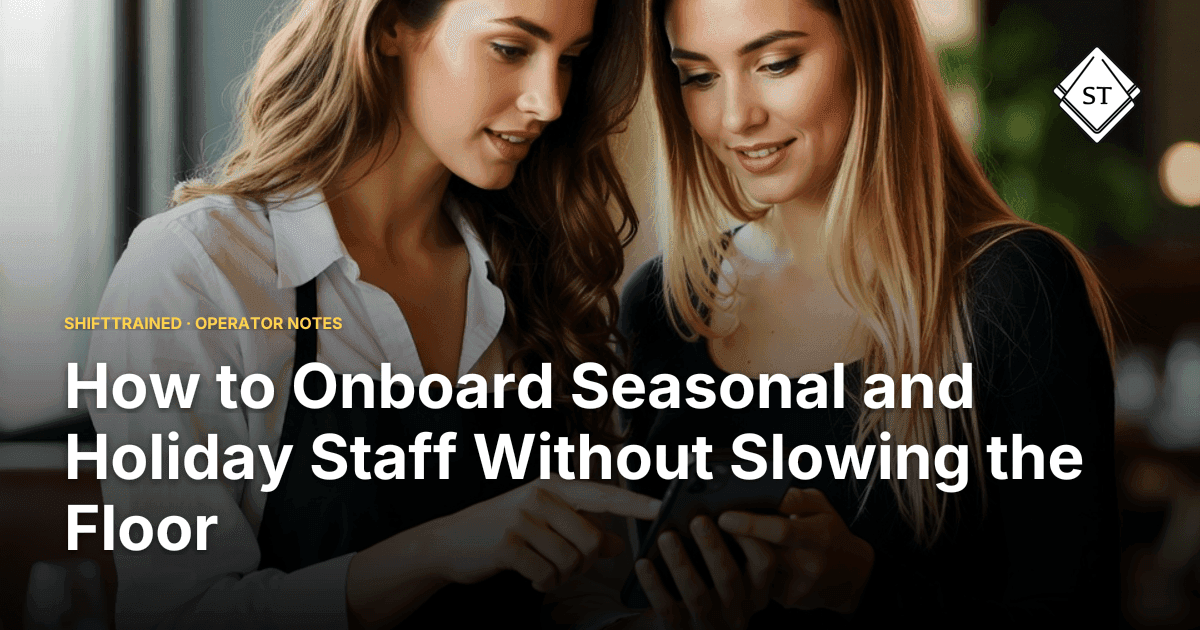
Here's what I've learned after doing this for thirty years. You can't slow the floor for training. So the training has to happen before the new person ever touches a table. Not a classroom. Not a manager standing in the side station running flashcards. They need to learn the menu on their own phone, before their first real shift, in stolen twenty-minute windows.
The first thing I do now when I bring on holiday help is tell them exactly that. "You have three days before your floor shift. The menu quiz is on your phone. I need you to pass it at 80 percent or better before you shadow anyone." That's the entry ticket. Not a verbal quiz from a manager who's also trying to expedite. A real, scored test they take on their own time.
What I found at both Fat Tommy's and Black Barrel Tavern is that most people will actually do it. Staff voluntarily retake the quizzes. Not because I'm twisting arms but because nobody wants to look lost in front of a full dining room. Self-interest is a better motivator than a training schedule.
Now let me tell you what actually matters in that pre-shift window, because you can't cover everything in three days and you shouldn't try. Prioritize in this order. Allergens first, always. If your new hire can't tell a guest whether the soup has gluten or the salad has tree nuts, that's a liability, not just a service gap. Second, the top sellers. What are the eight to ten dishes that are going to come out of that kitchen a hundred times this weekend? Make sure they can describe those cold. Third, anything on the seasonal or holiday menu that's new, because that's what guests are going to ask about and that's where experienced servers get caught too.
Everything else, the full wine list, the back story on the chef, the history of the building, that can come later. Get them functional for this weekend first.
The other thing I push hard on is the concept of "safe answers." A new hire who doesn't know something should never guess. Teach them two sentences: "That's a great question, let me grab that for you" and "I want to make sure I get you the right answer." Guests don't expect a three-week hire to know everything. They do expect honesty. What kills a table is false confidence delivering wrong information.
On the floor itself, pair your seasonal hire with your most patient veteran for the first two shifts. Not your best seller. Your most patient one. There's a difference. The best seller is moving fast and cutting corners on the training side because they're chasing their own numbers. The patient veteran is the one who'll actually stop and explain why you don't run the soup without checking if the guest has a dairy allergy first.
One more thing nobody talks about. Seasonal staff churn is brutal on morale for your core team if you let it be. Your full-timers have seen the holiday scramble before. They know what it costs them when a temp drops the ball. So get your regulars invested in the process early. Tell them what you're doing to prepare the new hires. Ask the vets to flag you privately if someone's struggling instead of letting it blow up mid-service. They'll respect that you have a system. And they'll help protect it.
The Cornell Hospitality research on employee turnover puts replacement cost at north of $5,000 per employee when you factor in recruiting, training, and lost productivity. Seasonal staff are a different calculation, but the principle holds. Every hour of bad service from an underprepared temp costs you something, whether it's a table that doesn't come back or a comp that eats your margin on a night you needed to run clean.
You're never going to get seasonal help to perform like a six-month veteran. That's not the goal. The goal is to get them menu-functional and guest-safe before they take their first order. If they know the top sellers, they can say something honest about the dishes they're less sure on, they know to flag allergen questions to someone more experienced, and they've got a manager they can find in under thirty seconds when they're stuck, you're going to be okay.
The weeks between Thanksgiving and New Year's are going to happen whether you're ready or not. The operators who come out the other side with their staff intact and their reviews holding are the ones who built a system before the rush, not during it.
Get the training off your plate and onto theirs. Literally. Put it on their phone.
Have a great day! — Terry Psaltakis
Your AI Restaurant Guy