You Already Have a Training Binder — You Just Can't Get Anyone to Read It

Hey Team!
You've got a binder. I know you do.
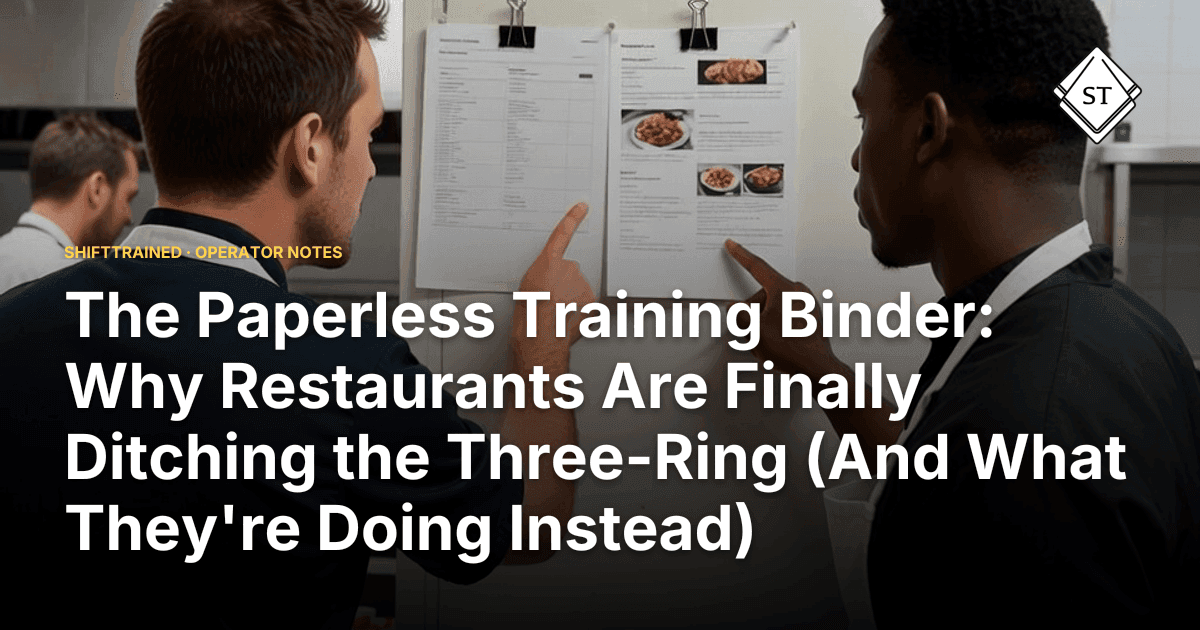
It's sitting on a shelf in the manager's office, or on top of the file cabinet, or in that drawer under the register that nobody opens unless they're looking for a pen. It's got a server knowledge test someone typed up years ago, steps of service, maybe a laminated allergen card taped to the inside cover. Some of you have spec sheets for every item on the menu. Some of you have a full onboarding checklist with checkboxes that someone actually printed and laminated, because they cared.
The content is real. The work went into it. The problem is that nobody reads it.
And I don't mean your staff is lazy. I mean nobody reads a binder. Not in 2025. Not your 19-year-old server who just picked up a Saturday lunch shift and has forty-five minutes before the floor opens. Not your 34-year-old bartender who's seen three different training binders at three different jobs and has absorbed maybe six combined pages of content across all of them. The binder format is the problem, not the material inside it.
I ran restaurants for thirty years before I built ShiftTrained. Long before that platform existed, I watched operators put genuine effort into training documentation and then watch it collect dust. Not because the writing was bad. Because the delivery method asked too much. It asked people to go to a specific physical location, sit down, flip through pages, read dense paragraphs, and self-test on information with zero engagement built in. Nobody does that voluntarily. Almost nobody does it when asked.
Here's what I want you to think about today. Not how to rewrite your training materials. How to move them.
Pull out that binder and look at what you actually have. A lot of operators are surprised when they do this with fresh eyes. There's usually a pretty solid knowledge base sitting in there. Questions like "what are the two proteins in our chili?" or "which three items on the menu contain tree nuts?" or "what's the table turn sequence we expect during a weekend rush?" You wrote those questions because you knew your staff needed to know the answers. That judgment was right. The judgment about format was just wrong.
Taking that content and getting it onto a phone doesn't mean rebuilding it from scratch. Your questions stay your questions. Your answers stay your answers. The things that matter to your specific operation, your specific menu, your specific steps of service, those don't change. What changes is that instead of a staffer squinting at a photocopied page in bad office lighting, they're looking at a quiz on the same device they already check twenty times an hour.
That's not a small difference. That's the whole game.
When training lives on the phone, it goes where the staff goes. Someone waiting for a shift to start takes a few questions in the parking lot. A new hire runs through allergen content on the bus. A veteran who wants to pick up expo for the first time reviews the kitchen flow on a break. None of that happens with a binder. None of it. The binder stays in the office. The phone is always in their pocket.
Now, you might be thinking, okay, but I'd have to type all of this into some system and that sounds like a whole project. And I understand why that feels that way, because every tool you've tried before made it a whole project. You've seen platforms that require you to build a course with modules and progress bars and a learning management system that feels like it was designed for a corporate HR team, not a wing joint with fourteen staff members.
That's why I built what I built. You upload the PDF, the platform reads it, and it generates the questions. The existing document does the work. If you've got a menu PDF or a training doc already typed up, that's the input. You're not starting over. The content you spent time writing just moves from paper into a format that someone will actually use.
The questions it generates are based on your material, not generic hospitality platitudes. Your items, your modifiers, your allergens, your table numbers, your steps of service. A staffer quizzing on it is quizzing on your actual restaurant, not some fictional bistro in a training template.
I see this same realization happen with operators all the time. They go into it thinking they need to create something new. Then they realize the work is already done. It's just trapped.
The operators who get the most out of this aren't the ones with the most sophisticated documentation. They're the ones who recognize that a decent set of questions in the right format beats a perfect binder that nobody reads. The bar manager who spent a weekend building a laminated guide to the tap list four years ago and then watched it fade in the sun behind the bar. That person is sitting on useful content. They just need to move it somewhere it can do something.
So this week, do one thing. Open that binder. Find the ten best questions you already wrote. The ones where if your whole staff knew the answers cold, your operation would genuinely run better. Start there. Get those ten questions onto a phone.
You'll see what happens. Staff will engage with it because it meets them where they already are. And you'll realize you've had a training program this whole time. It just needed a better home.
Have a great day! — Terry Psaltakis
Your AI Restaurant Guy
For more on putting this into practice, see how ShiftTrained approaches the best menu training programs.