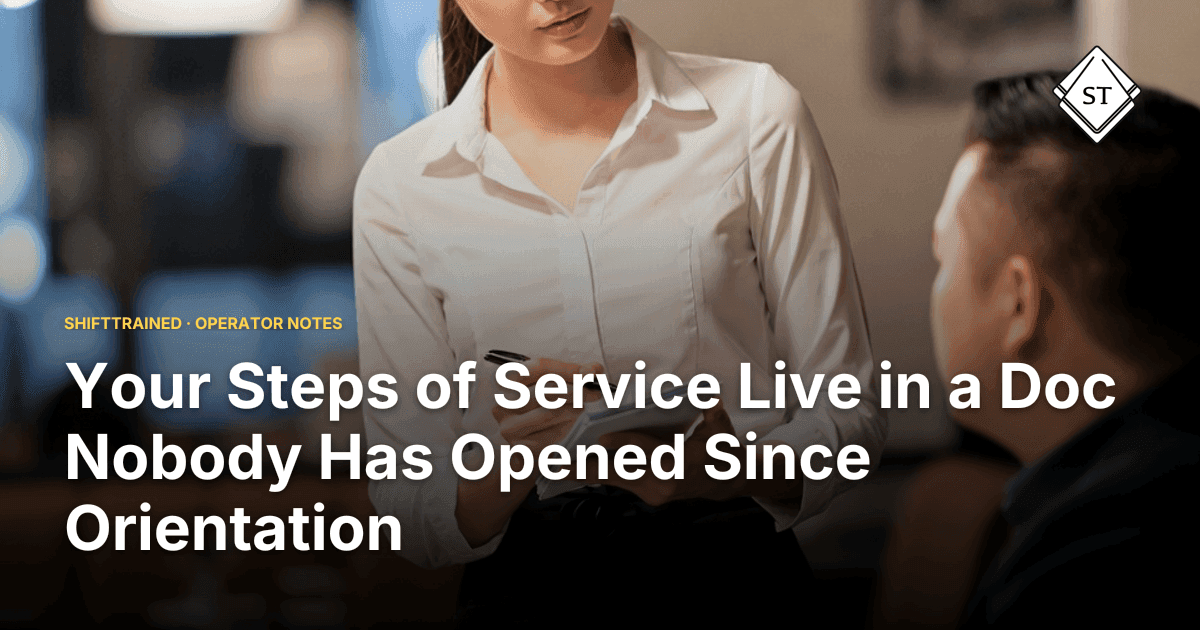
Your Steps of Service Live in a Doc Nobody Has Opened Since Orientation

Hey Team!
You've got a steps of service document. I know you do. It's probably a Google Doc, maybe a PDF someone made years ago, maybe a printed page in a binder that lives on the shelf above the manager station. It covers the greeting window, getting water down, how to fire the order, when to check back, pre-bussing before the guest has to look around for somewhere to put their used napkin. It's all in there. And your staff hasn't read it since orientation.
That's the real training gap. Not menu knowledge. Menu knowledge gets all the love because it's visible. A server doesn't know what's in the queso, you hear about it. But a server who takes six minutes to acknowledge a table, or who drops the check before anyone asked about dessert, those failures are invisible in a different way. The guest just feels vaguely annoyed and you never quite know why.
Here's what I've watched happen in restaurant after restaurant over thirty years. You write the steps down during your opening push, you train on them hard for the first few weeks, and then the urgency fades. New hires come in. The veteran staff shows them "how we do it here," which is really just how they personally do it, which may or may not match what you actually wrote down. Within six months you've got five different versions of your service sequence running on the same floor and none of them are yours.
And before you say "we go over it in pre-shift", do you? Every shift? With accountability? Or do you mention it when something goes wrong?
Now think about what happens when you're short-handed. This is the part that really gets me. Operators assume that when they're running lean, the steps of service can loosen up. You're two servers down, there's a wait, it's a Saturday during a game, you just need to survive the night. So the check-back disappears. Pre-bussing stops. The greeting window stretches from two minutes to five. And here's the thing: that's exactly backwards. When you're short-handed, a clean sequence is what keeps the wheels on. A server who owns their steps, who knows the order of operations cold, can actually cover more ground with less chaos than someone winging it. The sequence is what lets you be efficient. It's the difference between a server who runs in tight circles and one who's covering the room in clean passes.
But you can't run a tight sequence under pressure if you only learned it once, at orientation, in a half-hour walkthrough you barely remember.
So let's talk about what actually fixes this. The answer isn't a longer training document. It isn't a better binder. It's repetition on the steps themselves, the same way you'd drill menu knowledge. Most operators don't think to quiz on service sequence, but there's no reason you can't. "What's the check-back timing after food is delivered?" is a question with a specific answer. "When do we offer dessert relative to the check?" has a right answer too. Your steps of service are full of those questions and nobody's asking them.
At Fat Tommy's, when we built out the training on the platform I created, we uploaded the service standards the same way we uploaded the menu. Not because the tech required it, but because it forced us to treat the sequence as something worth drilling on, not just something worth filing away. Staff got quizzed on it. They got quizzed on it again. The repetition is what made it stick.
The sequence also matters for a reason most people don't articulate clearly: it's the only thing your guest actually experiences. They don't see your food cost. They don't see your scheduling headaches. They don't know whether you're two servers down. What they feel is whether someone greeted them in a reasonable window, whether their water was down before they had to ask, whether anyone circled back after the food landed to make sure everything was right. That's what they remember. That's what drives whether they come back and whether they tell anyone about you.
A server who knows your menu cold but runs a sloppy sequence still delivers a frustrating guest experience. A server who runs your sequence clean, even on a tough night, gives the guest the feeling that someone is in control. That feeling is worth more than any upsell.
The fix here is not complicated, but it requires you to treat the sequence with the same seriousness you treat the menu. Pull out that document. Read it yourself and ask whether it's still accurate, because sometimes the written standard and the actual current standard have drifted and you need to reconcile them first. Then build it into your regular training rotation. Quiz on it. Bring it into pre-shift when you see a step slipping. Name the specific step that broke down last Tuesday, not just "we need to do better on service."
When your team knows the sequence cold, two things happen. The guest experience gets more consistent, which is the whole point. And your floor gets more efficient, especially on hard nights, because everyone's running the same play. That's when the steps pay off the most, not when you're fully staffed and it's easy, but when you're short and it's hard and the sequence is the only thing holding the night together.
Dig out the doc. It's earned more than the shelf.
Have a great day! — Terry Psaltakis
Your AI Restaurant Guy
For more on putting this into practice, see how ShiftTrained approaches restaurant training software.