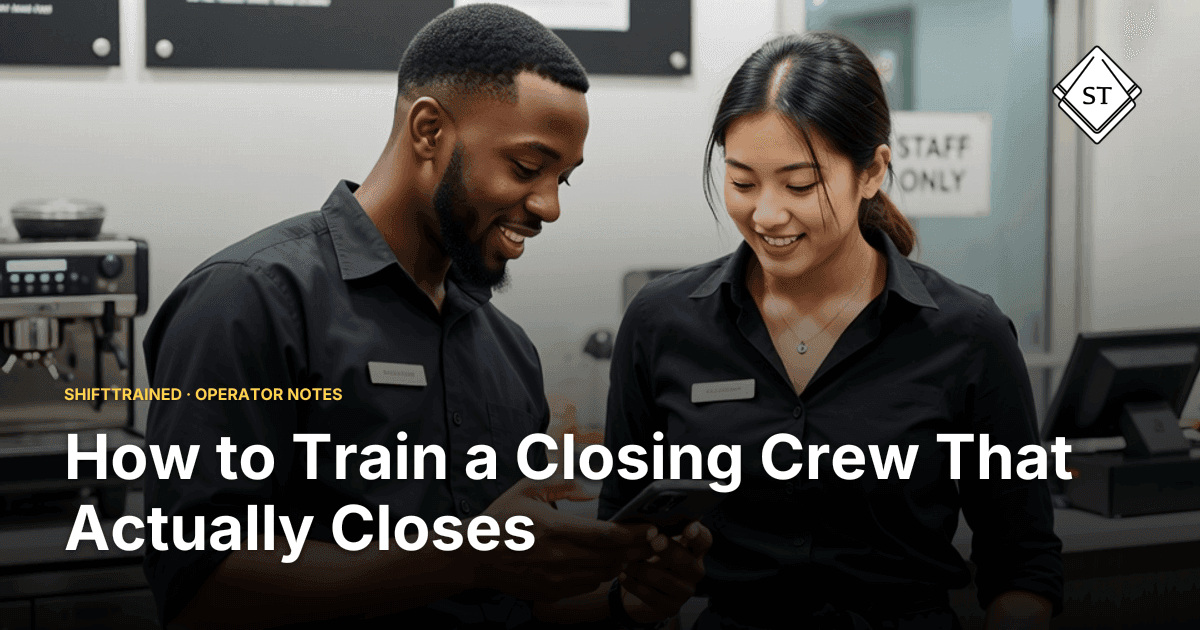
How to Train a Closing Crew That Actually Closes

Hey Team!
The opening manager walked into Black Barrel Tavern on a Tuesday morning and the beer cooler door was propped open. All night. The reach-in behind the bar was at 48 degrees. We pulled product. We ate the loss. And the closer? He swore up and down he did his checklist.
That's the thing about closing checklists taped to the wall. Nobody actually uses them. They become wallpaper. The closer glances at it, thinks "yeah, yeah, I do all that," and signs off without touching half the items. Then you spend your Tuesday morning fixing Monday night instead of prepping for the lunch push.
Here's what I've learned after doing this for thirty years. A closing routine only works when your staff knows it cold before they ever do it alone. Not "read it once" knows it. Not "I'll figure it out" knows it. Knows it the way they know their own phone number. You have to train the close the same way you train the menu.
Most operators don't do that. They hand a new closer the laminated sheet, walk them through it once, maybe twice, and then turn them loose. That works fine until it doesn't. And it always eventually doesn't.
The first shift I let someone close solo, I assumed the training we'd done was enough. Three months in, solid employee, knew the menu, handled a rush well. What I didn't account for was that she'd never been trained on the close the way I trained her on the floor. Nobody had ever quizzed her on it. Nobody had confirmed the knowledge was actually there. She did her best impression of what she thought the close was, based on watching other people half-do it for three months. The produce walk-in was 10 degrees warmer than it should have been because she didn't know where the thermostat readout was. Not her fault. Mine.
So how do you actually fix this? You start by separating the knowledge from the doing. Before anyone closes alone, they need to know the close on paper first. What temp does the walk-in need to read? What does "clean the fryer" actually mean, step by step, not just the phrase? What gets pulled to the line for tomorrow morning and where does it go? What does the bar look like when it's actually done versus "I think I got it"?
That's all knowledge. It lives in their head or it doesn't. And you can test for it before you ever find out the hard way at 6am.
Once you've confirmed the knowledge, then you pair them with an experienced closer for two full closes minimum. Not shadowing where they stand and watch. Doing it, with the experienced person checking each step. That's where the knowledge becomes muscle memory. The walk-in check, the temp log, the cooler door seal, the line breakdown, the mop sequence, all of it. Two nights of that with someone who actually knows the standard, and your new closer has something to build on.
The other thing that kills closing performance is that the checklist has too many items crammed together with no priority order. Your closer is tired. It's midnight. Their judgment about what matters most is impaired by the fact that they just survived a dinner service. If the checklist treats "wipe down the host stand" the same way it treats "verify all pilot lights are off," you've got a problem. Build the close around what actually matters. Safety first, temps second, sanitation third, restocking fourth, cosmetic stuff last. When a closer runs out of energy and starts shortcutting, you want them shortcutting the stuff that matter less.
Now let me tell you the thing nobody talks about in operator circles. The checklist itself is not the training. This is where most managers get it backwards. They write a great checklist, they're proud of it, and they treat distributing the checklist as equivalent to training. It's not. The checklist is the audit tool. Training is what happens before the closer ever runs the checklist alone.
Quiz the close. Put the key steps in front of your new staff and make them answer questions about it before they do it live. What temperature does the walk-in need to hit before you lock up? What do you do if it's two degrees high? Where do you document it? That kind of retention check catches the gaps before the gaps cost you money or a health code violation.
When we built the training system I use at my restaurants now, closing procedures were one of the first things I loaded in. Because the close is where training failures show up most visibly. The damage from a bad close doesn't announce itself during the bad close. It announces itself the next morning when the opening crew walks in. By then it's too late to do anything except manage the fallout.
A great closing crew is worth a lot. Your opening manager starts calmer. Your food costs tighten up because product isn't getting killed by a cooler door left open. Your kitchen crew coming in for breakfast prep isn't spending the first thirty minutes cleaning what should have been cleaned last night. You compound those marginal gains every single day and it adds up fast.
Train the close like it's the menu. Test the knowledge before they go solo. Run two supervised closes minimum. Build the checklist in priority order so when fatigue sets in, the important stuff still gets done. And stop letting the laminated sheet on the wall do work that a real training system needs to do.
The opener deserves to walk into a clean room. That starts with how you train the crew the night before.
Have a great day! — Terry Psaltakis
Your AI Restaurant Guy
For more on putting this into practice, see how ShiftTrained approaches a restaurant training program.