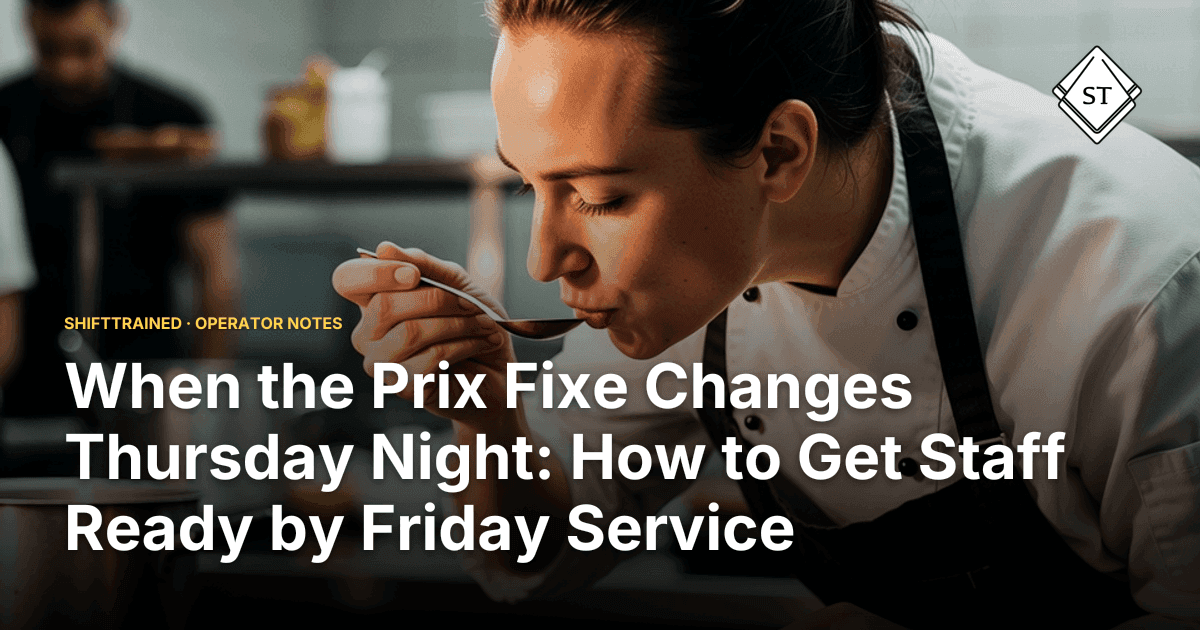
When the Prix Fixe Changes Thursday Night: How to Get Staff Ready by Friday Service

Hey Team!
Thursday night, your chef drops a new prix fixe on you. Five courses. New proteins, new preparations, new flavor stories you've never told before. Doors open Friday at six.
That's not a menu change. That's a fire drill.
À la carte rollouts give you some grace. A server blanks on the preparation for the salmon? She can run back, check, recover. The table barely notices. A prix fixe doesn't work that way. Every guest is eating the same five courses in the same order, and they're paying a premium to feel taken care of the whole way through. When someone at table four asks what farm the duck comes from and your server says "let me find out," you've already broken the thing you sold them.
So let's talk about what the 48 hours actually look like when you do it right.
The first thing I do Thursday night, before anyone goes home, is sit with the new menu and identify every single thing that needs a story. Not just the main protein. The puree under it. The sauce. The grain or vegetable that anchors the second course. The cheese on course four and where it's aged. I write those down because if I don't, Friday morning pre-shift is just me reading the menu out loud to people who aren't retaining a word of it.
Then I split the work. There's the factual layer, which is what everything is and where it comes from. And there's the selling layer, which is how you talk about it at the table without sounding like you're reciting a Wikipedia entry. Both matter. Guests don't want a lecture. They want to feel like their server actually ate this food and gave a damn.
Friday morning is where most operators get into trouble. They run a 20-minute pre-shift, go course by course, read the notes the chef wrote, maybe do a taste, and send everyone out. I've done that. I know exactly what happens. Your best server remembered 70% of it. Your newest hire remembered the amuse-bouche and the dessert and nothing in between. And nobody retained the provenance story on the second course because there were four other things they were trying to remember at the same time.
Twenty minutes of verbal walkthrough is not training. It's exposure. Those are two different things.
Here's what actually works. Get the material into people's hands Thursday night, after they leave. Not a text with a PDF attached that nobody opens. Actual quiz questions built from the new menu, on their phones, that they can run through before they go to sleep and again Friday morning on the train or in the parking lot before their shift. Spaced repetition. The human brain doesn't hold new information from a single pass. It holds it when it sees the same question twice over a short interval and has to retrieve the answer.
The platform I built, ShiftTrained, does exactly this. You upload the new menu, the AI generates quiz questions in just minutes, and your staff is drilling on their phones before Friday morning even starts. I built it because I spent thirty years watching good servers walk onto the floor with new menus they weren't ready for, through no fault of their own. The system failed them.
But here's the operational truth regardless of what tool you use: the prep cycle for a prix fixe changeover has to start before pre-shift, not during it. Pre-shift is for tasting, for answering questions people already have, for building confidence in people who've already done the work. If pre-shift is where your staff is learning the menu for the first time, you're behind.
The specific things I want staff drilling on for a prix fixe: the protein and its source, the preparation method in plain language a guest can picture, any allergy or intolerance flags on each course, the pairing logic for wine or cocktail options, and at least one genuine selling line per course. Not "it's really good." Something real. "The beet on course two is roasted for three hours and finished with goat cheese from a creamery about forty miles north of us." That's a sentence. It's specific. A server can say it with confidence because it's true and she drilled it.
The allergen piece on a prix fixe is worth saying out loud because it's the one that genuinely scares me. A la carte, a guest calls out a shellfish allergy and you navigate around two or three dishes. A prix fixe, that allergy touches every course and the kitchen needs to know before anyone sits down. Your staff has to be fluent enough in every course to have that conversation at the host stand, not at the table when the first course is already fired. That fluency only comes from real repetition before service, not from hoping someone reads the sheet.
By the time doors open Friday, I want every server to have seen every course question at least twice and gotten it right. Not read it. Retrieved it. There's a difference, and the difference shows at table.
The 48-hour window feels tight. It is tight. But it's enough if you use it right. The operators who get into trouble are the ones who treat Thursday night as a planning problem and Friday pre-shift as a training moment. Flip that. Plan Thursday, train Thursday night, confirm Friday morning, execute Friday night.
Your staff wants to do well. Give them the right material at the right time and they will.
Have a great day! — Terry Psaltakis
Your AI Restaurant Guy
For more on putting this into practice, see how ShiftTrained approaches restaurant staff training.