Nobody Trains Staff on Dessert — That's Why You're Leaving 20% of the Check on the Table

Hey Team!
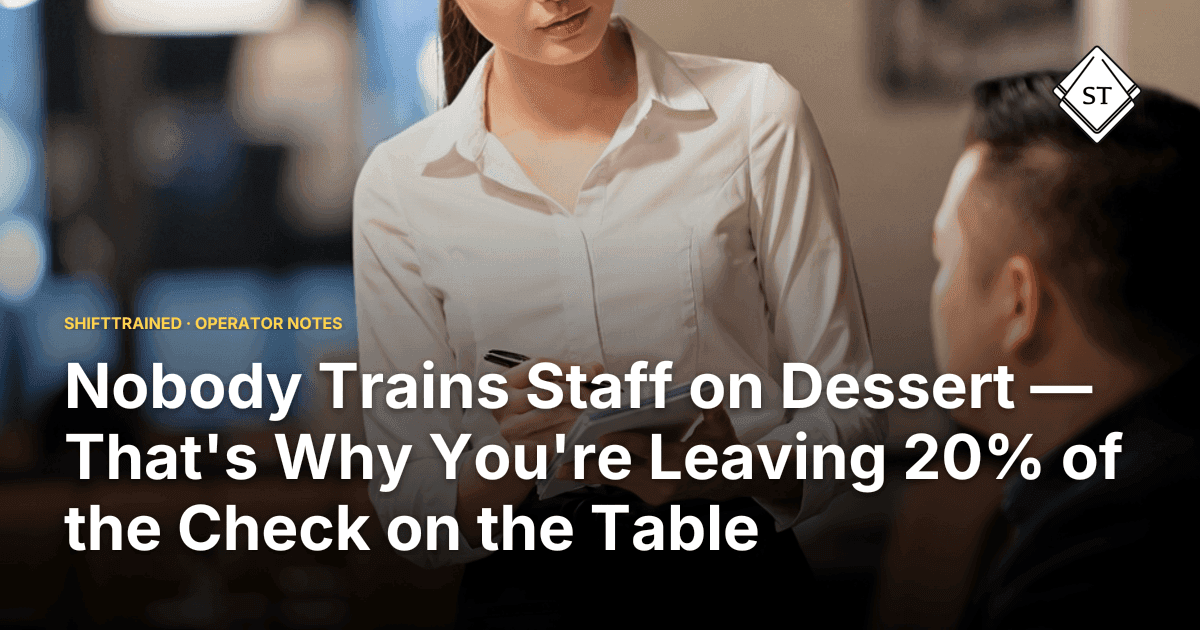
Saturday night at Fat Tommy's, one of our servers walked up to a four-top and said, "Do you want to see the dessert menu?" Flat. No eye contact. Already mentally bussing the table. The table said no. The check closed out and they were gone in four minutes.
That server had a 4.8-star average on service feedback that week. She was good. She just hadn't been trained on dessert.
That's the problem I want to talk about today, because I see it everywhere. Dessert is the last item in the training manual, when there's a training manual at all. It gets thirty seconds at pre-shift. New hires shadow someone for two nights and never hear anyone actually sell a dessert, so they model the same half-hearted "do you want dessert?" that's been echoing through restaurants since 1987. Nobody challenges it because the table already had a great experience. The check looks fine. The tip looks fine. And the operator never sees the $20 they didn't make.
Here's the math. Eight tables in a section. Average dessert price, call it $12. One dessert sale per table per shift. That's $96 in covers your server didn't bring in. Five shifts a week, that's $480. Fifty weeks, that's $24,000 a year, per server. You didn't need to change a single item on the menu. You didn't need to run a promotion. The dessert was already there. The table was already happy. The only thing missing was a trained server with something real to say.
The "do you want to see the dessert menu?" script is the problem. It's a closing question disguised as an offer. When you ask someone if they want to *see* something, you're giving them the easiest possible exit. They're already full, they're already thinking about the check, and you've just told them there's another step between them and the door. Of course they say no.
What actually works is what I call the bridge sentence. It's one sentence that acknowledges the guest's hesitation before it happens and gives them a specific reason to stay interested. Something like: "Before you say no, I have to tell you about the olive oil cake, because people come back for it." Or: "We make everything in-house and the one thing I'd feel bad not mentioning is the brown butter tart, it's meant to split." Short. Specific. Personal. It doesn't ask a yes/no question. It just says something true and lets the table decide.
The reason this works is that it shifts the dynamic. The server isn't presenting a menu, they're sharing information. That's a different posture. Guests read it differently. They lean in instead of backing out.
But here's the part nobody talks about: your server can't deliver that sentence if they've never tasted the dessert. They can't describe an olive oil cake with any conviction if the only thing they know is that it's on the menu. Training has to include flavor profile knowledge, texture, portion size, and shareability cues. Those last two matter more than people think. "It's big enough to split" is one of the most effective dessert sales tools in any restaurant because it removes the guilt. The guest wasn't going to order a whole dessert alone, but suddenly splitting something sounds reasonable.
At Black Barrel Tavern we started quizzing staff specifically on those three things for every dessert: what does it taste like, what's the texture, can it be shared. Not in a lecture, just short knowledge checks before service. When the staff can answer those three questions without thinking, the bridge sentence comes naturally. They're not reciting. They're just talking about food they know.
I'll tell you what surprised me. Once we started training on dessert the same way we trained on proteins and wine pairings, with real emphasis, real testing, real expectation that every server knows every item cold, the numbers moved fast. Not because we ran a special. Not because we discounted anything. Just because servers started saying specific things instead of giving guests an easy out.
There's also a timing piece worth mentioning. The worst time to bring up dessert is the second the last entree plate is cleared. The guest is still in digestion mode, mentally calculating how full they are, and the clearing of plates signals "we're wrapping up." Train your staff to plant the seed earlier. A good moment is when you're refilling a water glass mid-entree. One sentence: "By the way, save a little room, the pastry chef made the bittersweet chocolate thing today." That's it. No pitch. Just a word. When dessert comes up again at the end of the meal, it doesn't feel like an upsell. It feels like a reminder.
The other reason dessert training pays off in ways that don't show up immediately on the check: guests who finish with dessert stay in the experience longer. They order one more round of drinks about half the time. The tip percentage on dessert checks tends to run higher because the server has demonstrated they actually know the menu. And the guest leaves with a final impression that's the cake, not the entree. That matters for whether they come back.
Most operators I talk to think of training as a cost. Something you do to get someone functional and then stop. Dessert is the clearest example I know of where that thinking literally costs you money every single shift. The knowledge gap between "do you want to see the dessert menu?" and "let me tell you about the olive oil cake before you say no" is maybe two hours of real training. The return on that two hours is measurable, repeatable, and it compounds every shift for as long as that server works for you.
Train your desserts like you train your proteins. Quiz the flavor profile, quiz the texture, quiz whether it splits. Give your staff a bridge sentence they actually believe in. Then watch the last line of your check averages move.
Have a great day! — Terry Psaltakis
Your AI Restaurant Guy