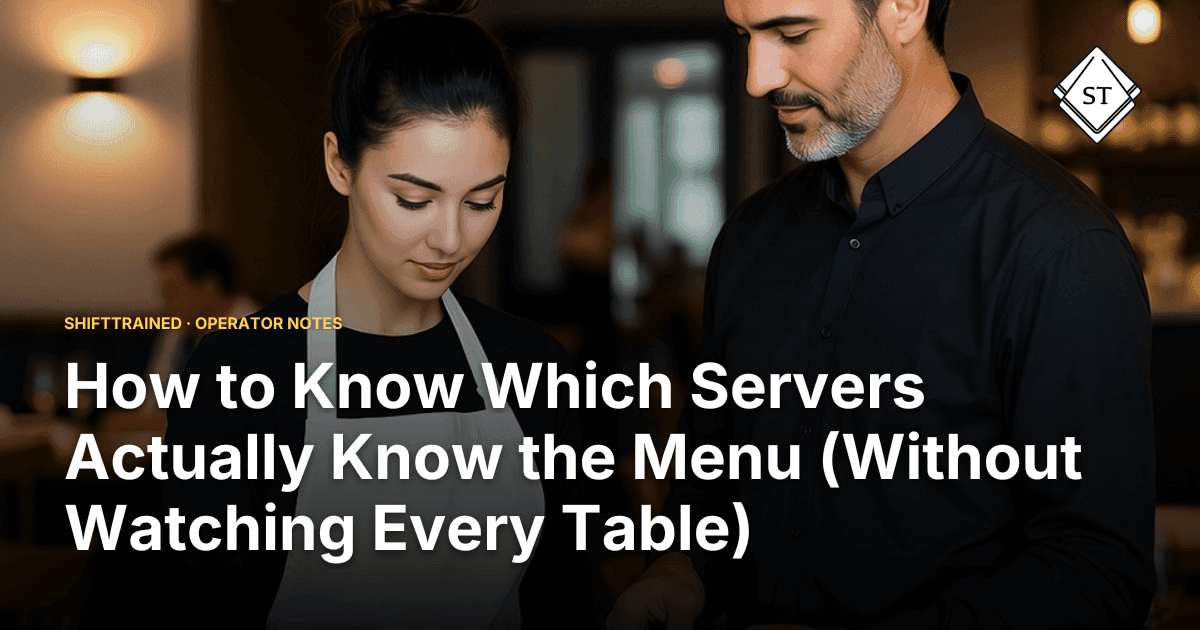
How to Know Which Servers Actually Know the Menu (Without Watching Every Table)

Hey Team!
The fastest way to know which servers actually know the menu is to quiz them and look at the scores. Not a verbal pop quiz at the start of a shift. A written quiz, tracked, so you can see every gap by name.
I know that sounds obvious. But I've been in this business thirty years and I still see operators doing it the wrong way. They watch a table. They see a server hesitate on a question about the pork option, or stumble when a guest asks what's in the sauce. They file that away mentally. And then they go fix it based on vibes and memory, which means the servers who are loud and confident get a pass, and the quiet ones who actually know the menu get overlooked. It's a gut-feel system dressed up as management.
Here's what measuring actually looks like.
You give every server a quiz on the current menu. Not a 60-question monster. A tight 10 to 15 questions that cover the things guests actually ask about on a Friday night: what's in that, can they make it without dairy, what does that come with, what's the difference between these two. When the quiz is done, you get a score per person. You also get something more useful than that: you see which questions everyone got wrong.
That second part is where the real information is. If eight out of twelve servers miss the question about which items contain tree nuts, that's not a coaching problem for any one individual. That's a menu communication problem. Your supplier changed something, or the training materials never covered it clearly, or the dish description on the menu is doing you no favors. You fix that at the source and you retrain the whole team.
But if two servers score below 60 percent and everyone else is at 85 or above, that's a different conversation. That's a one-on-one. You sit down with those two people specifically, you go through the questions they missed, and you figure out whether they need more time with the menu or whether something else is going on.
Now let me tell you the part most managers skip. The servers who haven't taken the quiz at all.
This is almost always your real problem. Not the person who scored a 70. The person who hasn't shown up in the data yet. Because either nobody followed up, or the quiz was assigned during a chaotic week and fell through the cracks, or they just slipped through. The absence of a score is telling you something.
At Fat Tommy's we see this come up whenever we add something seasonal. We push the quiz through ShiftTrained, the platform I built, and within a day or two we can see exactly who's completed it and who hasn't. The servers who haven't touched it are the ones most likely to blank on a guest question about the new item. Which means comped drinks, or a guess that lands wrong, or an upsell that never happened because the server had no idea what to say about the dish.
Speaking of upsells. This is where quiz data actually connects to money.
Think about what happens when a server doesn't know a menu item well. They don't describe it. They might not suggest it. If a guest asks, they give a vague answer and the guest defaults to whatever they already had in mind. That's a lost check. Not every time, but often enough. And you'll never be able to trace it back to a knowledge gap because it didn't look like anything went wrong. The table was fine. The guest left. You have no idea the opportunity was never there.
When you have quiz scores, you can start connecting them. The servers with the highest scores on the specialty items tend to be the ones whose checks reflect it. That's not always true, there are plenty of other variables, but it's a pattern worth tracking over a month or two. And when you run the next training cycle, you have something concrete to point to. You're not telling someone "you need to know the menu better." You're telling them "this question here, about the cheese on the burger, you missed that, and you're leaving money on the table every time someone asks."
That's a real coaching conversation. That's specific. And it's a lot easier to have than a vague note about improving your tableside manner.
One more thing that trips people up. They run the quiz once, during onboarding, and then never again. Menu changes. Ingredients change. That item that had gluten in the crust last spring doesn't anymore. The quiz has to follow the menu, and the menu is never done changing. If your training doesn't move when the menu moves, you have servers out there confidently giving guests the wrong information. Which is worse than not knowing. At least the ones who don't know will say "let me check on that." The ones who were trained months ago will just answer.
The point is this: you cannot watch every table. You're not supposed to. Your job is to build a system that tells you where the gaps are before they turn into a comp or a complaint or a missed sale. Quiz scores, sorted by person and by question, are that system. It's about ten minutes of your week to actually look at the results and make a call. The guesswork costs you a lot more than that.
Have a great day! — Terry Psaltakis
Your AI Restaurant Guy
For more on putting this into practice, see how ShiftTrained approaches cocktail training.