Spaced Repetition for Restaurant Training: The One Technique That Makes Menu Knowledge Actually Stick

Hey Team!
Hermann Ebbinghaus was a German psychologist who, back in the 1880s, spent years memorizing nonsense syllables and testing himself to see how fast he forgot them. Not the most glamorous career path, but what he found matters more to your restaurant than almost anything else you'll read this week. He mapped what he called the forgetting curve. And the short version is this: within 24 hours of learning something new, a person forgets roughly 70% of it. Within a week, if nothing reinforces it, they've lost almost all of it.
That's your pre-shift meeting. Right there. That's the 45 minutes you spent on a whiteboard walking your servers through the new seasonal menu on a Thursday. By Saturday night at 8pm, when a four-top asks about the difference between the two new sandwiches, your staff is guessing. They're not guessing because they're bad at their jobs. They're guessing because that's what human memory does without reinforcement.
Now here's the part that changes how you think about training. Ebbinghaus also found that memory works the opposite way when you review material at spaced intervals. Each time you come back to something, the forgetting curve flattens a little more. You retain it longer. The retrieval itself is what locks it in, not the original lecture.
This is spaced repetition, and it's not a new idea. It's been standard practice in medical schools and military training programs for decades. It just never made it into restaurant training because our tools weren't built for it. A laminated menu card doesn't space your repetitions. A 45-minute video doesn't either.
Let me make it concrete. Say you've got a 10-item seasonal menu. Burgers, a new chicken sandwich, a couple of appetizers, some rotating taps. Nothing exotic. You need your staff to know the ingredients, the allergens, and the two or three selling points on each item.
Old approach: you call everyone in 30 minutes before a Friday shift, walk through the menu, maybe hand out a printed sheet. Servers write notes on their order pads. By Sunday, the notes are gone. By next Friday, the training might as well not have happened.
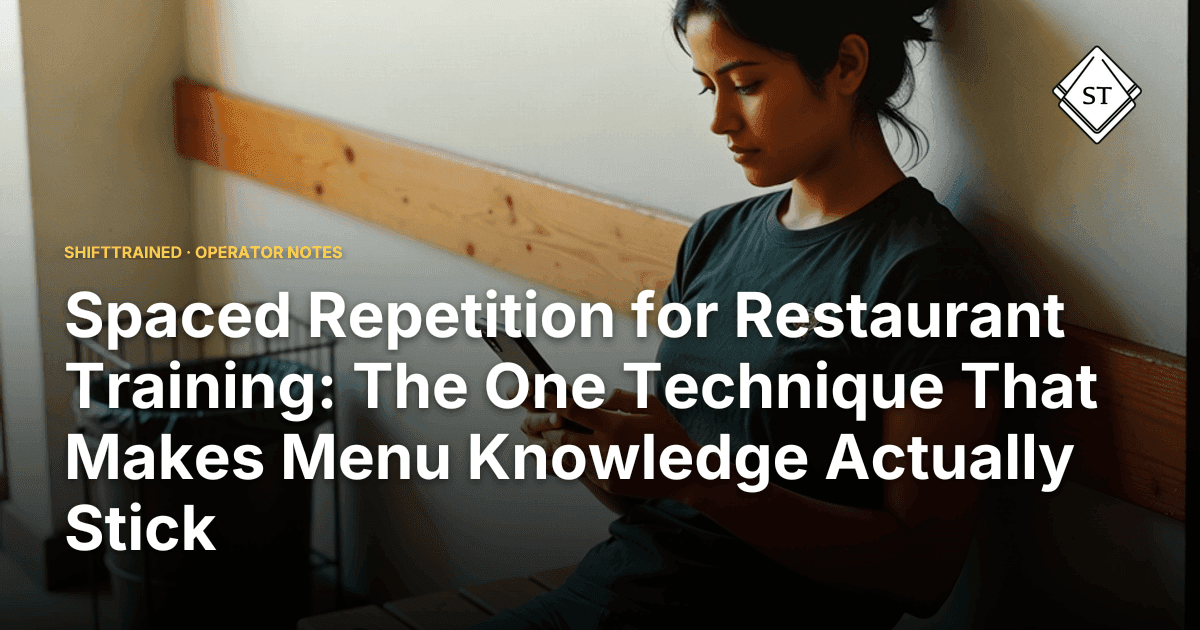
Spaced approach: you give them five questions on Monday. Just five. On their phones, during a five-minute break. They answer them, they get feedback, they move on. Wednesday, five more questions, but two of them revisit Monday's material. Friday, five questions again, with some from Monday and Wednesday recycled in. You do this across 14 days total. Same 10-item menu.
The difference in retention at the three-week mark isn't marginal. It's not a 10% improvement. We're talking about the gap between a server who can confidently walk a guest through the new menu and one who says "I think it comes with fries?" The research behind spaced practice consistently shows retention rates three to four times higher than a single-session lecture when material is reviewed at intervals over time. Educators call this the "spacing effect" and it's one of the most replicated findings in cognitive science.
What operators get wrong is thinking that more time equals better learning. A 45-minute training session feels thorough. It feels like you did the job. But memory doesn't care how long the meeting was. Memory cares about how many times you've been asked to retrieve the information and how spread out those retrievals were. A three-minute quiz session on Monday, Wednesday, and Friday will beat your 45-minute Thursday meeting every single time, measured by what staff can actually recall under pressure on a busy floor.
The other thing that matters is retrieval practice specifically. Reading a menu isn't the same as being asked a question about a menu. When you read, you're recognizing information. When you answer a question, you're reconstructing it. Reconstruction is what builds durable memory. It's why flashcards work and passive reading doesn't. It's why a quiz on a phone is a better training tool than a printed FAQ sheet.
At Fat Tommy's, we run staff through quizzes on their phones before every menu change. Not a meeting. Not a printout. Questions, on their phones, at spaced intervals over the two weeks before we launch. By the time a new item goes live, the staff has been asked about it five or six times across different days. They know it. They don't know it because we drilled it in a single session. They know it because their brains were made to retrieve it repeatedly, and each retrieval built on the last.
The math on why this matters operationally is straightforward. A server who doesn't know your menu can't upsell it. A server who guesses on allergens is a liability. A server who confidently explains what makes a new item worth ordering is the difference between a $38 check and a $55 check. You're not training for the sake of training. You're training because menu knowledge is a direct revenue input.
The platform I built at ShiftTrained is designed around this model because it's the only model that actually works at scale. But you don't need a specific tool to start applying the principle today. Whatever you use to train staff, space it out. Five questions Monday. Five questions Wednesday. Five questions Friday. Bring back earlier material as you go. Make them retrieve it, not just read it. Do that for 14 days on any new menu and watch what happens to your floor.
Ebbinghaus proved this in the 1880s with nonsense syllables. It works just as well with your chicken sandwich.
Have a great day! — Terry Psaltakis
Your AI Restaurant Guy
For more on putting this into practice, see how ShiftTrained approaches restaurant staff training.