What Should a New Server Know by the End of Day Three? (Here's the Actual List)

Hey Team!
Sunday brunch. Counter is full. There's a 45-minute wait and your new server, three days in, is standing at table seven looking at a guest who just asked what's in the green chile sauce. Blank stare. Guest shifts in their seat. Your best server swoops in from across the room to save it. That's the moment most operators feel in their gut but never trace back to the actual problem, which is that they never defined what "ready" actually means before day four.
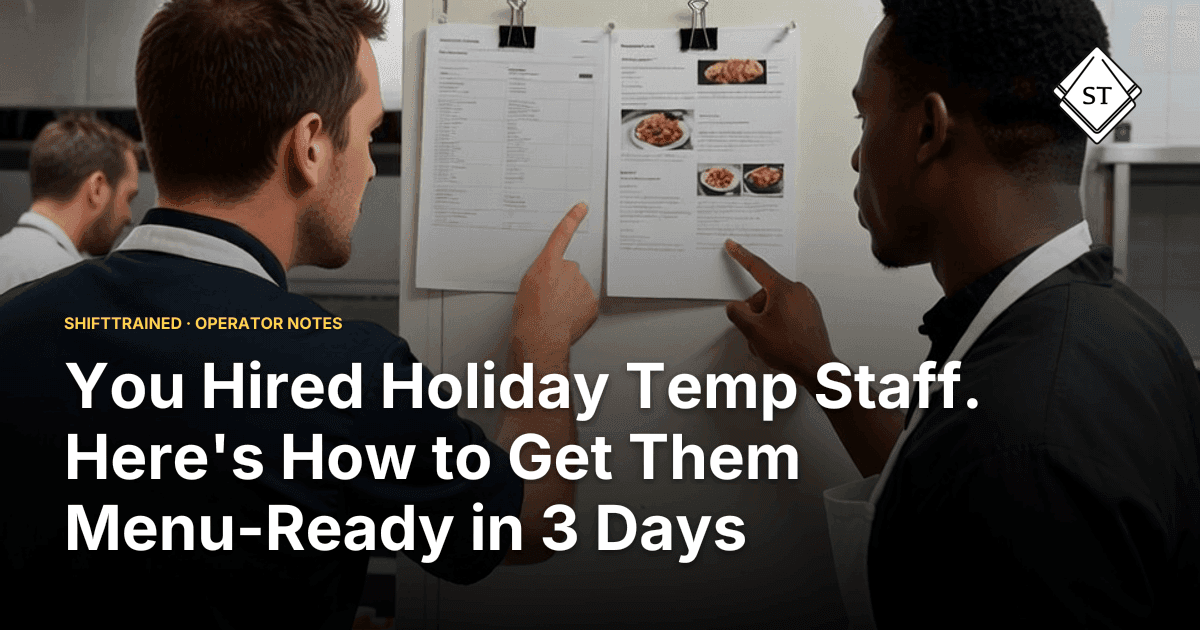
Most of us run new hires through a tag-along, hand them a printed menu, and then release them onto the floor based on vibes. They seem pretty sharp. They've got a good attitude. They'll figure it out. And sometimes they do. And sometimes they're at table seven with a blank stare and a guest who's already checked out mentally.
Here's what I've learned after 30 years and over 20 concepts: readiness isn't a feeling. It's a list. And if you don't have the list written down, you're not training. You're hoping.
So let me give you the actual list. Fifteen things a new server should be able to demonstrate cold before they go solo. Not recite in the back office. Cold. Under a little pressure. Like a guest just asked.
They need to know your top five dishes well enough to describe each one without looking at the menu. Not just the name. The protein, the prep, what it comes with, what makes it worth ordering. If you've got a smash burger that sells 200 covers on a Saturday, your server should be able to close somebody on it in two sentences.
They need to know your allergen flags. Every one of them. Gluten, tree nuts, peanuts, shellfish, dairy, soy, eggs. And more importantly, they need to know which of your actual menu items carry them. Not a general "we may have cross-contact" disclaimer. Specific dishes, specific risks. This isn't optional and it's not a quiz question you skip. A guest's reaction depends on your server getting this right.
They need to know the three modifications guests ask for most often on your top sellers. At a wings joint it's "no sauce on the side, put it on the wings" vs. "sauce on the side," or "extra crispy," or "boneless only." Whatever your version of that is, they need to know it without hesitation and they need to know how you ring it in.
They need to know what's 86'd. This changes daily. They need to know the process for finding out before their shift starts, not by going back to the kitchen three times during service and annoying your line.
They need to know how to read back an order before they walk away from the table. Not just repeat it robotically. Actually confirm it. "So that's the patty melt on sourdough, no onion, fries instead of the soup, and a Diet Coke. Perfect?" That loop catches mistakes before they hit the printer.
They need to know your table numbers. Every one of them. If you call out "86 on the queso, fire table 14" over the radio and your new server looks around trying to count booths, that's a problem.
They need to know how to enter a basic modification in your POS. Not a tutorial. Actually do it. Ring in a substitution, add a note, split a check. Day three is not too early for that.
They need to know your happy hour windows if you have them, and what's included. Guests ask this constantly and an "I'm not sure, let me find out" on a Tuesday at 4pm is a missed sale.
They need to know your two or three house drinks. Not the full cocktail menu. Just the ones you push, the ones on the table tent, the ones your bartender is actually proud of.
They need to know when to get a manager. Not just "if something seems wrong." Specific situations: a guest mentions an allergy after they've already ordered, a guest says they got sick last time they were in, any mention of a foreign object in food, any situation that's about to get loud. They should not be handling those solo.
They need to know where things are. Ice, backup napkins, to-go containers, the closest spot to get a manager without walking across the whole floor.
They need to know how to greet a table in a way that fits your culture. If you're a loud sports bar, the greeting sounds different than a neighborhood breakfast spot. They should have heard it modeled, practiced it once, and actually done it with a real table by day two.
They need to know your tip-out structure if you have one. Nothing creates bad blood faster than a new server not understanding what they owe the busser or the bar at the end of the night.
They need to be able to tell a guest what's good here when asked with zero notice. That's different from describing a dish. That's having a read on the room, the menu, and what the kitchen actually nails. Takes a few days of paying attention. But by day three, they should have an answer.
And the last one: they need to know how to ask for help without disappearing. Say you need a minute, find someone, come back. Guests can wait 60 seconds. They can't wait four minutes while you wander.
That's the list. Fifteen things. None of them are unreasonable expectations for day three. And here's the part that changes everything: if you can put those fifteen things into a quiz on their phone before the start of day four and see the score, you stop guessing. You know exactly which gaps to close before they go solo. That's what we built ShiftTrained to do, and it's how both of my Chicago spots run onboarding now.
If they pass, they're ready. If they don't, you know what to fix. Either way, you're not standing across the room watching somebody blank out at table seven and hoping for the best.
Have a great day! — Terry Psaltakis
Your AI Restaurant Guy
For more on putting this into practice, see how ShiftTrained approaches menu training software.