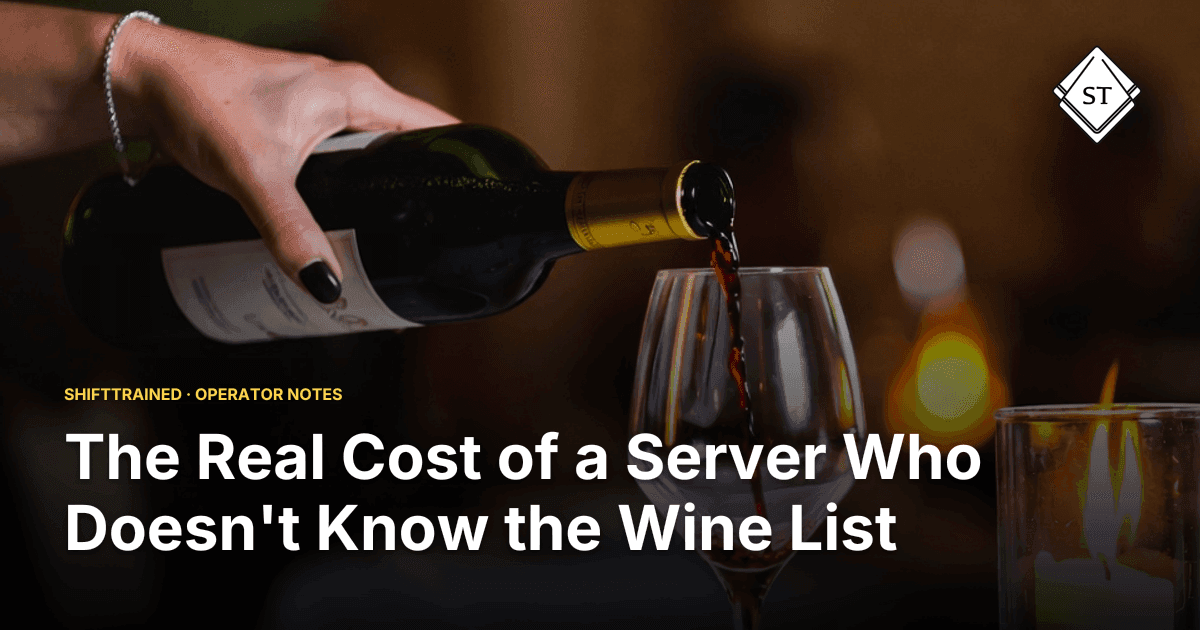
The Real Cost of a Server Who Doesn't Know the Wine List

Hey Team!
Let me tell you about a Tuesday night at Black Barrel Tavern about two years ago. Table of four, celebrating something, clearly in the mood to spend. Our server, good kid, working hard, gets to the wine question and says, "We have a really nice house red." That's it. That's the whole recommendation. House red. The table ordered two glasses.
I was watching from across the room and I felt it in my chest.
Not because the server did anything wrong, exactly. He just didn't know what else to say. He hadn't been trained on the wine list in any real way, so he defaulted to the only thing he was confident about. And that table, who would have happily spent $80 on a bottle of Malbec if he'd described it for thirty seconds, walked out having spent maybe $18 on wine.
Here's the thing nobody actually sits down and quantifies. That gap, the one between a confident wine recommendation and a shrug toward the house pour, is costing most full-service restaurants a significant amount of money every single week. And it's so gradual, so woven into the texture of normal service, that operators stop seeing it. It just feels like "that's how the wine program performs."
So let's do the math. Average bottle markup in a full-service restaurant runs roughly three times cost. A $50 bottle on your menu costs you somewhere around $16 or $17 to put on the table. When a server confidently recommends that $50 bottle instead of defaulting to a $12 house glass, you're looking at roughly $30 in additional revenue on that one interaction. Not theoretical revenue. Real revenue that was already in the room, attached to a guest who was ready to spend it.
Now scale that. A decent server on a solid shift gets five or six real wine conversations. Real ones, where the table is considering it. If they can confidently step into even five of those moments per shift, that's $150 in additional revenue from wine alone. Four shifts a week, that's $600 per server per week. If you've got four or five servers on floor on a given night, you start seeing how fast this compounds.
That's not a wine program problem. That's a training problem.
And I want to be careful here, because I'm not talking about upselling in the pushy, please-order-the-ribeye sense. I'm talking about a server who can say, "The Malbec we just brought in is really smooth, a little dark cherry, pairs great with the short rib you're looking at." That's not pressure. That's hospitality. That's a server doing their job well. The guest feels taken care of. They order the bottle. They tip more. They come back.
The problem is most wine training is a one-time thing. You hand a new server the wine list, maybe do a quick walk-through during onboarding, and then wonder why three months later they're still defaulting to house pours. Knowing a wine list isn't the same as being comfortable recommending from it. Comfort comes from repetition, from being quizzed on it, from having to retrieve the information under pressure enough times that it becomes instinct.
We ran into this at Fat Tommy's when we added a small but solid Italian wine program. The list wasn't complicated, maybe twelve bottles. But in the first month, bottle sales barely moved. Servers knew the list existed. They couldn't talk about it. So we started drilling it. What's the grape, what does it taste like, what's on the menu it goes with. Short questions, repeated often. Within six weeks, bottle sales on those twelve SKUs were up measurably. Same guests, same menu, same price points. Different server confidence.
Now let me be honest about something. The wine knowledge problem is just a visible version of a broader issue, which is that most restaurants train people once and assume the information sticks. It doesn't. Memory doesn't work that way. If your server learned your wine list during a two-hour onboarding session eight weeks ago and hasn't been tested on it since, they've retained maybe 20% of it. That's not a knock on your staff. That's just how human memory works without reinforcement.
The research on this goes back decades. We know that spaced repetition, being tested on something across multiple sessions over time, dramatically improves retention. We know that retrieval practice, having to actually pull information out rather than just re-read it, is more effective than re-studying. None of this is controversial neuroscience. It's just not how most restaurant training is built.
What works is short, frequent, specific practice. Not a lecture. Not a printed sheet. Quiz a server on five wine questions before their shift. Do it again next week with different questions. By the third or fourth week, those answers are in their long-term memory, not just floating around waiting to evaporate under the pressure of a busy Saturday night.
The $600-a-week-per-server number I gave you earlier? That's conservative. It doesn't account for tables that order a second bottle because the first recommendation was so good. It doesn't account for the bump in tips. It doesn't account for guests who come back specifically because that server made them feel like they were in good hands.
Your wine program isn't underperforming. Your training program is.
And the fix isn't complicated. It's just consistent. Test your people on what you need them to know, not once, but repeatedly, until it's reflex. The money's already in the room. You just need servers who know how to meet it.
Have a great day! — Terry Psaltakis
Your AI Restaurant Guy