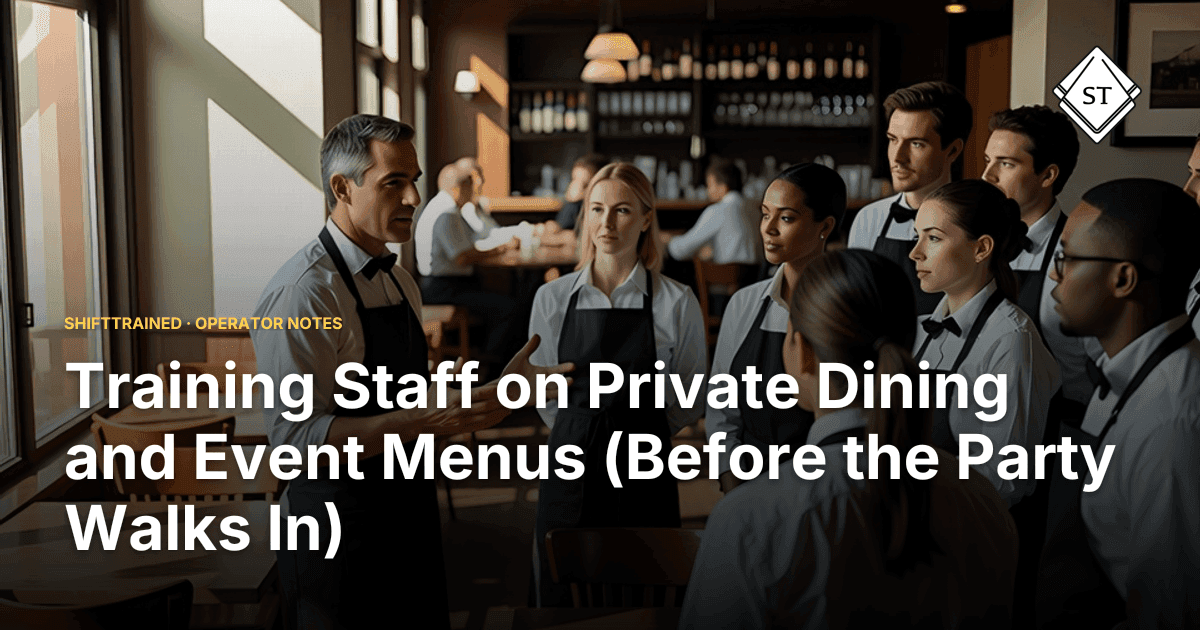
Training Staff on Private Dining and Event Menus (Before the Party Walks In)

Hey Team!
Private dining is one of the most profitable things you can do with your square footage. A buyout, a corporate dinner, a wedding rehearsal, a milestone birthday, you're running a fixed menu, the bar is usually pre-set, and the guests paid a premium to feel taken care of. The stakes are real.
And yet. I've watched operators, good operators, people who run tight ships, completely blow the training side of a private event. Not because they don't care. Because they treat the event menu like a last-minute announcement instead of a training event in its own right.
Here's what typically happens. The sales team closes a 60-person corporate dinner. There's a custom menu, three courses, a chicken and a fish option, one dessert. Maybe a dietary note or two buried in the banquet event order. The day of the event, someone prints the BEO. The captain or floor manager reads it aloud in a five-minute pre-shift. Staff nods. Doors open at 6:30.
By 7:15, a server is back in the kitchen asking what's in the sauce for the fish. Someone else sold a modification that wasn't part of the deal. A guest with a tree nut allergy, noted on the BEO, is now getting something that hasn't been cleared. The event coordinator, who's been at this venue before and expected it to go smoothly, is quietly furious.
I've lived that night. More than once.
The core problem is that we treat event menus like a variation on our regular menu, when they're actually a completely different operating reality. A regular service menu has depth. Staff has context. They've talked about the salmon seventeen times in pre-shift. They know what's in it, what it pairs with, how to sell it. An event menu is usually something they've never seen before, landing in their hands twenty minutes before service.
And because it's fixed, there's less room to recover. On a regular night, a server who doesn't know a dish can redirect. "Let me check on that for you." On a plated dinner for sixty, you don't have that runway. The courses are timed. The kitchen is running a sequence. There's no ad-libbing.
So what does actually work? Training the event menu the same way you'd train a new seasonal menu, just compressed into a shorter window. The BEO should go out to your event staff three to five days before the event, not three hours before. That sounds obvious. It almost never happens.
At Black Barrel Tavern, when we have a private event, the menu hits the floor team before the week is out. Staff can look at it, ask questions, and walk in knowing the proteins, the modifications that were pre-approved, and the allergy notes. By the time they're standing in that private room, it's not new information. It's review.
The allergen piece is where I get the most serious. Private event guests often have dietary restrictions that were communicated during the booking process and documented somewhere in the BEO. That note doesn't always make it from the sales sheet to the floor staff. And unlike a regular service where a guest can flag it themselves when ordering, a plated event often just arrives in front of them. They assume someone handled it. You need to know every allergy at the table before service starts, by name and seat number, not just "someone at table four has a shellfish allergy."
There's also the modification question, which is its own problem. Corporate clients and event planners often negotiate modifications when they book. Gluten-free option for the second course. Vegan alternative for two guests. No sauce on the protein for someone who submitted it in writing six weeks ago. That stuff gets lost. It lives in an email thread or a PDF that never made it to your floor staff. The server walks up with the standard plate and now you have a guest who specifically asked for something different when they paid a deposit months ago.
The other thing I'd flag is upsell behavior. Private events are not the night to freelance. I've seen servers try to sell a wine upgrade, push a cocktail add-on, suggest a dessert modification, all outside the scope of what was contracted. That sounds like initiative. To the event planner it looks like your team doesn't know what was arranged. The event was planned. Respect the plan.
What I've found is that when you give staff the event menu early, when you quiz them on the proteins, the modifications, the allergy flags, the run-of-show, something shifts. They walk into that room confident. Confident staff read the room better. They can tell when a guest is confused, when someone needs something, when a course timing is off. They're not burning mental cycles trying to remember what's in the sauce.
We built ShiftTrained in part because I got tired of the printed sheet method. Upload the event menu, get questions generated fast, staff takes them on their phones before the shift. The knowledge is there when they need it, not improvised on the floor. But regardless of what tool you use, the principle is the same. Pre-load your staff on the event menu the same way you'd pre-load them on any new offering. Give it time. Give it weight. The guest paid for an experience that required planning. Your training should match that.
Private events will make or break your reputation in ways that regular service rarely does. A bad night in the dining room is a bad Yelp review. A bad private event is a lost corporate account, a story that gets told at every planning meeting that person attends for the next three years. The margin for error is tighter than it looks.
Train for it accordingly.
Have a great day! — Terry Psaltakis
Your AI Restaurant Guy