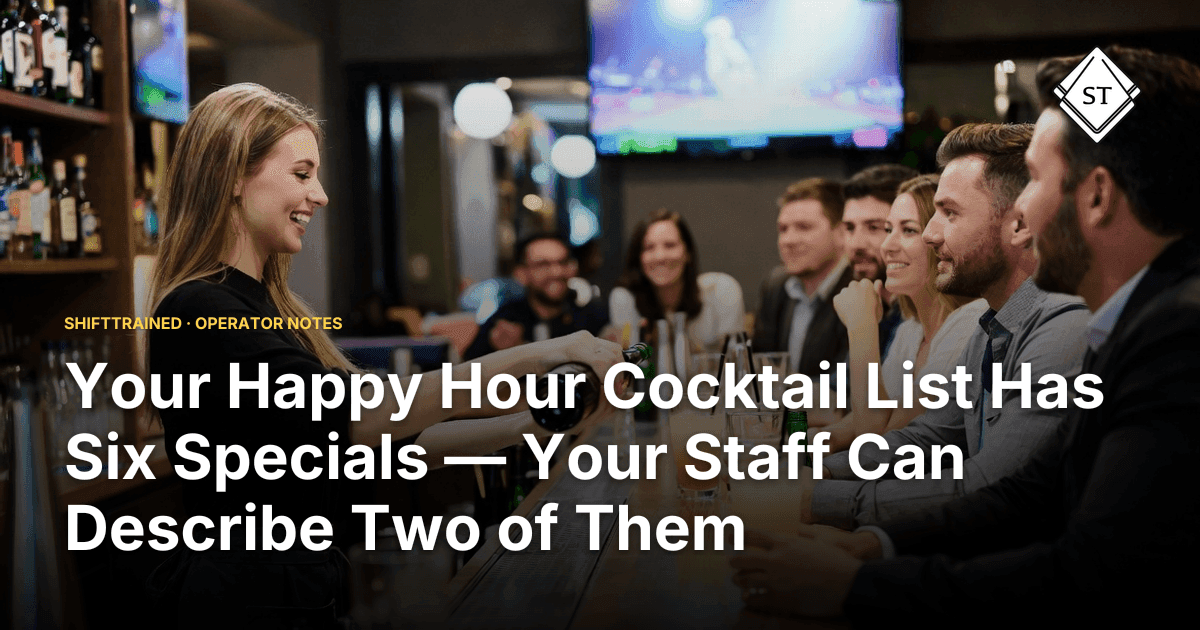
Your Happy Hour Cocktail List Has Six Specials — Your Staff Can Describe Two of Them

Hey Team!
Happy hour starts at 4pm. Your bartender knows the rail. Your server knows the tables. But ask either one of them what's in the cucumber gimlet and you're going to get a shoulder shrug and "it's pretty refreshing."
That costs you money every single shift.
Here's what I've watched happen in my own places more times than I can count. A guest sits down at 3:58, looks at the happy hour menu, and asks the first staff member they see, "What's good?" That's a buying signal. That's a guest who wants to be sold. And when the answer is "they're all pretty good" or "I honestly haven't tried them all," the guest picks whatever sounds familiar, a Bud Light, a house margarita, and you never upsold the $12 watermelon mule that's got a $4 margin advantage over the draft beer.
Multiply that across a four-hour happy hour window, across a full section of tables, and you've left a lot of money on the bar top.
The problem isn't that your staff is lazy. Most of them aren't. The problem is that nobody trained them on the actual descriptions. They got a menu. Maybe someone ran through the specials at a pre-shift meeting three Tuesdays ago. That's not training. That's information with no retention attached.
Six cocktails on a happy hour menu is not a lot. But here's what I actually see when I quiz staff on their own specials: two or three can describe confidently, two they can name but not explain, and one or two they've never even tasted or heard explained out loud. Six items on a printed card and your team is batting .333. That's fine for baseball. It's not fine when someone's asking you what to order.
Now let me tell you what actually closes this gap, because it's not complicated.
For every cocktail on your happy hour list, you need three things written down somewhere your staff can study. First, a one-sentence flavor profile. Not "it's citrusy with a hint of something." Something with a little specificity: "bright and tart with a cucumber finish, almost like a spa day in a glass." Staff can memorize a line like that. Second, the base spirit. Someone's going to ask. Especially guests who don't drink tequila, or who are watching what they mix with their medication. Your server should know without hesitating. Third, a food pairing from your actual menu. Not "it goes with anything." Tell them the cauliflower bites or the smash burger or the loaded queso. When a server says "that mule is really good with our wings because it cuts the heat," the guest orders both, and you just ran a better ticket.
That's the whole framework. Flavor profile, base spirit, food pairing. Fifteen words per cocktail, six cocktails, ninety words total. Your staff can learn ninety words before a shift.
The question is how you actually get those words from the paper into their heads before 4pm.
What I've seen work at Black Barrel is a short phone quiz the morning of the happy hour shift. Not a full training session. Not a workbook. Five questions on their phones, right when they're checking their schedule or grabbing coffee. Something like: "Which cocktail on tonight's happy hour menu is tequila-based?" or "Finish this description: the blood orange smash is bright and sweet with a..." The format doesn't matter as much as the timing. You're hitting them in the window when the shift is on their mind but hasn't started yet. That's when they'll actually engage with it.
The other thing the quiz does is flag who doesn't know. That's the part operators skip. You send out a training sheet and you assume everyone read it. A quiz tells you which three servers on tonight's floor have no idea what's in the specialty cocktail and which two actually do. Now your pre-shift is targeted. Instead of going over all six drinks for ten minutes, you spend five minutes on the two that came back wrong across the board, and you move on. That's the difference between a productive pre-shift and one where half the room already knew the material and tuned out.
One more thing worth saying. Guests who ask "what's good?" are not skeptical buyers. They want a recommendation. They're handing your staff an invitation to guide the order. When your server gives a confident, specific answer, something like "the passion fruit margarita is the move tonight, it's not too sweet and it's great with the flatbread," you've done two things. You've built trust, and you've started a second-round conversation. Because now that guest knows your staff actually knows the menu. They're going to ask again when it's time to reorder.
That trust doesn't happen with a shrug and a "they're all pretty good."
Training cocktail descriptions is not a big lift. It's about fifteen minutes of prep from whoever writes the happy hour menu: document the three facts per drink, turn them into five quiz questions, push it to the floor before the shift starts. The platform I built, ShiftTrained, does a lot of this automatically from whatever menu doc you upload. But even if you're doing it manually in a notes app or a group text, the logic holds. Specificity before service. Quiz before the bar opens. Know your two pairings, know your base spirits, and have one sentence ready for each drink.
That's the difference between a server who sells and a server who takes orders.
Have a great day! — Terry Psaltakis
Your AI Restaurant Guy
For more on putting this into practice, see how ShiftTrained approaches restaurant staff training.