Your New Manager Knows the Food — But Has No Idea How to Train Anyone on It

Hey Team!
Promoting from within is one of the best moves you can make. I've done it dozens of times over thirty years. You take someone who already knows the culture, already knows the food, already knows your regulars by name, and you hand them a bigger role. It feels right. It usually is right.
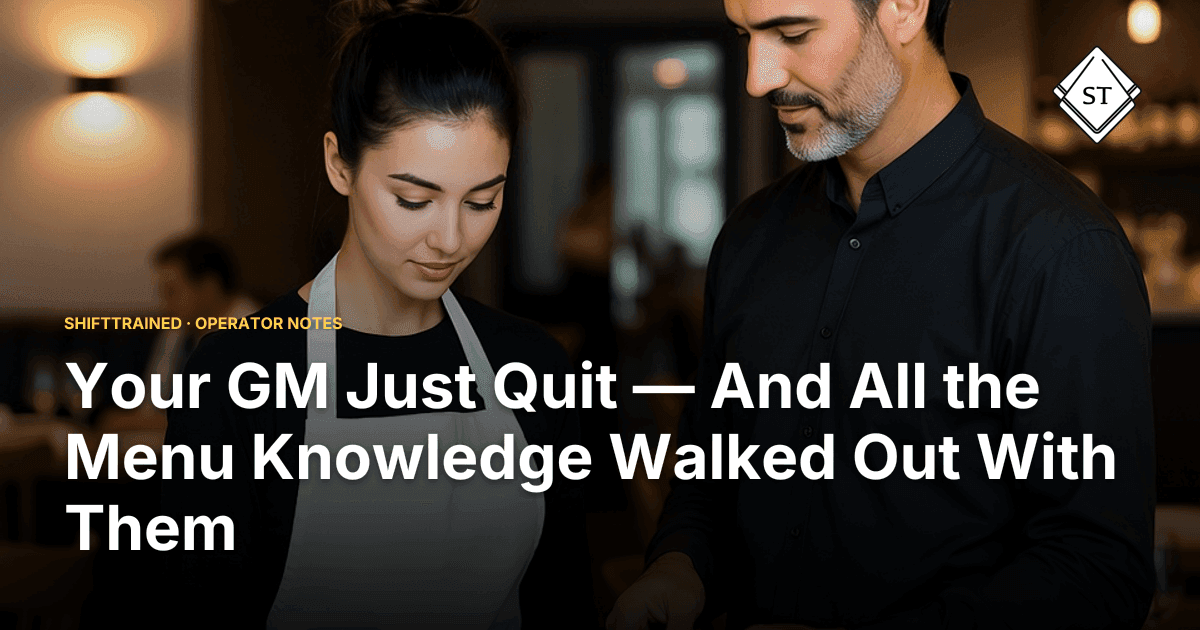
But there's a moment that happens, pretty much every time, that nobody talks about when you're making the promotion. The new manager runs their first pre-shift. They've got seven servers in front of them, maybe a new seasonal menu, and it's 4:45 on a Friday. And they freeze. Not because they don't know the food. They know it cold. They freeze because nobody ever taught them how to teach.
I've watched this play out more times than I can count. The person who was your best server, the one who could describe every dish on the menu with their eyes closed, suddenly has no idea how to figure out what the people standing in front of them actually know or don't know. So they do the only thing that feels natural. They talk. They walk through the menu out loud, hitting every modifier, every allergen, every suggested pairing. It sounds great. It feels productive. And almost none of it sticks.
That's not a knock on the manager. That's just what happens when someone is trained in a craft but never trained to transfer it.
The specific gaps are worth naming because they're consistent. The first one is that new managers have no real method for diagnosing what staff don't know. They just assume if they say it, people will learn it. A seven-minute verbal rundown on a new pasta dish tells you nothing about whether your servers can actually answer a table's questions ninety minutes later. The manager doesn't know what they don't know about their staff's gaps, and the staff doesn't retain what they only heard once while half-checking their phones.
The second gap is that lecturing replaces drilling. There's a big difference between telling someone a dish has a walnut-based sauce and making them answer, out loud or in writing, "what is the sauce base on table seven's favorite pasta?" One of those things creates a memory. The other creates the illusion of training.
The third gap is verification. Most new managers skip it entirely, not because they're lazy, but because they don't have a mechanism. They finish the pre-shift, they feel good about it, and they have no idea whether anyone actually absorbed anything. If a server blanks at the table, the manager finds out after the complaint, not before service starts.
Here's what I've learned actually works. The manager's job in training isn't to perform what they know. It's to find out what their staff doesn't know, and then close that gap before the guest ever has to experience it. That's a fundamentally different job, and it requires a fundamentally different set of tools.
The system I've found most useful is simple enough that a brand new manager can run it without much coaching. You upload the menu. The platform generates quiz questions from it automatically, anywhere from a hundred to four hundred questions depending on the depth of the content. Staff take the quizzes on their phones, before the shift or at home the night before. The manager doesn't have to build the questions, doesn't have to run a verbal drill, doesn't have to guess at what people know. They can look at the scores and see exactly who's got gaps and where. Then the pre-shift becomes a real conversation. The manager walks in knowing that three servers are shaky on the gluten-free modifications and one person hasn't completed the quiz at all. That's a coaching conversation, not a performance.
That's what I built at ShiftTrained, and it's what we run at both of my Chicago spots today. The thing that surprised me early on was that staff started retaking the quizzes voluntarily. On their own phones, between shifts, sometimes late at night. Not because we required it. Because the format actually works for how people learn now. Short. Interactive. On a device they already have in their pocket.
The manager's role shifts when the verification layer exists. They stop being the person who has to know everything and say it out loud. They become the person who monitors, adjusts, and coaches to the specific gaps the data surfaces. That's a manageable job for a first-time manager. The alternative, which is somehow developing a perfect sixth sense for what a seven-person team doesn't know about a forty-item menu, is not manageable. It's not even really a skill you can teach. It's just luck.
If you've promoted someone from within recently and they're struggling with their pre-shifts, I'd bet it's not because they don't know the food. It's because they don't have a structure that separates "what I know" from "what my staff knows." That gap is fixable. You don't need to send them to a management course. You need to give them a system where the quiz does the diagnosing and they do the coaching.
The best managers I've ever worked with weren't the ones who could describe a dish the most beautifully. They were the ones who could figure out, fast, who on their team had the hole, and close it before the first ticket fired.
Have a great day! — Terry Psaltakis
Your AI Restaurant Guy
For more on putting this into practice, see how ShiftTrained approaches a restaurant training program.