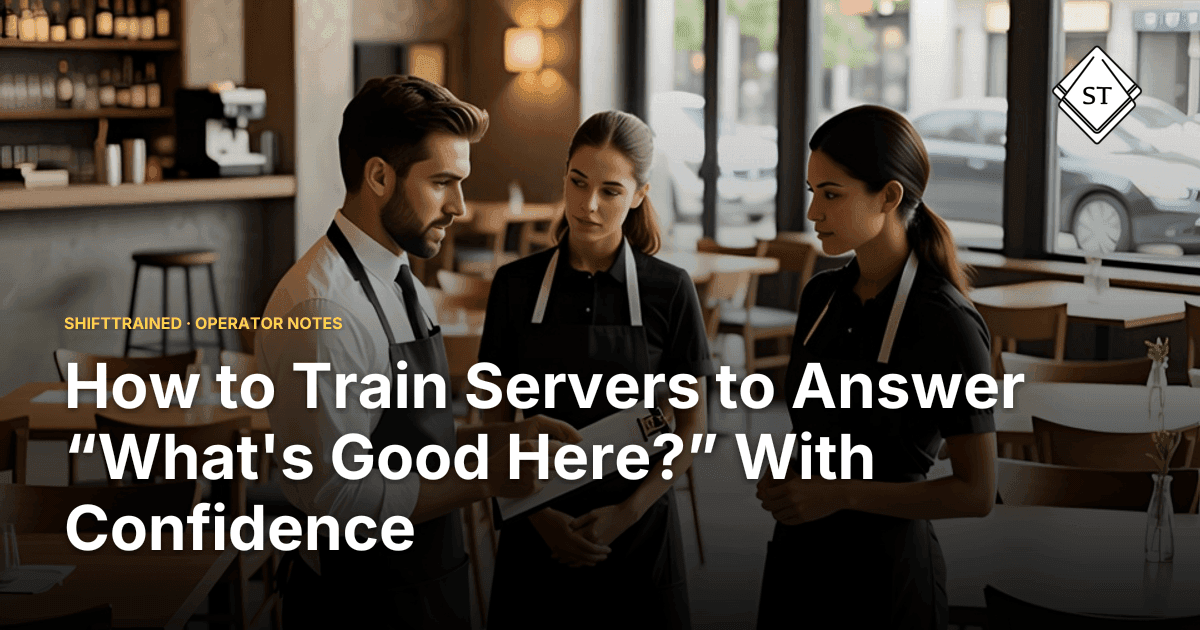
How to Train Servers to Answer “What's Good Here?” With Confidence

Hey Team!
Every server gets asked this within five minutes of a table sitting down. "What's good here?" Four words. And I'd bet serious money that in most restaurants, right now, tonight, at least half the staff is answering it wrong.
Not because they're bad servers. Because nobody taught them how to answer it.
The shrug is the worst version. Shoulders up, kind of a smile, "I mean, everything's pretty good." Guest nods. Picks something random. The moment is gone. What could have been the server becoming a trusted guide to that table for the next two hours just... evaporates.
The second worst version is the menu recitation. "Well, we have the salmon, and the ribeye is popular, and the pasta is really nice." That's not a recommendation. That's a reading. Guests can do that themselves. They're not asking you to read them the menu. They're asking you to tell them what to order.
Here's what that question is actually asking: it's asking the server to be an expert. To have a point of view. Guests ask it because they want someone to take the wheel for just a second and say "trust me, get this." That moment is a gift. Most servers throw it away.
The reason servers fumble it is almost always one of two things. Either they don't know the menu well enough to have a real opinion, or they've never been given a framework for how to express one. Both are fixable. Both are on the house.
When we opened Black Barrel Tavern, I watched table after table ask our bartender what she recommended off the new cocktail menu. She'd been behind that bar for years, knew what she liked personally, but she'd hedge. "The Old Fashioned is classic, the mule is good if you like ginger..." She'd trail off. The guest would order the Old Fashioned because it was familiar, not because it was the right call. The Smoked Manhattan she actually loved never got ordered because she never just said "get the Smoked Manhattan, here's why."
So we started doing something simple. Before service, every server and bartender had to commit to two things they were recommending per section of the menu. Not "things that are good." Things they would put in front of someone with no caveats. And they had to have a reason. One sentence. That's it.
Not "the ribeye is great." That's not a reason. "The ribeye is our wood-fired cut, it's finished with herb butter, and it's the thing our chef is most proud of on this menu", that's a reason. It takes three more seconds to say and it makes the guest feel like they're getting inside information. That's the feeling you're selling.
The framework I use is simple enough to train in fifteen minutes. Two recommendations per section, a reason for each, and at least one of them should be something the guest wouldn't have ordered on their own. Not the most expensive thing. Not the special-of-the-day by default. The thing the server would eat if they were sitting at that table. That specificity is what makes it land.
Menu fluency is the foundation. You can't fake a real recommendation. Guests hear the difference between a server who actually knows the dish and one who's reciting a training card. Which means before any server can answer "what's good here" with confidence, they have to know what's in every dish, where it comes from, what it tastes like, and what kind of guest tends to love it. That's not optional. That's the job.
At Fat Tommy's, we quiz staff on the menu before they ever hit the floor. Not because I want to be the homework teacher, but because I watched for years what happens when a server gets caught not knowing something. The table's confidence in them collapses. They go from guide to order-taker. And an order-taker doesn't sell, doesn't upsell, and doesn't get tipped the way a guide does. The quiz isn't a hoop to jump through. It's the thing that gives them the confidence to actually answer the question.
Once they know the menu cold, the two-recommendation framework does the rest. You rehearse it in pre-shift. You make it specific. "If someone asks what's good and they seem like they want something lighter, you say this. If they seem like a meat-and-potatoes guest, you say this." Scenario-train it. Don't just tell them to be confident. Show them what confident sounds like with this menu, tonight, with these dishes.
One more thing. Teach servers to follow the recommendation with a short close. "That's what I'd get" or "you won't be disappointed" or even just "it's really good." It sounds small. It isn't. That little affirmation is what tips a considering guest into a committed one. It also signals that the server actually stands behind what they said. And that's the whole point. You're not just training them to answer a question. You're training them to be someone the guest wants to take advice from.
That trust, once built in the first two minutes of a table interaction, carries through the whole meal. It's the difference between a guest who orders confidently and enjoys the night and one who second-guesses their choice and leaves feeling like they might have missed something. The "what's good here" moment sets the tone for everything that follows. Make sure your staff knows how to own it.
Have a great day! — Terry Psaltakis
Your AI Restaurant Guy