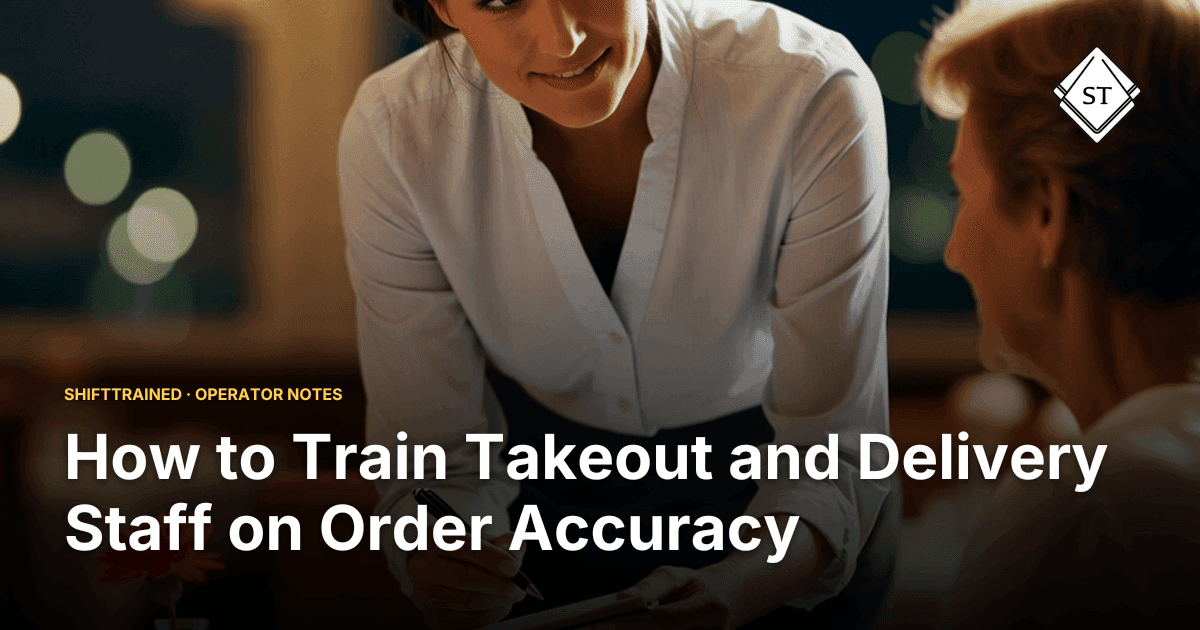
How to Train Takeout and Delivery Staff on Order Accuracy

Hey Team!
A wrong dine-in order is uncomfortable. A wrong takeout order is a disaster nobody sees coming until it's already three miles away and the guest is standing in their kitchen staring at the wrong thing.
I've watched operators treat off-premise almost like an afterthought. The kitchen gets trained, the front-of-house gets trained, and then somewhere in the middle there's a gap where the order gets bagged, stickered, and handed off without anyone truly owning accuracy. That gap costs real money. Not just the refund, not just the redelivery. The bad review that lives on Google for the next two years. The regular who just quietly stops ordering.
The problem isn't that your staff doesn't care. It's that nobody trained them on what "accurate" actually means for a bag that's about to leave the building.
Here's what I mean. When a server brings out a wrong plate, the guest flags them. You recover. Everybody moves on. When a delivery bag is wrong, there's no recovery window. The guest opens that container in their living room and they're already frustrated before they even call you. The feedback loop is broken by default. So your only option is to get it right the first time, every time.
Modifiers are where most orders fall apart, and not because people are careless. It's because modifiers don't get trained the same way the core menu does. Ask your staff to name the top ten modifiers your kitchen gets wrong under pressure and most of them will shrug. Ask your kitchen to name which modifiers require a completely separate prep step versus a simple swap and you'll get ten different answers. That's the gap. Modifiers need to be trained with the same specificity as the dish itself. "No onions" on a burger is a pull. "No onions" on a breakfast burrito that gets built from scratch means something different. Staff need to know which is which before they're handling volume on a Friday night.
Allergens in a takeout context are serious in a way that's different from the table. At the table, you can ask. You can confirm. The bag doesn't talk. If a guest marked a shellfish allergy on a third-party platform and that note doesn't make it to the kitchen clearly, you're not just looking at a refund. So allergen training for your off-premise staff has to cover the full chain: where the allergy flag shows up on the ticket, who confirms it before bagging, and what the fallback is when it's unclear. Write that down. Make it a checklist if you have to. Don't rely on memory when the stakes are that high.
Now let me tell you what I see working. The operators who run clean off-premise programs treat the bag itself as a last line of defense. Every container matched to the ticket before it's sealed. Cold sides separate from hot food, not because the app says so, but because your staff knows a lukewarm container is a one-star review. The person doing the bagging isn't just packing, they're reading the ticket line by line. That's a different job than "put the food in the bag." It needs to be framed that way and trained that way.
One thing that helps is drilling against the actual modifiers in your system. Not hypothetical modifiers, not generic quiz questions about allergens in the abstract. Pull your real tickets from last month and find the ten modifiers that showed up most. Use those. If you run a wing joint and "bone-in, extra crispy, sauce on the side" shows up forty times a week, that's what your staff should know cold. If your pizza shop does half-and-half orders with different sauce bases, that's where your training should live. Generic training produces generic results. Specific training produces accurate bags.
I built ShiftTrained specifically because I couldn't solve this with paper quizzes and a ten-minute pre-shift rundown. When we upload a menu at Fat Tommy's, the platform generates questions on our actual modifiers, our actual allergen flags, our actual packaging notes. Staff quiz on it on their phones. They come in knowing what "no cross-contamination, separate packaging" means on a gluten-sensitive order before they touch the first bag of the night.
The behavior you want to reinforce is verification as a habit, not a check. There's a difference. A check feels like a burden. A habit is just how you do the job. The way you get there is repetition, and the way you get repetition is training that's short enough to actually happen and specific enough to actually stick. Not a one-hour onboarding video about the importance of accuracy. Fifteen focused questions on your real menu, your real modifiers, your real ticket flow.
One more thing. The third-party platforms are going to keep growing. More orders off-premise, more distance between your kitchen and your guest. You can't control what happens once the bag leaves. But you can control the thirty seconds before it does. Build a culture where nobody hands off a bag without reading the ticket against what's inside. That's it. That's the whole system. Every piece of training you build should point toward that thirty seconds.
The guests who order delivery are giving you a real opportunity. They chose you. They didn't walk in somewhere else. A right order is how you earn the next one.
Have a great day! — Terry Psaltakis
Your AI Restaurant Guy
For more on putting this into practice, see how ShiftTrained approaches menu training software.