Your Whiskey Wall Has 40 Bottles — Your Staff Can Name Three of Them

Hey Team!
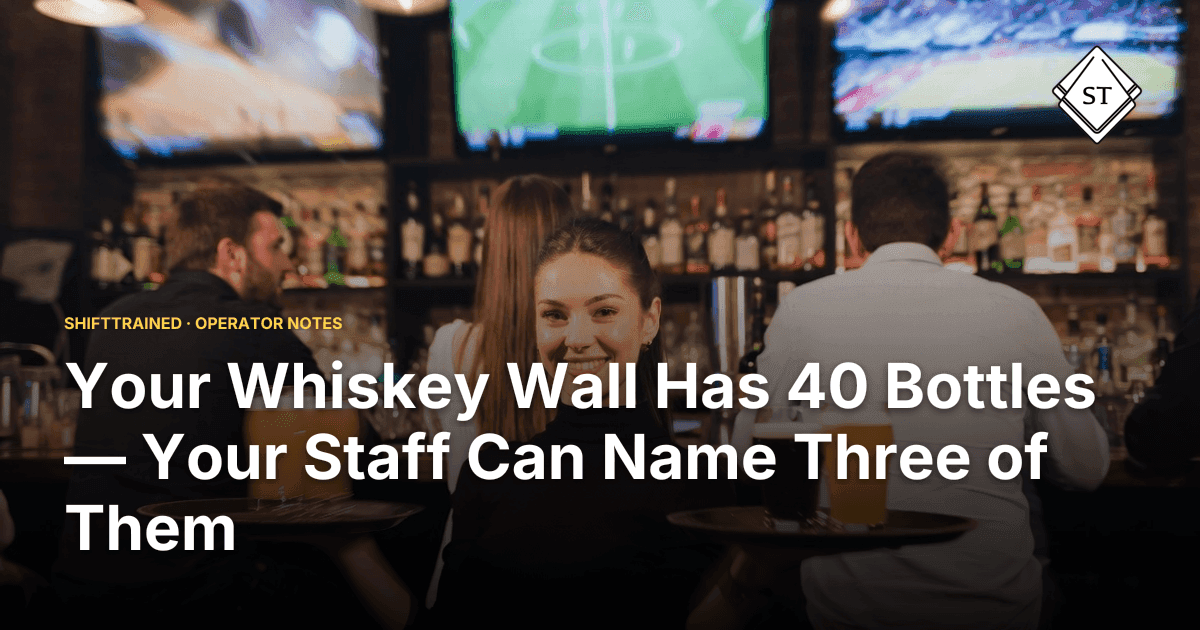
Walk behind most bars in this country and you'll find the same thing. Forty, maybe fifty bottles of whiskey lined up on the back wall. Beautiful labels. Great margin. And a staff that can confidently name three of them.
That's not a knock on your servers. It's a systems problem. Nobody ever taught them the stuff in a way that stuck.
Here's why it matters financially. Bourbon, rye, scotch, Japanese whisky, these are some of the highest-margin pours on your menu. A server who talks a guest into a Basil Hayden's instead of a well bourbon just added four or five dollars in margin on a single drink. Do that twelve times on a Saturday night shift and you've moved the needle on your weekly revenue without changing your cover count, without a promotion, without printing new menus.
But most spirits upselling dies at the same moment. Guest asks "what's a good whiskey?" Server says "it's pretty smooth." Guest orders whatever they already know. Money left on the table.
The fix isn't handing your staff a laminated sheet with tasting notes. Nobody reads those. The fix is building spirits knowledge in layers, the same way you'd teach anything that has to live in someone's brain during a busy Friday service.
Start with the category layer. Before a server can sell anything, they need to understand the basic shape of the category. Bourbon is American, made from at least 51% corn, usually sweeter, often with vanilla and caramel from new charred oak. Rye is spicier, drier, less sweet, it's the one that makes a Manhattan sing. Scotch is made in Scotland, usually with malted barley, and the flavor profile can swing wildly depending on the region. A blended Scotch like a Famous Grouse drinks completely differently from a peated Islay single malt. Japanese whisky tends to be balanced and precise, lighter on the smoke, great for guests who say they're "not really a whiskey person."
That's not a lot of information. That's four sentences. Your staff can know that. And once they have it, they can do something with it.
The second layer is your pour hierarchy. Every bar has it but most staffs couldn't draw it. Well pours, house pours, call, premium, super-premium. Your servers need to know specifically what sits at each level and roughly why, not the full production story, just enough to justify the price difference in one sentence. "Our house pour is a good solid bourbon. If you want something a little more interesting, we've got Angel's Envy, which is finished in port wine barrels, that's why it's a little softer and sweeter than most." That's it. Thirty seconds. Guest is now engaged instead of just picking a number off the menu.
The third layer is where you actually make money. Two or three storytelling hooks per bottle on your premium shelf. Not a full distillery tour. Just one interesting thing a server can drop naturally in conversation.
The sherry cask example is real. Glenfarclas, Macallan 12 Sherry Oak, a lot of Highland Park expressions, they're finished or matured in sherry casks, which means the whisky picks up dried fruit, a little raisin, sometimes a dark chocolate note. A server who can say "this one spent time in sherry casks, so it's got a little more dried fruit than you'd expect from a Scotch" is doing two things at once. They're giving the guest information and they're signaling that they know what they're talking about. That trust closes the upsell.
Same principle works everywhere on the shelf. Knob Creek is aged nine years in a smaller barrel entry, which is why it hits harder and tastes more intense than most bourbons in its price range. Buffalo Trace is the starter point for a huge amount of what's on the Pappy family tree, which is a fun piece of context for a guest who's heard of Pappy but has never tried anything from that distillery. Bulleit Rye has an unusually high rye content, which makes it one of the spicier options on the shelf and a natural for guests who want their Old Fashioned to have a little more bite.
None of these are secrets. They're just things your staff probably doesn't know because nobody sat down and taught them.
The training process doesn't have to be complicated. Pick eight to ten bottles from your premium shelf. For each one, write down the category, one sentence on why it costs what it costs, and two tasting descriptors a normal person would understand. Not "barnyard notes with a floral retronasal finish." Say "a little smoky, with something almost like dark chocolate at the end." Quiz your staff on it. Repeat it. Let them taste when you can. The knowledge compounds fast once they have the framework to hang it on.
I built spirits training into ShiftTrained because I watched this problem play out in my own places for years. A server can absorb a lot if you give it to them in the right format at the right time. Short, specific, repeatable. Not a binder. Not a lecture before a Friday dinner rush when they're already thinking about their section.
The whiskey wall is a revenue asset. Right now, for most restaurants, it's mostly decoration. A server who knows even half of what's on that wall, knows the categories, knows the hierarchy, knows two hooks per bottle, will outsell a table tent every single time. Table tents don't answer questions. Your staff does.
Have a great day! — Terry Psaltakis
Your AI Restaurant Guy
For more on putting this into practice, see how ShiftTrained approaches wine training.