Your Patio Menu Is Different From Your Dining Room Menu — Most of Your Staff Doesn't Know That

Hey Team!
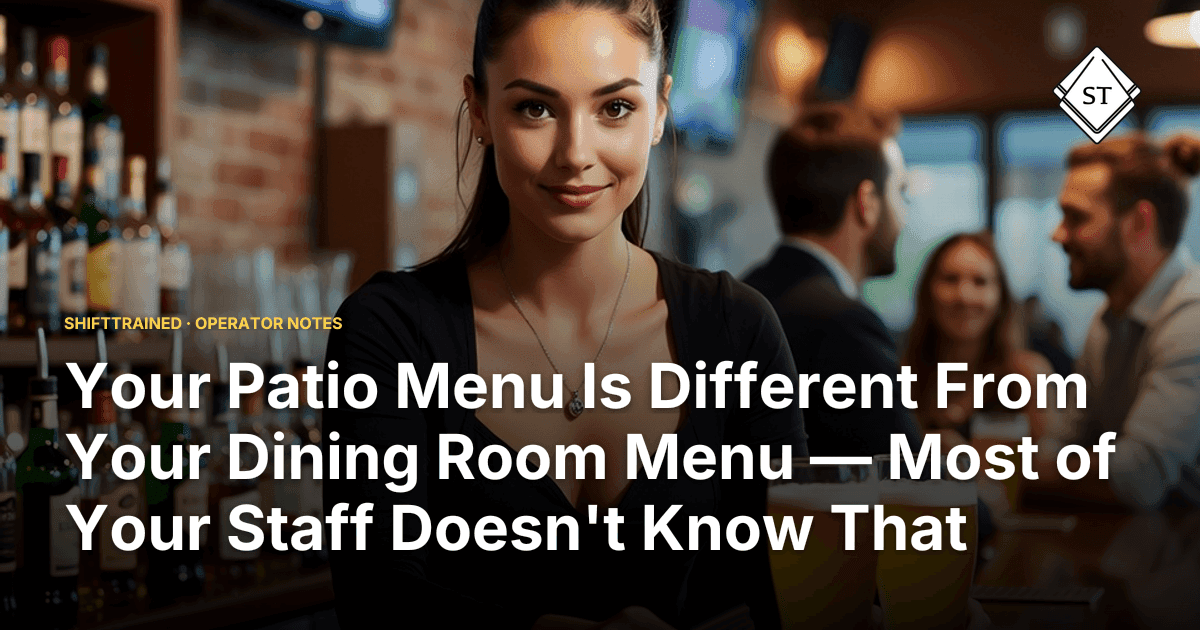
Summer hits and suddenly you're running two restaurants. One inside, one outside. Same building, different menus, different rules, different everything. And most of your staff has no idea.
I watched this play out at Black Barrel Tavern a few summers back. We opened the patio mid-May, rolled out a patio-specific menu: half the food items, two frozen drink specials, a couple of shareable boards that weren't on the dining room menu at all. We briefed the team before opening weekend, did the usual walk-through, answered questions. By Saturday afternoon we had servers quoting dining room prices to patio guests, a runner delivering a dish to the patio that we weren't even plating out there, and a bartender who had no idea the frozen mango margarita was a patio-only call. One guest got upset. Not because we couldn't make the dish, but because she'd been told we could, waited forty minutes, and then found out we couldn't.
That's a training problem. That's it. Good people, bad system.
Here's the part nobody talks about: a single pre-shift briefing doesn't actually split into someone's brain as "dining room = this, patio = that." When you dump both menus at once and say "the patio is abbreviated," what staff actually retains is the main menu, because that's what most of them have been tested on, quizzed on, and running for months. The patio version feels like a footnote. It gets treated like one.
The failure modes are pretty consistent across every place I've seen run a seasonal patio. First, servers quote prices from the wrong menu. Your patio burger is $14, your dining room burger is $17 because it comes with a different set of sides. Guest gets the check and it's not what they were told. That conversation is awkward every single time. Second, servers offer items that aren't available outside. A guest asks "can I get the nachos?" and the server says yes, because nachos are on the menu they memorized. Except the kitchen isn't running nachos to the patio because the expo line doesn't flow that way. Now someone's walking back to that table to explain it. Third, no one knows the outdoor specials are actually specials. You built a frozen sangria program specifically for the patio. You priced it to move. You want servers excited about it. But if nobody knows it exists, or knows what's in it, or knows it's not on the QR code inside, they're not mentioning it. You left money on the table.
The fix isn't a longer pre-shift. It isn't a laminated cheat sheet stuffed in an apron pocket that gets forgotten by 6pm. It's segmented training by station.
Stop training your whole team on one menu. Train your patio staff on the patio menu. Train your dining room staff on the dining room menu. Overlap where it makes sense, separate where it doesn't. If someone is floating between both, they need to understand both, and they need to know the difference explicitly, not assume it.
When I built the platform I use at my restaurants now, this was one of the things I wanted to solve directly. We can generate a separate quiz set from a separate menu upload. Patio server gets patio questions. Dining room server gets dining room questions. Bartender covering the outdoor rail gets questions specific to the frozen drink program. It takes minutes to build because the AI handles the generation. Staff takes it on their phones before their first patio shift. No stack of papers, no three-hour training session that nobody fully absorbs.
The difference that actually shows up is staff confidence. A server who has been specifically quizzed on the patio menu, who got a question wrong and learned the right answer before they ever took a table, is a different server than one who "sat in on the walkthrough." They know the two boards that are patio-only. They know the frozen drinks. They know which dining room items don't cross outside. That confidence translates directly into tableside conversation. It's the difference between "I think we have that" and "Yeah, that's actually a patio exclusive, you picked a great one."
One more thing worth saying. Summer patio menus change. You'll add a special, drop something that isn't moving, swap out a frozen cocktail when a spirit runs short. Every one of those changes needs to hit your patio staff specifically, not your whole team. If you're running training as one big undifferentiated blob, a menu change goes out to everyone and applies to no one cleanly. Segmented training means a change to the patio menu triggers a quiz update for patio staff. It's contained. It's relevant. It actually lands.
I've been doing this for thirty years and the thing I keep coming back to is that most service failures aren't attitude failures. Your servers aren't lazy. They want to do the job right. But you can't hand someone a forty-item menu and a twelve-item patio menu, run a group walkthrough, and expect them to perform with precision under Saturday night pressure. That's not how people learn. It's not how retention works. You have to build the training to match how they actually work, which is by station, by role, by the specific set of things they're responsible for knowing tonight.
Your patio is an asset. You paid for that space. You built a menu for it. You hired staff to run it. Train them on it like it matters, because it does.
Have a great day! — Terry Psaltakis
Your AI Restaurant Guy
For more on putting this into practice, see how ShiftTrained approaches menu training software.