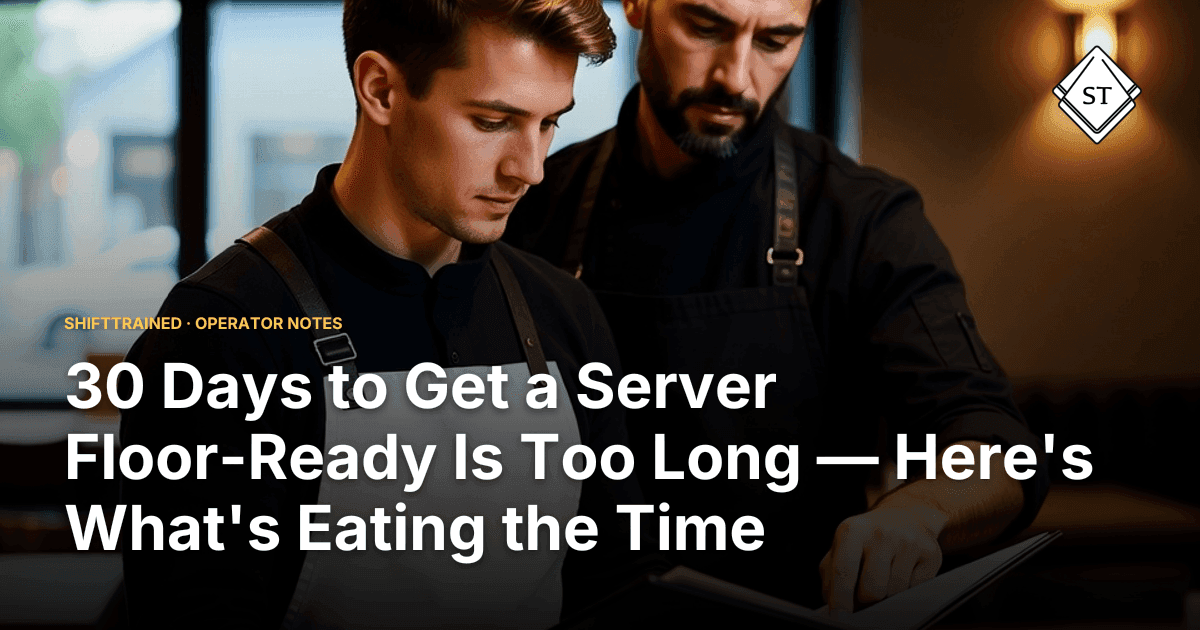
30 Days to Get a Server Floor-Ready Is Too Long — Here's What's Eating the Time

Hey Team!
Thirty days. That's what most operators budget when they bring on a new server. Four weeks of hand-holding before someone is actually carrying their own section and generating real revenue. I've heard it from operators across the country, and for a long time I said the same thing myself. That's just how long it takes.
Except it isn't. I know that now. And when I look back at 30 years of opening restaurants and watching new hires stumble through their first weeks, the culprit is almost always the same thing. It's not steps of service. It's not learning the POS. It's not sidework, rollups, or table numbers. It's menu knowledge, or the lack of it, and the way we've always tried to fix that problem makes everything else slower.
Here's what the ramp actually looks like at most places. Day one, someone hands the new hire a printed menu and a copy of the employee handbook. Maybe they walk through the kitchen, get introduced to a few cooks, taste two or three things if you're generous. Then they shadow someone. Then they shadow again. Then they shadow a third time because they still can't describe the burger without reading off the menu card. Meanwhile, the trainer is stuck babysitting instead of running their section at full speed. The new hire feels embarrassed. The guest feels it. And the manager is watching week two start to look a lot like week one.
What nobody says out loud is that the shadowing just keeps going because the new hire isn't ready, and the reason they're not ready is that nobody ever actually made sure they knew the food.
I've had servers on my floor who could set a table perfectly, greet with genuine warmth, and still completely freeze when a guest asked whether the queso had dairy in it. That's a confidence killer. When someone doesn't know the answer to a basic question about what they're selling, they start hedging, they start walking away to find a manager, and the guest clocks it immediately. You lose the table. Sometimes literally.
The fix isn't more shadowing. It's front-loading the menu before someone ever puts on an apron.
Here's what a real two-week ramp looks like when you actually structure it this way. Day one, the minute the hire paperwork is done, they get access to menu training on their phone. Not a PDF to "review at home." Actual quiz-based training built directly from your menu. Dishes, ingredients, prep methods, allergens, the modifiers that matter. They're testing themselves the same night they got hired. Day two, day three, day four, same thing. Ten minutes before bed, ten minutes on the bus, whenever. They're getting faster and they're starting to build real recall.
By day seven, you run a proper certification. Not a vibe check. An actual scored quiz. Can they describe every entrée? Do they know what the soup is made with? Do they know which items can be made gluten-free and which ones absolutely can't? If they pass, they move. If they don't, you know exactly where the gaps are, and you fill them before they hit the floor.
Day eight, nine, ten. Now they shadow. But it's different this time. They're not shadowing to learn the food because they already know the food. They're shadowing to learn the rhythm of the floor, how the kitchen communicates during a rush, how the POS flows, where everything lives. That stuff takes maybe three shifts to click, not three weeks. By day ten or eleven, they're picking up tables with a trainer nearby, and by day fourteen, most of them are running their own section with real confidence.
I've watched this play out at my own spots. The servers who come in with solid menu knowledge move completely differently on the floor. They make eye contact instead of looking down at the menu card. They suggest things. They answer allergen questions without flinching. Guests trust them faster, and when guests trust their server, check averages go up. That's not a theory. That's just how it works.
The other thing worth saying: training this way is better for the new hire. Walking onto a busy floor and not knowing your food is genuinely stressful. It's one of the main reasons people quit in the first 90 days. Cornell's research on restaurant employee turnover puts the cost of replacing a single restaurant employee at over five thousand dollars. Compressing ramp time and building actual confidence before someone hits the floor is one of the simplest ways to protect that investment.
What I built with ShiftTrained came directly from watching this gap play out for three decades. Upload your menu, the platform generates quiz questions in minutes, staff trains on their phones before their first real shift. No manual entry, no binders, no hoping someone reads the laminated card in the back. The point isn't the technology. The point is that menu knowledge is the bottleneck, and it's a bottleneck you can actually clear before day one on the floor.
Thirty days is a habit, not a requirement. The time is getting eaten by unstructured menu learning that never really finishes. Fix that part, and the rest of the ramp compresses on its own.
Have a great day! — Terry Psaltakis
Your AI Restaurant Guy
For more on putting this into practice, see how ShiftTrained approaches wine training.