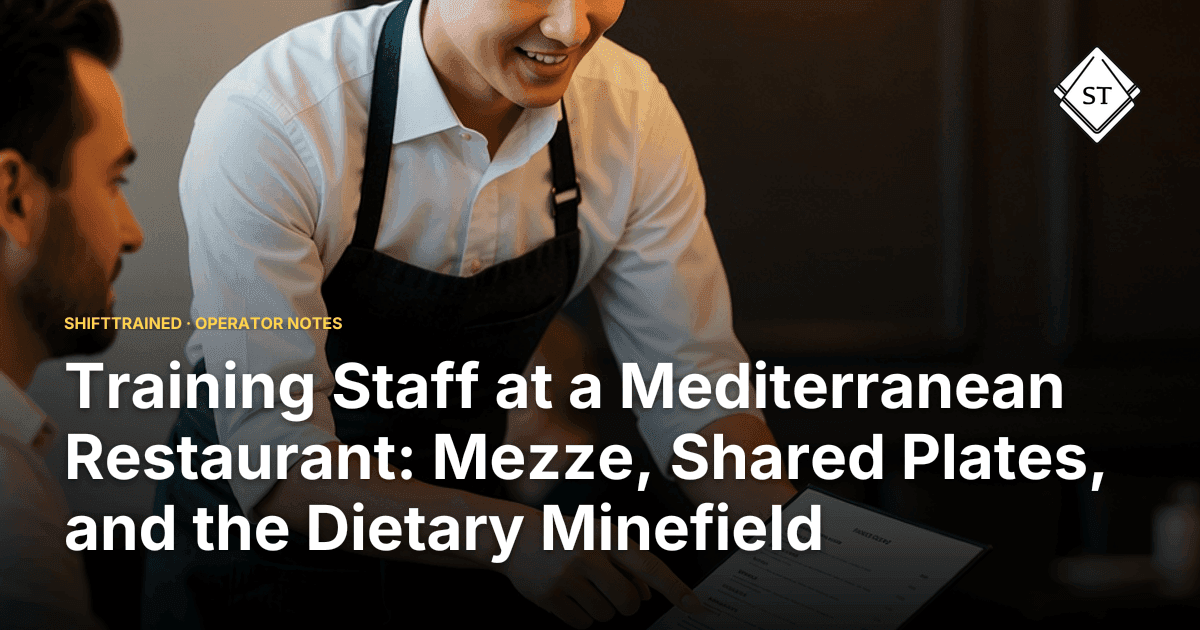
Training Staff at a Mediterranean Restaurant: Mezze, Shared Plates, and the Dietary Minefield

Hey Team!
Mediterranean menus are beautiful. They're also a minefield, and I say that with genuine respect for the cuisine. When a guest asks "does anything have nuts?" at a concept built on tahini, pine nut-studded rice, and walnut-dressed salads, your server has about four seconds to either nail it or accidentally hurt someone. The shared-plate format makes that pressure worse, not better. Let me walk you through what I've seen go sideways and how to actually train against it.
Start with the five dishes that consistently trip up servers. Hummus is the obvious one, but it's obvious in the wrong direction. Servers learn "hummus has tahini, tahini is sesame" and they stop there. What they miss is that the hummus might be the safest thing on the table, but the plate it comes out on got drizzled with a house oil that also sees pine nuts somewhere upstream in prep. That's a kitchen conversation, not a menu conversation, and your servers need to know the difference. Grape leaves are the second one. Guests see a vegetable-forward package and assume vegetarian or vegan-safe. A lot of grape leaf recipes have ground lamb tucked inside. Some have rice cooked in a chicken stock. The server who says "oh those are fine, they're just stuffed with rice" is the server who costs you a table and potentially a lawsuit. Baba ganoush trips people up because it reads as an eggplant dish, which it is, but again tahini is in there and often the prep station is shared with other sesame-heavy items. Tzatziki looks dairy-obvious, but guests with multiple restrictions sometimes miss the garlic-herb oil that finished it, and you'd be surprised how many people have garlic sensitivities stacking on top of their dairy issues. Finally, spanakopita. Filo dough, butter, cheese. That's three potential issues before you even get to the filling, and servers routinely call it "just spinach and cheese" because that's what they remember from the menu description.
Here's the thing about shared plates specifically. À la carte service gives your server some cover. One guest orders one dish, you discuss that dish, you confirm what's in it. Mezze service means four people order eight plates to share, all arriving at roughly the same time, and the guest with the tree nut allergy is reaching across the table while someone else is scooping from a pine nut-topped muhamarra. The allergen risk isn't just in the dish anymore. It's in the format. Your servers need to understand this and say it out loud. Not in a scary way, but clearly. Something like "a couple of these have tahini and we have pine nuts on the table, so if anyone's got a nut sensitivity let me flag those for you before we order." That sentence takes eight seconds. It prevents a lot of damage.
The pitch for shared plates is also a skill in itself. Servers at Mediterranean concepts need to be able to sell the communal experience without steamrolling the dietary conversation. Those aren't opposites. We trained the staff at one of my Chicago spots to think of it as a two-beat move: first you sell the spirit of the table ("this is meant to be passed around, get a little of everything"), then you make space for the flags ("before we lock in, anyone working around anything?"). The menu knowledge has to support that second beat. If your server confidently sells the adventure and then can't answer a specific question about sesame, you've created a trust problem. Guests feel the gap.
Speed of recall matters more in mezze service than most operators think. When someone orders four courses à la carte across two hours, a server can pause, check, come back. When eight dishes land at once, that server is fielding table questions in real time while also managing plate placement and upselling the wine. Slow recall isn't just a training gap, it's a service gap. The server who hesitates on "wait, does the fattoush have anything in the dressing?" while three other people are asking about the kebabs is losing the table. This is why I believe in quizzing, not shadowing. Shadowing gets you through the first two weeks. Quizzing gets you recall under pressure, which is what mezze service actually demands.
At ShiftTrained, the platform I built, we generate quiz questions directly from your menu, including the allergen flags you upload. Mediterranean operators have been some of the best early adopters because their menus demand exactly this kind of fast, specific recall. A question like "what two allergens are present in the classic hummus and how does the prep station affect cross-contact risk?" is a different level of learning than "name three dips on the mezze menu." Both matter. Only one of them saves you at 7pm on a Friday when the table in the corner has two sesame allergies and a question about the chef's mezze spread.
Training for this style of menu also means being honest with your staff about what they don't know. Sesame got added to the FDA's major food allergen list as the ninth allergen in January 2023. A lot of servers, especially those trained before that update, are still operating on an eight-allergen mental model. Tahini, sesame oil, sesame seeds on a za'atar spice blend, the sesame paste worked into some house dressings. These are all the same risk. Your training needs to make that explicit, not assume they've kept up with regulatory changes on their own.
Mediterranean food done right is some of the most hospitable food in the world. The whole format is built around generosity, sharing, lingering. Your servers can absolutely deliver that experience. They just need the knowledge to protect the guests who are trusting them while they do it.
Have a great day! — Terry Psaltakis
Your AI Restaurant Guy