Tableside Is a Performance — Here's How to Train Staff to Pull It Off

Hey Team!
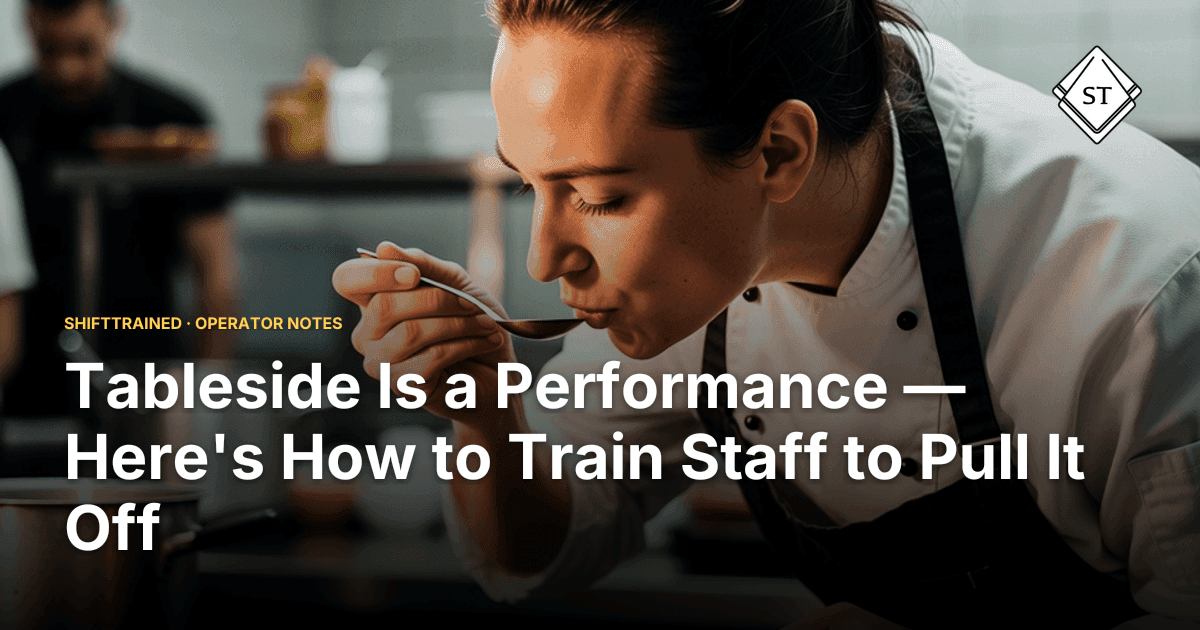
Tableside service is one of the most powerful things you can do in a dining room. When it's done right, the whole room watches. When it's done wrong, the whole room watches. That's the thing nobody tells you when you decide to put Caesar salad or bananas foster on your menu.
I've been in rooms where a server finished a tableside Caesar and the table next to them flagged down the manager to ask how to add one to their order. I've also been in rooms where a server fumbled the anchovies, forgot why the egg gets coddled, and answered every guest question with "I'm not totally sure." The dish is the same. The outcome is completely different.
Tableside preparation is theater. But unlike a stage production, your server doesn't get a second run if they blank in act two. So the question isn't whether to offer it. The question is how you build the knowledge and muscle memory before a staff member ever strikes a match or picks up a pepper mill in front of a paying table.
Here's how I think about it. Tableside work has three distinct layers, and most operators only train one of them.
The first layer is physical execution. The steps. The sequence. Which bowl you use, how you build the emulsion, the order you add ingredients, how you control the flame if you're doing something like bananas foster. This is the part that gets rehearsed in the kitchen before service. Every time. The server has to be able to do it without thinking, because the moment they have to think about what comes next, the table feels it.
The second layer is narration. Tableside service lives and dies on whether the server can talk through what they're doing in a way that sounds natural, not recited. Guests aren't watching a cooking class. They want to feel like they're part of something. "I'm going to char this citrus for about thirty seconds to pull out the oils before I press it" tells a story. Silence with occasional glancing at the gueridon doesn't. The narration has to be practiced just like the physical steps. I tell my staff to treat it like sportscasting. You're calling the action as it happens, and you already know what's coming.
The third layer is recovery. Something will go wrong. The lemon slips. A guest asks whether the dressing has anchovies right as you're pressing them into the bowl. Someone at the table has a walnut allergy and mentions it halfway through a dish prep that has walnuts in it (this happened at Fat Tommy's during a gueridon service and our server caught it because she knew every ingredient cold). Recovery isn't improvisation. Recovery is trained. You prep your staff with the three or four things that can go wrong and you rehearse the exact sentence they say when it happens. Matter-of-fact. Calm. Not apologetic in a way that signals panic.
Now let me tell you where most operators skip steps. They train physical execution, do a few run-throughs in a pre-shift, and call it done. Then on Saturday at 8pm, a guest asks mid-prep what makes the dressing emulsify, and the server either freezes or gives a wrong answer. The physical steps were fine. The knowledge wasn't there. And when someone doesn't know *why* a step exists, they can't answer questions about it, they can't adjust when something goes sideways, and they can't narrate it with any confidence.
At Black Barrel Tavern we treat tableside items as a separate certification. Not a long one. But a real one. The server has to demonstrate the prep, narrate it out loud to another staff member playing a guest, and answer five guest questions about the dish without hesitation. Some of those questions are easy. Some are designed to trip them up. "Is there dairy in this?" "What does coddled mean?" "Can you make it without anchovies?" They've heard the questions before they ever hear them from a table.
The knowledge-before-execution rule is the thing I'd put in big letters if I could. It's not enough to know the steps. You have to understand the steps. Because understanding is what makes narration sound real instead of rehearsed. It's what gives a server the confidence to pause mid-prep and actually engage with a guest's question instead of fumbling through an answer just to get back to the task. And it's what keeps a small mistake from becoming a visible one.
One more thing I'd say to any operator considering tableside or trying to get more out of what they're already running. Film it. Have a senior server do the prep on video, narration included, and let the staff study it before they run it live. At ShiftTrained, the platform I built, we generate quiz questions off menu content so staff can get tested on the ingredients and technique before they ever touch the gueridon. But even if you're not using a platform, the principle holds. Knowledge has to come before execution. Not during. Not through trial and error in front of a table of eight.
Tableside service can be one of the best margin decisions you make. Guests order more. They linger longer. They tell people about it. But it requires staff who know the dish the way a chef knows it, not just the sequence of motions. Build the knowledge, build the narration, and build the recovery. Then let them perform.
Have a great day! — Terry Psaltakis
Your AI Restaurant Guy