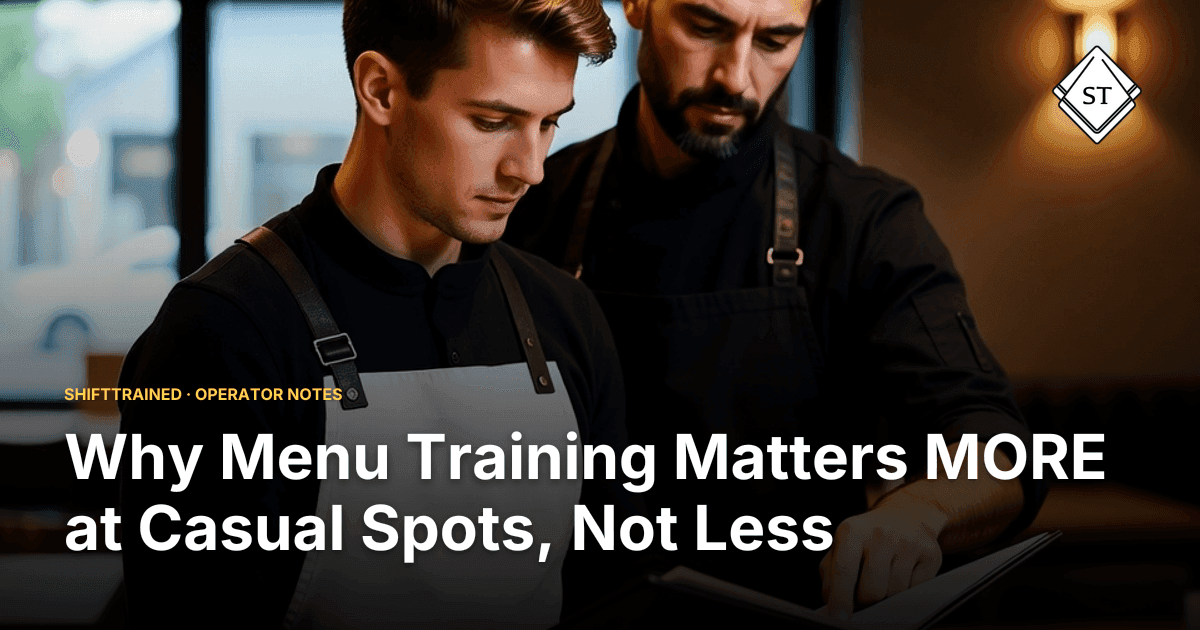
Why Menu Training Matters MORE at Casual Spots, Not Less

Hey Team!
Walk into most casual dining spots right now and ask the shift lead how they trained their servers on the menu. Nine times out of ten you'll get some version of the same answer. "We had them shadow somebody for a couple shifts." Maybe a printed sheet. Maybe a binder in the back office that nobody's touched since the remodel.
That's it. That's the whole system.
Now ask the same question at a fine dining room across town. You'll hear about tasting sessions, wine walk-throughs, detailed prep on every component on the plate, managers quizzing servers before service. There's rigor there because the industry decided fine dining deserves rigor.
I think that's completely backwards.
Here's where the assumption breaks down. Fine dining rooms are staffed largely by career servers. People who have been doing this for ten, fifteen, twenty years. They've seen hundreds of menus, they know how to learn a menu, and they understand why it matters to their paycheck. The stakes are obvious to them. A guest spending $200 on dinner expects answers, and those servers know it.
The sports bar with 22 servers on the floor for a Saturday NFL slate? That's a different situation entirely. You've got a 19-year-old on their second job ever. A college junior who's been there six weeks and is also enrolled in 15 credits. A guy who worked Tuesday and Wednesday last week and wasn't there when you changed the wing sauce. These people aren't career hospitality professionals yet. Some of them will be. Most of them won't. And they are serving your guests today, handling allergen questions today, representing your food today.
The allergy laws don't care what the room looks like. A guest at your counter with a sesame allergy is just as protected under the law as a guest in a white tablecloth room. If your server doesn't know which burger bun has sesame, the outcome is the same regardless of what the check average is.
That's the part that doesn't get said enough. Operators at casual spots often think the stakes are lower because the food is simpler. Wings, burgers, loaded fries, whatever's on tap. But simpler food doesn't mean fewer questions. It often means more. Because casual guests ask casually. "Hey what's in the queso?" "Does the ranch have dairy?" "Can you make that gluten-free?" These questions come fast, they come mid-rush, and they come from guests who didn't make a reservation and don't expect to be impressed, they just expect a straight answer.
A server who doesn't know the answer will guess. Or they'll say "I think so." Or they'll disappear into the kitchen during an eight-top and never come back with a clear response. I've watched this happen. I've watched it cost tables. I've watched it cost the restaurant a guest who never came back.
The fine dining room built a system to prevent that. The casual spot assumed it would work itself out.
Now let me tell you what I've actually seen work, running a sports bar and a tavern.
The thing that moves the needle at casual spots isn't longer training. It's more frequent, lower-lift repetition. The servers at my places take menu quizzes on their phones. Not during a formal sit-down session. On their way in. During a slow Tuesday. While they're waiting for a table to be bussed. Short, specific, tied to the actual menu. What goes on the nachos. What's the allergen flag on the house burger. What's on draft this week. When you make it that easy to engage with the material, people actually engage with it.
And here's something I didn't expect when I started doing this at scale. Staff start competing. They want better scores. They retake the quiz not because you told them to, but because it's sitting on their phone and they want to beat what they got yesterday. You don't get that behavior from a printed handout in a binder.
The other thing I've learned is that the turnover rate at casual spots makes the training problem worse in a very specific way. Cornell's research puts replacement cost per employee at nearly six thousand dollars when you factor in recruiting, onboarding, and lost productivity. The National Restaurant Association consistently reports industry turnover in the range of 75 to 80 percent annually. At a casual volume spot, that churn is often even higher. So you're not just training for the current team. You're training for the next team, and the one after that. The training system has to work for the new person who started yesterday and the person who'll start three weeks from now after the current one leaves.
A system that only exists in someone's head, or in a two-hour shadow shift, doesn't scale through turnover. It resets every time someone walks out the door. The knowledge walks with them.
That's why the training infrastructure at a casual spot needs to be stronger than at a fine dining room, not weaker. At the fine dining room, the culture and the veteran staff carry a lot of the institutional knowledge. At the sports bar, the system has to carry it, because the people carrying it this week might not be here next month.
I built ShiftTrained because I couldn't find anything that actually worked for the kind of restaurants I run. The tool had to work for a 19-year-old on their phone, not a career sommelier with a notebook. The problem was too real to leave unsolved.
If you run a casual spot and your training system is basically "shadow somebody and figure it out," you're not running a low-stakes training environment. You're running a high-stakes one without any infrastructure to back it up.
That gap is costing you money. More importantly, it's costing your guests a good experience.
Have a great day! — Terry Psaltakis
Your AI Restaurant Guy
For more on putting this into practice, see how ShiftTrained approaches wine training.