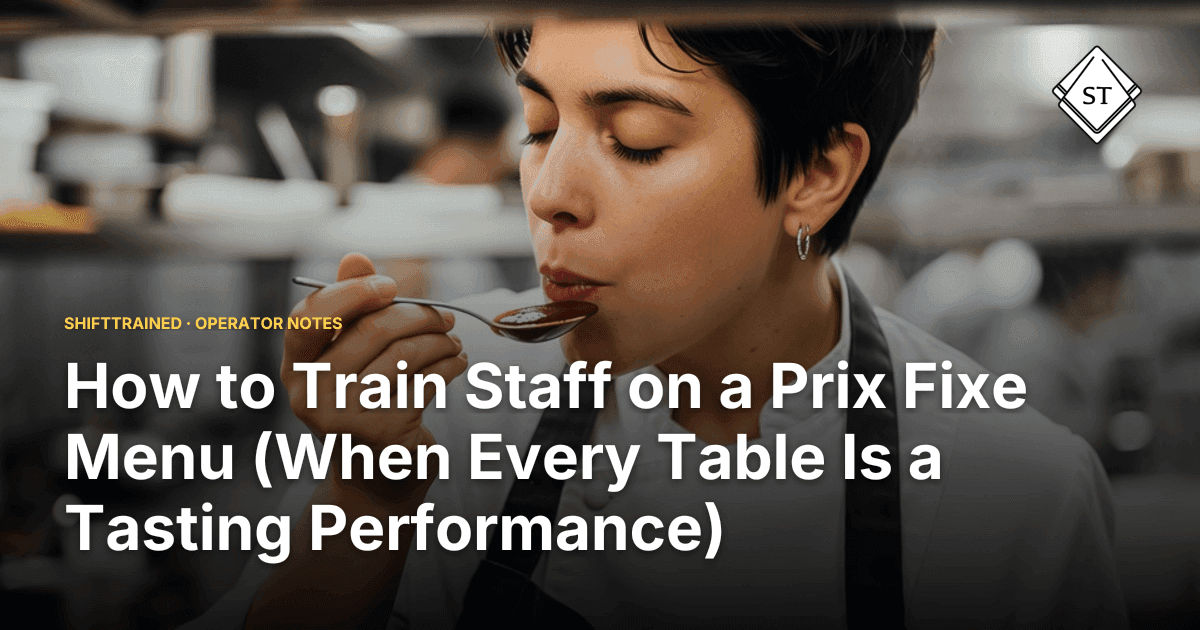
How to Train Staff on a Prix Fixe Menu (When Every Table Is a Tasting Performance)

Hey Team!
Prix fixe is a completely different job than à la carte. I don't think enough operators actually say that out loud to their staff before they launch one.
With à la carte, a server can be shaky on two or three menu items and still have a good night. A guest orders the burger, the server knows the burger, everyone goes home happy. Prix fixe doesn't work that way. Every table is moving through the same sequence, every course is coming whether the guest planned on it or not, and your server is narrating the whole thing from start to finish. If they're fuzzy on course three, they can't skip to something they know better. Course three is coming regardless.
The stakes are also higher because guests who book a prix fixe have usually already decided this is a special night. They're not grabbing a quick dinner. They've committed mentally before they walked in the door. A confident, knowledgeable server who can describe each course with real detail makes the whole experience feel intentional. A server who hesitates, who has to run back to check on a preparation, who says "I think it comes with..." breaks something that's very hard to rebuild mid-meal.
So the prep sequence matters a lot, and most operators I talk to get it wrong in the same way: they try to train everyone on everything equally. That's a waste of the limited time you have before service.
Here's what actually works. Before you run a new prix fixe, or when you update one, look at your menu and ask yourself honestly: which two or three dishes will generate a question at almost every table? Not the simple ones. Not the grilled chicken with roasted vegetables where the description sells itself. The ones with an unusual technique, a sourcing story, an ingredient guests won't recognize, or a substitution that comes up constantly because of allergies.
On a recent menu change we ran, it was the amaro-cured course and a composed salad with a house-made cheese most guests had never heard of. Those two were going to get questions. We also knew the fish course was going to prompt a substitution request at least twice a night from guests with shellfish concerns even though there was no shellfish in it. The dish name implied something it wasn't.
Those are your targets. Train deep on those before anything else.
When I say drill them, I mean really drill them. Have your servers say the description out loud. Not read it. Say it. There's a big difference between a server who read the menu notes and a server who has said "this is a slow cure in bitter orange and gentian root, so the texture is silkier than you'd expect and the finish is slightly herbal" enough times that it comes naturally at a table. The second server sounds like they cooked it. The first one sounds like they just read a card in the kitchen.
Do a quick walk-through on pacing before the doors open. Prix fixe pacing is its own skill. Guests need to feel like the kitchen is in control, not rushing them and not forgetting them. Your servers need to know roughly how long each course is running that night, and they need to be comfortable giving a guest a truthful status update without making it feel like an apology. That takes practice too.
Now here's the part that kills me when I watch how most restaurants handle knowledge gaps. You do this pre-shift run-through, you feel pretty good about it, and then service starts and three things happen at once and the information walks out of two servers' heads instantly. Pre-shift lectures are better than nothing, but retention after a one-time verbal briefing is genuinely bad. This is not opinion. There's a real body of research on how people retain information under stress, and "someone told me once before a busy Friday" is basically the least effective delivery format.
What closes the gap is repetition, spaced out, on the actual thing the person is going to say. Short quizzes on specific dishes, delivered on a phone, where you get a question wrong and the right answer comes back immediately. That feedback loop is what actually moves information from short-term to long-term. It's why the platform I built works the way it does: upload the menu, the AI pulls the questions, and servers are drilling on their phones in the parking lot before the shift instead of nodding along to a briefing they'll forget by the time the amuse hits the first table.
It also gives you visibility as an operator. With a pre-shift lecture, you have no idea who retained what. With a quick quiz, you know who's solid on the fish course substitution language and who isn't. You can pull that person aside for two minutes before service with something targeted. That's a completely different conversation than a general "make sure you know your menu" reminder.
One more thing on substitutions specifically. In a prix fixe context, a substitution can't look improvised. It has to feel like it was always an option. That means your servers need to know the approved swap before service, not figure it out at the table. If you haven't briefed that clearly, you're going to have a server quietly panicking while a guest with a dairy sensitivity waits to find out if they can eat tonight. Put the substitution policy in the quiz. Make it a question. Make sure every server answers it before they clock in.
Prix fixe is a performance, not just a meal. Your staff are cast members in it from the moment the first course lands. Get them solid on the two or three things that will actually be tested every night, use a tool that lets them practice instead of just listen, and the rest usually takes care of itself.
Have a great day! — Terry Psaltakis
Your AI Restaurant Guy
For more on putting this into practice, see how ShiftTrained approaches restaurant training software.