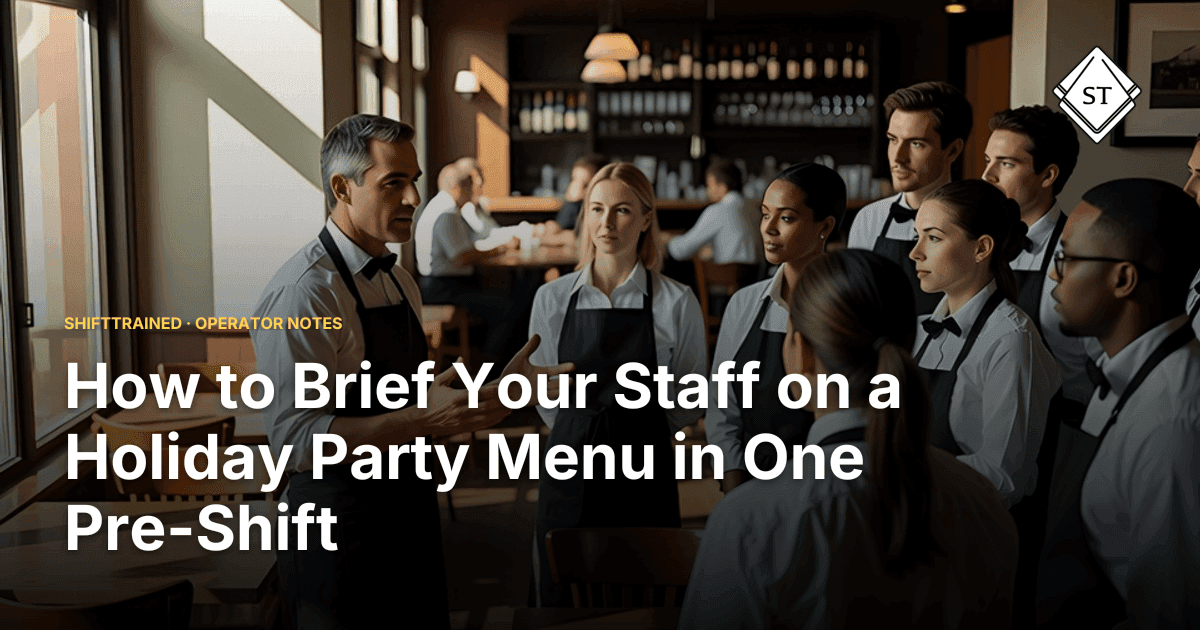
How to Brief Your Staff on a Holiday Party Menu in One Pre-Shift

Hey Team!
Holiday party season is absolutely a different animal, and yes, you can brief your staff on a 40-cover set menu in a single pre-shift if you do the work the night before. That's the answer. Here's how it actually runs.
The call comes in a week out. Someone's booked the private room for their company Christmas party. Forty people, three courses, a drink package, and a Google Doc attached to the email with dietary notes: two vegans, one celiac, somebody with a tree nut allergy, and a handful of pescatarians. The organizer has also helpfully noted which seats are which, because she's been doing this longer than most of us have been in the business. Great. Now you've got to get your floor staff, your bar, and your kitchen all speaking the same language before the first guest walks in.
Most operators I know print the menu, tape it to the wall in the server station, and call it a day. Then service starts and someone's asking the host whether the soup has gluten in it, and the host is staring at the server like they've asked her to solve a physics problem. Don't do that.
The night before the event, I send the set menu out as a five-question quiz to every server and bartender working that shift. Five questions. Takes four minutes to answer on a phone. I built ShiftTrained for exactly this reason because pre-shift prep used to cost me an hour of fumbling through paper menus and watching my staff glaze over. Now the quiz goes out the night before and people show up having already thought about the food. They've had to recall whether the salmon course has a cream sauce, they've had to remember what the vegetarian swap is, they've had to confirm whether well drinks are on the package or just beer and wine. That retrieval practice matters. It's not magic, it's just how memory works.
So by the time your pre-shift actually starts, you're not introducing the menu. You're confirming it. That's the shift.
Open your pre-shift by walking the courses in order, but fast. Don't narrate. Just anchor. "Amuse is the butternut squash shooter. Course one is the Caesar, no croutons for the celiac at table position four. Course two splits: most of the table gets the braised short rib, the two vegans at positions six and nine get the mushroom Wellington, the pescatarians get the pan-seared halibut. Dessert is plated chocolate cake, there's a fruit sorbet for the vegan positions." That's two minutes. Your staff already had the quiz. They're not hearing this cold.
The dietary list is where pre-shifts fall apart. You've got a sheet from the organizer but it lists names, not seat numbers. Someone has to convert that before service. That's your job, or your floor manager's job, before the pre-shift begins. You want a physical card or a printed seating chart at the server station with position numbers flagged. Color works: a small dot sticker or a handwritten X next to the positions that have restrictions. When the fish course goes down, your server isn't searching her memory for whether "Karen from accounting" is the celiac or the vegan. She's reading a position. Keep it physical, keep it simple.
Drink package rules need maybe three sentences of your pre-shift and no more, but they need to be exact. "The package runs beer, house wine, and well cocktails. It's open for two hours from the reservation time, then it goes off. After that, anything additional goes on a separate check for the guest, not the host." That's it. What breaks down in practice isn't the rule, it's the bartender who keeps pouring because nobody told him the cutoff time, or the server who doesn't know whether to split the post-package drinks onto individual cards or run one tab. Decide that before service. Tell them the answer in the pre-shift.
The timeline conversation is the one most operators skip because it feels like micromanagement. It isn't. A 40-person private party has a room they've booked until a certain hour, a speech someone wants to give before dessert, and a bus back to the office at 9:30. Your staff doesn't have to know all of that, but they need to know the course pacing you're targeting. "We're dropping course one at 6:30, thirty minutes after they're seated. We'll read the room on course two, but I want it out no later than 7:45. Dessert follows after the remarks, which the organizer says will be about ten minutes." Now your expo knows what he's working toward. Now your servers aren't wandering back asking if they should fire the next course.
Assign the host relationship to one person and say it out loud. "Sarah, you're the point of contact for the organizer tonight. She's sitting at position one. If anything changes, she's going to find you." The whole rest of the table can rotate however your section assignments fall, but there's one person who owns that relationship. That person checks in with the organizer when they're all seated, when the first course drops, and before dessert to confirm the speech timing. Three check-ins. That's it.
The thing about a holiday party brief is that it doesn't need to be long. It needs to be complete. Every person walking into that service should know what they're serving, who can't eat what and where they're sitting, what the drink rules are, how the timing is supposed to flow, and who owns the relationship with the person writing the check. If you've done the quiz the night before and you walk in with a clean seating chart and a two-minute timeline talk, you can cover all of that in fifteen minutes and still have time to do a quick line check before doors open.
The staff that go in prepared don't just perform better. They're calmer. And calm is contagious on a party night in a way that panic absolutely is too.
Have a great day! — Terry Psaltakis
Your AI Restaurant Guy
For more on putting this into practice, see how ShiftTrained approaches the best menu training programs.