Stop Drilling Your Staff During Service — Here's When Training Actually Has to Happen

Hey Team!
Saturday night at 6:45pm is the worst possible moment to explain to a server that the fish tacos have a chipotle crema on them, not a cilantro lime sauce. But that's where most operators are having that conversation. Standing on the floor, mid-rush, half-whispering corrections over a tray of drinks somebody's about to drop. Meanwhile table nine is waiting, the bar is four tickets deep, and the person you're correcting is nodding at you while mentally calculating how long until their section dies down.
That training moment is already a failure. Not because you said the wrong thing, but because you said it at the wrong time.
I've opened more than twenty concepts over thirty years, and the single most expensive habit I've watched operators carry is this: treating the live floor as a training environment. It isn't. Never was. The floor during service is a performance. You don't rehearse a play while the audience is already seated.
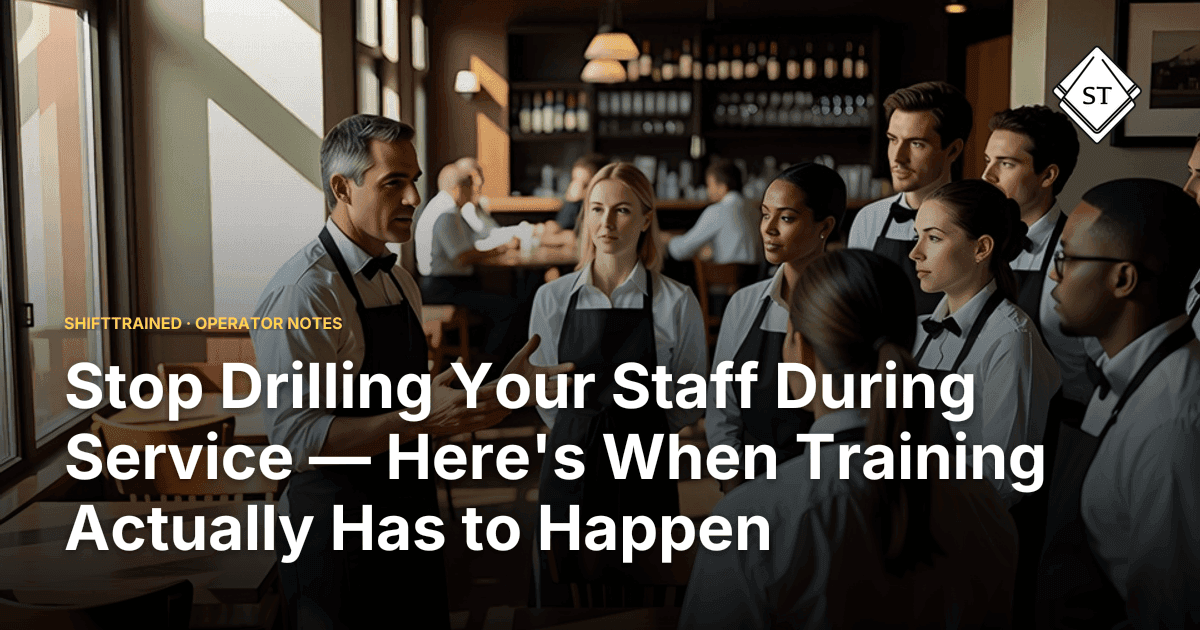
Here's where the window actually is. Between roughly 3pm and 4:30pm, depending on your concept, you have a quiet kitchen, a slow bar, and staff who aren't yet in survival mode. That's it. That's your window. Everything before that they're still waking up, doing sidework, setting up. Everything after that you're in it. The window closes fast and most operators let it slide without doing anything meaningful with it.
The old model was to fill that window with a manager talking at people. Gather the staff, run through the specials, answer a couple of questions, send them out. And that worked fine when the floor was the only option you had. But most of what a manager announces in a five-minute pre-shift vanishes from a server's head before they've taken their first table. That's not an insult. It's just how memory works. You tell someone something once, verbally, with no reinforcement, and retention is terrible.
What actually changes behavior is retrieval practice. Making someone pull information back out of their brain, not just receive it. That's the research, and it also matches thirty years of watching what sticks on actual restaurant floors.
The operators I talk to who've moved their drilling to phone-based quizzes during that 3-to-4:30 window are seeing something specific. Fewer mid-rush corrections. Fewer comps from wrong-item mistakes. Not zero, but meaningfully fewer. And the reason isn't complicated. A server who already got tested on the fact that the new wings come with three sauces, not two, doesn't need you to catch that error at the table. They already know it. The question already fired in their head, they already retrieved the answer, it's there when they need it.
The comp math is brutal if you actually track it. One wrong entree fired, one comped appetizer to smooth it over, a table that doesn't come back. Do that twice on a Saturday night and you've burned more than the cost of any training tool you'd ever use. I'm not making up numbers here. Cornell's research on hospitality turnover and error costs puts replacement cost alone at nearly six thousand dollars per employee. Comp costs and lost repeat business aren't even in that figure. The floor is expensive when it goes wrong.
Now contrast two versions of a Saturday rush. Version one: your team had a two-minute standup before service, maybe you mentioned the new seasonal item, and then doors opened. By 7pm someone fires a burger without the bacon because they didn't know it was reworked, a table sends it back, a manager gets flagged, the kitchen has to refire, and now that ticket time is wrecked for the next three covers too. Version two: your team spent twenty minutes before service running through menu quizzes on their phones. The bacon question was in there. They got it right or they got corrected instantly by the quiz before service started. At 7pm that Saturday, none of that happens.
Version two is not a fantasy. It's just a decision about when training happens.
The psychological piece matters too, and I don't think operators talk about it enough. When you correct someone in the middle of a rush, they're embarrassed. They're in front of coworkers, possibly in front of guests. They get defensive or they get flustered. Neither state is great for learning. When a phone quiz corrects them at 3:30pm in the side station, it's just them and a screen. No ego on the line. They're far more likely to actually absorb it.
Some pushback I hear: "My staff won't do quizzes on their own time." Fair. So don't make it their own time. Build the fifteen minutes of phone quizzing into the paid pre-shift. Put it in the schedule. It's not homework, it's part of the shift. At my own spots, staff started retaking quizzes voluntarily. Not because I mandated it, but because knowing the menu actually makes the shift easier and the tips better. That motivation is real once they feel it.
The harder truth is this: if you're still running corrections on the floor during service, that's a systems problem, not a staff problem. Your people aren't doing it wrong. Your training is just happening at the wrong time.
The window is 3pm to 4:30pm. That's it. Once you've opened the doors, you're not training anymore. You're managing damage.
Get the training done before the damage starts.
Have a great day! — Terry Psaltakis
Your AI Restaurant Guy
For more on putting this into practice, see how ShiftTrained approaches restaurant staff training.