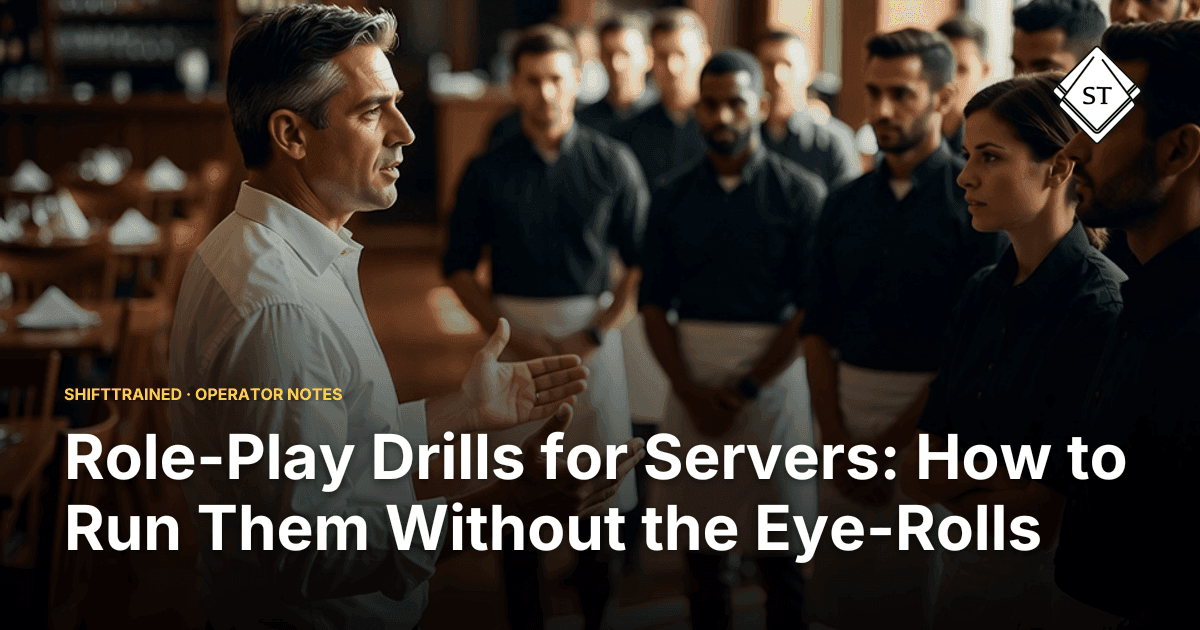
Role-Play Drills for Servers: How to Run Them Without the Eye-Rolls

Hey Team!
You've seen the face. You ask for volunteers to run a role-play drill before service and half the room suddenly finds something fascinating on their phones. The other half laughs nervously and waits for it to be over. The drill happens, it's awkward, nobody learns anything, and you quietly promise yourself you'll never do that again.
I did the same thing for years. Skipped role-play entirely because it felt like community theater and my staff hated it. Then I realized the reason it always died wasn't the format. It was the sequencing. I was asking people to perform before they could actually play the part.
Here's what that means in practice. You put two servers in front of the room. One plays a guest with a shellfish allergy asking about your shrimp tacos. The other plays themselves. And the server playing themselves panics, mumbles something about checking with the kitchen, and the whole thing falls apart in ninety seconds. Then everyone feels bad. You end the drill early. Nothing transferred.
That's not a role-play problem. That's a knowledge problem wearing a role-play costume.
The fix is simple, and it costs you almost nothing. Before any live drill, your staff needs to have already done the recall work on their phones. Quiz them on the menu. Quiz them on allergens. Quiz them on which dishes share a fryer with shellfish, which sauces have hidden dairy, which modifications are actually safe versus which ones just sound safe. Let the quiz handle the recall load. Then the drill can do what a drill is actually for: testing whether someone can apply knowledge under pressure, to a real human, in real time.
Once the prep is done, the drill itself runs tight. Eight minutes, one scenario, two people. That's it.
Pick one server to play the difficult guest. Difficult doesn't mean rude. Difficult means realistic. Give them one of three scenarios: a shellfish allergy, a price objection, or the dreaded "what's your favorite?" question from someone who eats nothing like you do. Have the guest server write down two or three follow-up questions before the drill starts so the thing doesn't die in thirty seconds. The other server plays themselves, which matters, because you're not asking anyone to act. You're asking them to do their job while someone watches.
Set a timer. Two minutes to run the scenario cold. Then stop and debrief for five minutes as a group. One thing the server did well, one thing they'd do differently. You wrap in the last minute by asking the whole room how they'd handle the price objection or the allergy question differently than what they just saw. Then you're done. Clock out at eight minutes.
The shellfish allergy scenario is the one I want to spend a second on because it's where the stakes are real. "What's your favorite?" is about building rapport. Price objections are about confidence and suggestive selling. But a guest with a serious food allergy is a liability and a life-safety issue, and your server needs to know the answer before they're standing at the table. They should know whether your fryer oil crosses over. They should know which appetizers are safe to recommend without the kitchen running a special clean prep. If they don't know that before the drill, the drill doesn't teach them. It just exposes them.
That's why the quiz-first sequence matters. I've watched servers who struggled in every previous drill suddenly run the allergy scenario clean because they'd already done the work on their phones during a slow Tuesday. They knew the answer. The drill just gave them a chance to practice saying it out loud, calmly, in a way that makes the guest feel safe.
The price objection scenario is underrated. You've got servers who apologize for prices, servers who repeat the price louder like that helps, and servers who pivot to the value without being asked. Role-play is the only way to find out which one you're working with before they're at a four-top on a Friday night. Run it. Let the "guest" say "thirty-two dollars for a burger feels steep." Watch what happens. Debrief honestly. The server who says "I know, it's a lot" and moves on is telling you something you need to know.
The "what's your favorite?" question trips people up because it feels personal and open-ended. The good answer isn't the server's actual favorite, necessarily. It's a dish they can talk about with genuine specifics. That's what the quiz prep builds. Staff who know the menu cold have two or three things they can champion with real detail. Staff who don't revert to "the pasta is pretty good." The drill reveals which is which in about fifteen seconds.
None of this requires a training room or a projector or a dedicated training shift. You can run it in the last eight minutes before doors open. You can do it in the service alley at a pizza counter. The format travels.
The operators I talk to who've stuck with role-play have one thing in common. They stopped using the drill to teach information and started using it to test application. The knowledge lives in the quiz. The drill is just the proof that it stuck.
Staff don't roll their eyes at drills because they hate learning. They roll their eyes because they've been put on the spot before they were ready. Give them the prep first. Make the drill short and specific. Debrief without shame. You'll be surprised how fast the energy in the room changes.
Have a great day! — Terry Psaltakis
Your AI Restaurant Guy
For more on putting this into practice, see how ShiftTrained approaches a menu training app.