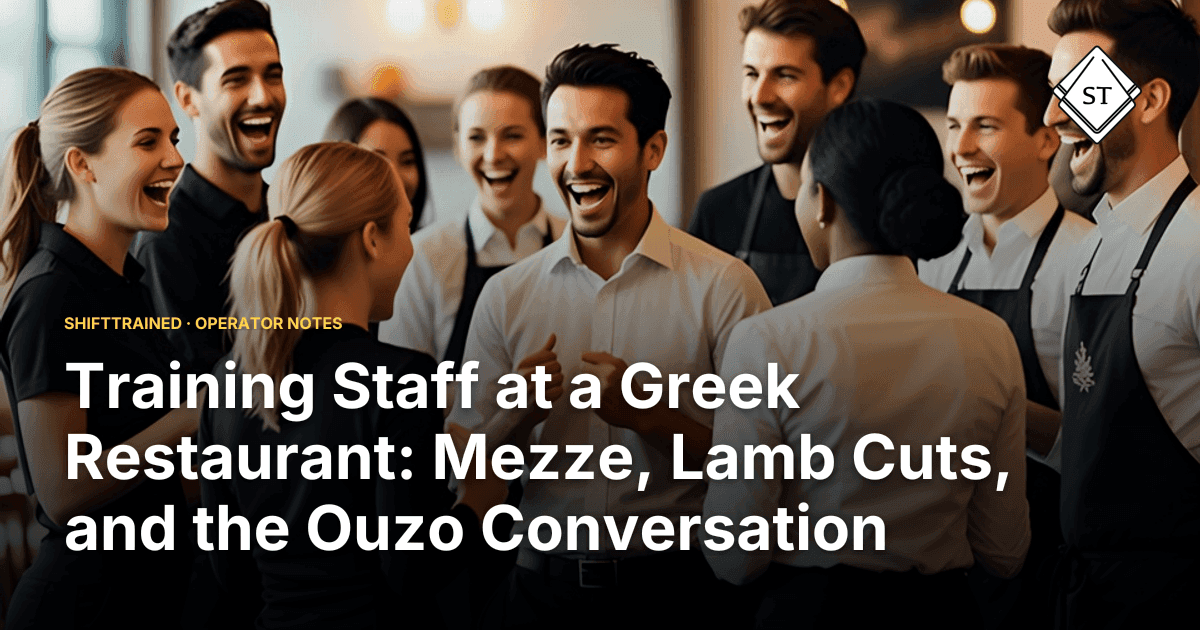
Training Staff at a Greek Restaurant: Mezze, Lamb Cuts, and the Ouzo Conversation

Hey Team!
Greek menus are a trap for undertrained servers. Not because the food is obscure. Because it isn't. Guests think they know what they're ordering, and that's exactly where things go sideways.
Someone asks for souvlaki and what shows up is a gyro. The guest doesn't send it back. They just leave a little disappointed and a little confused, and they don't come back. That's the Greek restaurant training problem in a sentence.
Here's what actually trips servers up on a Friday night with a full dining room. The dish names feel familiar, but the details are where confidence falls apart. Souvlaki is grilled meat on skewers, usually pork or chicken, served with pita on the side. A gyro is shaved meat off a rotating spit, wrapped. They're not interchangeable. A guest asking "what's the difference" is a totally reasonable question, and if your server stumbles on it, you've lost a little trust before the apps even hit the table.
The cheese conversation is another one. Feta comes up constantly and most servers can handle that. But then someone asks about the saganaki, or the tirokafteri, and whether there's animal rennet involved. That's a vegetarian concern, and it's legitimate. Authentic Greek cheeses, including many feta varieties, are traditionally made with animal rennet. If you're sourcing from a Greek importer, that's likely true of what's on your table. If your server doesn't know, and guesses, and gets it wrong, you've got a problem that goes beyond one unhappy guest.
Phyllo is the other one that catches people off guard. Guests with celiac or gluten sensitivity will ask about spanakopita and tiropita. Yes, phyllo contains gluten. That's not complicated, but it needs to be automatic for your staff. A server who has to go check, or worse, who assumes it's fine, is a liability.
The lamb cuts are their own category of confusion. A menu that lists lamb chops, braised lamb shank, lamb souvlaki, and a lamb keftedes is actually describing four completely different cooking preparations and textures. A guest who didn't love a dry rack of lamb somewhere else might love a slow-braised shank falling off the bone. A good server makes that connection. An undertrained server says "yeah it's all good" and hopes for the best.
Now let's talk about the bar side of this, because Greek restaurants with a thoughtful beverage program are leaving real money on the table when servers can't navigate it.
Ouzo is what most guests know. It's anise-forward, meant to be sipped with food, typically diluted with water or ice, which turns it cloudy. That louche effect is worth explaining. It's a conversation starter if your server knows to start it. But then there's mastiha, which is completely different. It's produced from resin harvested from mastic trees on the island of Chios. The flavor is piney, slightly sweet, not anise at all. It's a digestif conversation. And tsipouro is different again. It's a pomace spirit, grape-based, closer to grappa or marc. Dry, strong, not sweet. A guest who loved ouzo might not like tsipouro and vice versa. Your server needs to know which is which, what they taste like, and when to suggest them.
That's the Friday night conversation. Not in a training manual sense. In a real sense, at table ten at 7:45pm when a guest asks what's good after dinner.
Here's the part that takes time in traditional training: building the questions. A manager sits down to write a quiz for the new Greek menu and they start with the obvious stuff. What is moussaka? What's in a Greek salad? Fifteen minutes later they've got eight questions and they're already repeating themselves. The actual staff knowledge gaps don't get covered because nobody has time to think through every angle, the allergen angles, the spirit comparisons, the cheese sourcing questions, the cut-by-cut lamb breakdown.
When we built ShiftTrained, I wanted to solve exactly this. You upload the menu PDF and the AI generates 100 to 400 questions from what's actually in the document. Not generic restaurant trivia. Questions about your spanakopita, your lamb shank, your house ouzo cocktail, your saganaki preparation. The questions a guest will actually ask on Friday. The difference between how you prep the souvlaki versus the gyro, whether the phyllo is made in-house or sourced, what the taramasalata is made from for guests who avoid fish roe.
Fifteen minutes of setup. The staff takes the quiz on their phones before the shift. They're not sitting in a conference room. They're not watching a video nobody's paying attention to. They're getting specific, answerable questions about the actual menu they'll be serving that night.
The thing I keep coming back to is how much of Greek cuisine depends on the server being a guide, not just an order-taker. A guest who's never had tsipouro doesn't know to ask for it. They'll order a beer. You just missed a higher-margin sale and, more importantly, a memorable experience. That guest who tries the tsipouro with a story attached comes back. They bring people. The server who can tell that story confidently is worth training right.
Rennet in the feta. Gluten in the phyllo. Souvlaki versus gyro. The louche in the ouzo glass. That's what your servers need to know cold before a Friday service at a Greek restaurant. The training tool you use should be able to build those questions in minutes, not hours. If it can't, you're working too hard for results that aren't good enough.
Have a great day! — Terry Psaltakis
Your AI Restaurant Guy
For more on putting this into practice, see how ShiftTrained approaches menu training software.