Your GM Just Quit — And All the Menu Knowledge Walked Out With Them

Hey Team!
Your GM walks out on a Friday. Maybe it was a better offer somewhere across town. Maybe it was burnout. Maybe it was just time. Doesn't matter why. What matters is what walks out with them.
The Thursday soup special that can't have cream because half your regulars are lactose intolerant. The way the wings get plated with the celery on the left because the owner is weirdly particular about it. Every allergen workaround your kitchen worked out over two years of trial and error. The answer to "what's in the house sauce?" The verbal quiz they'd run new servers through on Tuesday mornings before the lunch rush.
All of it. Gone. In a box with their apron.
This is the part of turnover nobody budgets for. Everyone talks about the cost of hiring and retraining a new body. The Cornell Hospitality study by Tracey and Hinkin puts replacement cost for a single hourly employee at around $5,864. That number is real and it stings. But the invisible cost, the one that doesn't show up in any spreadsheet, is what happens to your training program when the person who ran it leaves.
Because here's what most restaurants actually have for a training program. They have a person.
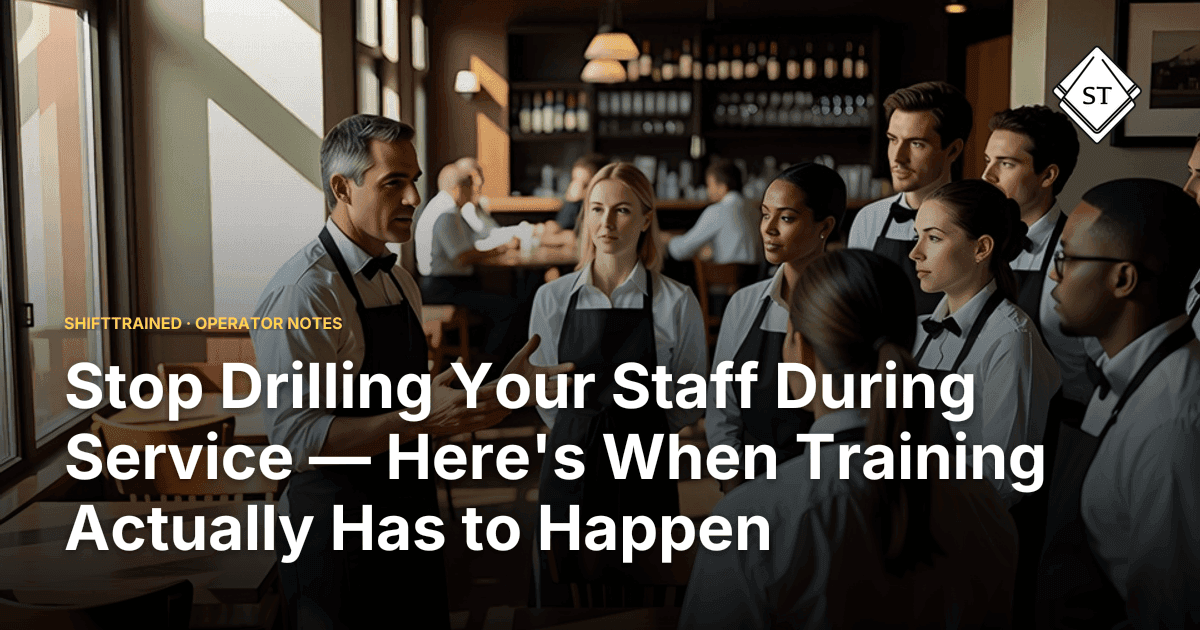
Not a system. A person. Usually whoever opened the place, or whoever's been there longest, or the GM who cared enough to actually run pre-shifts. They've got it all in their head and they've been transmitting it person-to-person for however long they've been there. It works fine, right up until it doesn't.
I've opened more than twenty concepts over thirty years and I've watched this happen at my own places. You think you're fine because your trainer is great. And you are fine. Until they're not there anymore.
The new manager comes in on a Monday. They're sharp, they're motivated, they want to do things right. You hand them a binder, maybe. A printed menu, definitely. And then you basically say, "figure it out, ask the kitchen." That new manager spends their first thirty days catching up instead of leading. Meanwhile your servers are getting inconsistent answers to the same guest questions, your training for new hires is improvised, and the standard your last GM spent two years building quietly erodes.
Nobody notices until someone has an allergy incident, or until a server gets caught flat-footed by a question about the burger, or until you look at your Google reviews and see three comments in a row about the staff not knowing the menu.
The root problem isn't turnover. Turnover is a fact of this industry. The National Restaurant Association tracks it at 75 to 80 percent annually. You're not going to fix that number. What you can fix is whether your training program survives it.
That means the knowledge has to live somewhere other than a person's head.
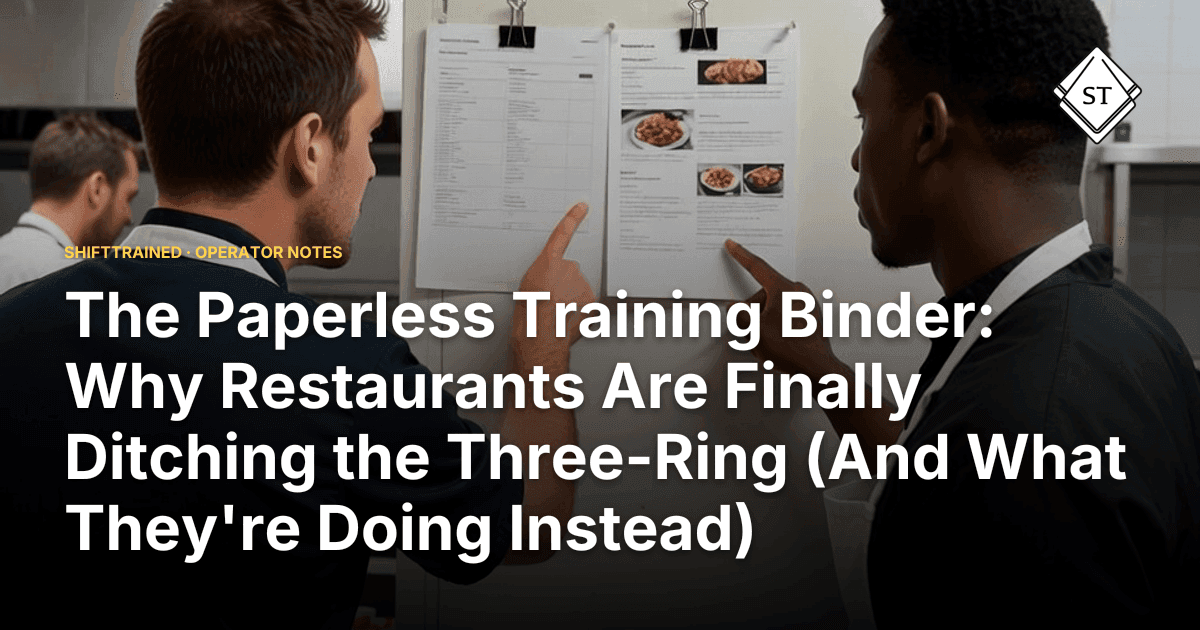
I'm not talking about a dusty PDF on a shared drive nobody opens. I've seen those. They're updated once and then they're wrong forever. I'm talking about something a brand-new shift lead can pick up on day one, use to actually test themselves, and feel confident behind. Something your new GM can hand to a new hire on Tuesday and know that the information is current and complete.
At Black Barrel Tavern, when we bring in a new manager, there's no scramble. They have access to the same quiz bank the staff has been using. They know what questions get asked, what the right answers are, what the staff already knows. They can see where the gaps are. That's only possible because the training material doesn't live in someone's head. It lives in the platform.
The GM departure scenario is a forcing function. It reveals exactly how fragile verbal-only training is. But it's not the only scenario. A trainer calls in sick the week you're onboarding three new servers. Your most experienced bartender moves to days and the new night bartender has nobody to shadow. Your owner goes on vacation and something changes on the menu. Any single-point-of-failure in your training chain is a liability.
Now, most operators don't build a real training system until they've been burned. I'd rather you build it before that happens.
The good news is that the barrier to doing this used to be high. Writing quiz questions is tedious. Keeping them updated when the menu changes is more tedious. Most operators just don't have the time, so they default to the verbal system and hope the person who knows everything sticks around. That's the calculation most restaurants have been making for decades.
That calculation made sense when building a proper training system took weeks of someone's labor. It doesn't make sense anymore. When I built ShiftTrained, the whole premise was that uploading your menu PDF and having a complete quiz bank ready in minutes is table stakes. That's the baseline. The training program shouldn't be the thing you get around to; it should be the thing that's done before your first hire walks in the door.
When your GM leaves, and eventually one will, the question isn't whether your training survives. The question is whether you built the kind of system that doesn't need any one person to hold it together.
If you did, you hand the new manager a login. They get up to speed. Service doesn't miss a beat.
If you didn't, you spend the next six weeks realizing how much was stored in one person's head, and piecing it back together from scratch while your staff gets inconsistent answers and your guests feel the difference.
Build the system. Don't wait for the resignation letter.
Have a great day! — Terry Psaltakis
Your AI Restaurant Guy
For more on putting this into practice, see how ShiftTrained approaches the best menu training programs.