Your Menu Is in Two Languages — Your Staff Should Be Able to Explain Both

Hey Team!
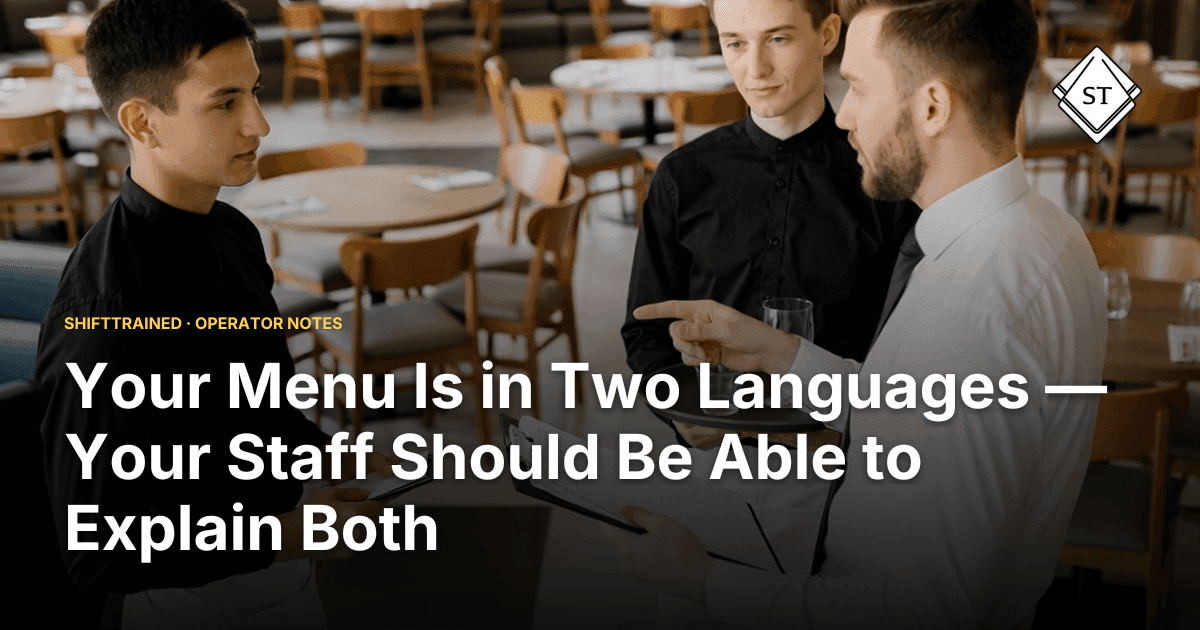
Picture a server at a nice Japanese spot, standing tableside, pointing at the menu and saying "the, uh... the yu-kee-tor-ee?" The guest looks up. The server smiles apologetically and says "it's like a grilled chicken thing." The guest nods. The moment passes. But something small just died at that table, the guest's confidence that this person actually knows what they're talking about.
That server isn't dumb. They probably know the dish cold. They know it comes off the robata, they know it's thigh meat, they know the tare glaze has a slightly sweet finish. But they couldn't say *yakitori* with any authority, so the whole explanation fell apart. Guests don't separate pronunciation from knowledge. If you stumble on the name, they assume you don't really know the dish.
This is a training gap that most restaurants ignore because it feels awkward to address. Nobody wants to stand in a pre-shift meeting and drill their servers on French syllables while everyone shuffles their feet. So it just doesn't happen. And guests keep getting apology-explanations instead of confident ones.
Here's what's actually going on. When you write a menu in two languages, a Spanish name with an English description, a Japanese term with a phonetic note, a French preparation with an anglicized spelling, you're asking your staff to operate in two systems at once. Most training handles the English side fine. Here's what's in the dish. Here's how it's prepared. Here are the allergens. But the foreign-language side gets a quick mention at best, usually just a handwritten phonetic note on a pre-shift sheet that disappears by Tuesday.
The problem compounds fast in certain menu styles. A modern Latin concept with dishes named in regional Spanish, *mole negro, sopa azteca, agua de tamarindo*, has staff who can describe what's in the bowl but trail off or mispronounce when they actually say the name out loud. Same thing at a French bistro where half the menu is in French and servers are saying "beurr blon" instead of *beurre blanc*. Or an omakase-adjacent spot where the staff can describe each course beautifully but winces slightly when they hit *chawanmushi* or *kabocha*. Guests who know the cuisine hear that wince. It tells them something.
The fix isn't expensive or complicated. It's just deliberate.
You pair phonetic drilling with dish knowledge, and you treat them as one skill, not two. When a server can say *mole negro* with a flat o and soft e, and then immediately pivot to "it's a sauce built on dried chiles, dark chocolate, and about a dozen spices, runs rich and earthy, pairs with the duck", that's a whole different guest experience than the stumble version. The name lands first. It frames everything that comes after it.
How do you actually drill this? The old-school method is phonetic index cards. Write the dish name, write a pronunciation guide underneath, run through them in pre-shift like flash cards. It works. It's also labor intensive to build from scratch every time you update the menu, and it depends on a manager who's confident enough in the language to correct wrong attempts, which isn't always a given.
The more practical version now is building quiz questions specifically around pronunciation and naming. Not just "what's in this dish" but "how do you pronounce this, and what does the name mean in the context of the dish?" When I was building out quiz question sets at ShiftTrained, one of the things we focused on was giving operators a way to flag which dishes needed extra drilling, specifically the ones with foreign-language names that staff were consistently mispronouncing or avoiding. The AI can generate targeted questions around those dishes at a higher frequency, so staff are seeing the hard names more often, not just getting one pass at them and moving on.
Repetition is what makes this stick. A server who's answered a quiz question about *escabeche* five times over two weeks is going to say it differently than one who heard it once in onboarding and never saw it again. That's just how pronunciation memory works. You need volume, and you need it spread out over time, not crammed into one training day and forgotten.
There's another piece here that doesn't get talked about enough, which is the meaning side. When a server understands that *aguachile* literally describes a broth made with chile water, and that knowing that helps them explain the dish's intensity level, they say the name with more weight. The word means something to them. That comes through when they say it. Compare that to a server who memorized a phonetic spelling but has no idea what the word actually refers to. One sounds like they belong in the room. The other sounds like they're reading off a cue card.
The venues where this matters most aren't just white-tablecloth rooms. A casual taqueria with a menu that mixes English and regional Mexican Spanish has the same issue. A ramen counter where the servers need to explain the difference between *tonkotsu* and *shoyu* broth runs into this constantly. A neighborhood French cafe where "croque madame" sounds different depending on who's working the floor, that's the same problem in a cheaper room. The guest always notices. They might not say anything. But they notice.
Train both languages. Treat the name and the description as one unit. Drill the hard ones more. If your staff can say the dish with confidence, the explanation that follows it lands completely differently. That's not a small thing at the table. That's the whole moment.
Have a great day! — Terry Psaltakis
Your AI Restaurant Guy
For more on putting this into practice, see how ShiftTrained approaches restaurant training software.